Microtraumatismes répétés
Le scan manuel de milliers de livres cause des troubles musculo-squelettiques (RSI) au personnel.


Les bibliothèques sont des lieux de vie pour la communauté, mais les bibliothécaires ont souvent l’impression de travailler comme des magasiniers. Les horaires sont consacrés à la vérification manuelle des livres à l’entrée et à la sortie, au tri des retours et à la recherche d’ouvrages mal rangés à l’aide de scanners code-barres nécessitant une ligne de vue.
Les usagers veulent du confort. Ils veulent prendre un livre et partir, ou le retourner 24 h/24 et 7 j/7 sans faire la queue. Les bandes de sécurité EM traditionnelles protègent contre le vol, mais n’apportent aucune intelligence de gestion du stock.
Le résultat : une expérience frustrante, où les équipes sont noyées sous des tâches administratives plutôt que de se consacrer à la communauté.
Le scan manuel de milliers de livres cause des troubles musculo-squelettiques (RSI) au personnel.
Un livre mal rangé est un livre perdu. Sans RFID, trouver un livre placé sur la mauvaise étagère est une recherche d'aiguille dans une botte de foin.
Les heures de pointe créent de longues files au comptoir de prêt, frustrant les usagers.
Nextwaves fait entrer la bibliothèque dans l’ère moderne grâce à des solutions RFID HF/NFC et UHF. Nous intégrons une étiquette RFID fine et invisible dans la tranche ou la couverture de chaque livre.
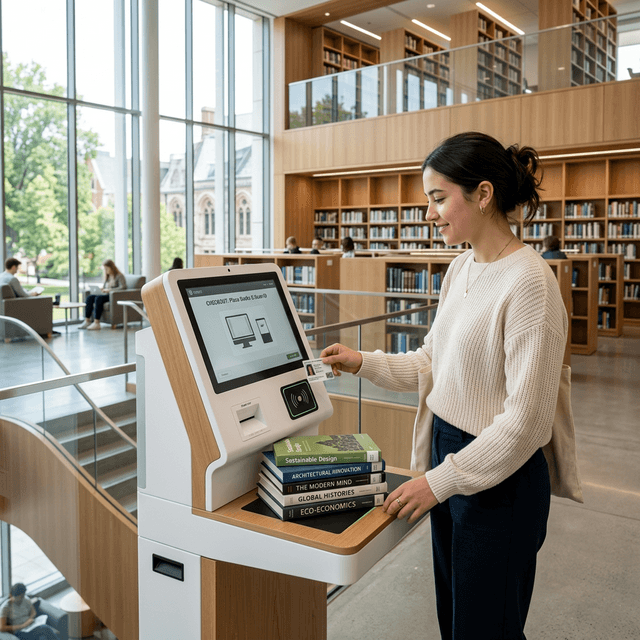
Les bornes de libre-service Self-Checkout permettent aux usagers d’empiler 5 à 10 livres à la fois sur le tapis. Le système les lit instantanément, désactive la puce de sécurité et imprime un reçu en quelques secondes.
Les Smart Return Chutes (AMH) acceptent les retours 24 h/24. Pendant que le livre glisse dans la goulotte, il est scanné, enregistré en retour, et même trié automatiquement dans des bacs pour être remis en rayon. Le personnel peut utiliser des perches portatives pour balayer les rayonnages, retrouver instantanément les livres perdus et vérifier le bon rangement.
Permettez aux usagers d'emprunter et de retourner des articles instantanément, réduisant les files.
Trouvez un livre mal rangé en quelques secondes en passant simplement dans l'allée avec un lecteur portable.
Les boîtes de retour automatiques mettent à jour le compte de l'usager immédiatement.
Les Bibliothécaires passent d'« manipulateurs de livres » à « spécialistes de l'information ».
Une nouvelle bibliothèque centrale voulait ouvrir avec un modèle de prêt « sans personnel » pour maximiser le budget des programmes communautaires.
Passer l’ensemble du fonds d’une bibliothèque représente un chantier important, c’est pourquoi nous concevons la coexistence. Nos tags hybrides contiennent à la fois l’ancien code-barres et une nouvelle puce RFID dans la même étiquette. Ainsi, votre système ILS existant continue de fonctionner, pendant que les équipes migrent progressivement vers des flux RFID, à leur rythme.
Pour la plupart des bibliothèques publiques, nous recommandons la technologie HF (13,56 MHz). La même fréquence que celle utilisée par les cartes de paiement et les téléphones NFC, offrant une excellente précision et la confidentialité des usagers. Les grandes archives académiques qui gèrent un volume important de dizaines de milliers d’articles tirent avantage de la vitesse de l’UHF. Nous évaluons votre fonds et recommandons la bonne fréquence, sans approche « one-size-fits-all ».
Le RFID rend viable le modèle « sans personnel » pendant certaines plages horaires. Les usagers enregistrés peuvent accéder au bâtiment avec leur carte d’adhérent, parcourir et emprunter des livres en autonomie, puis retourner les articles via des retours automatisés. à 22 h un mardi, ou à 6 h un dimanche.
La même infrastructure donne au personnel une intelligence de gestion du stock : un passage au balai avec une perche portative sur toute une allée prend quelques minutes et fait remonter chaque article mal rangé. Ce qui prenait auparavant à un bibliothécaire une journée complète ne prend plus que quelques minutes en début de journée.
Protégez les ordinateurs portables et les équipements IT avec des portiques de sécurité RFID, des étiquettes anti-métal et des audits automatisés.
Créez une expérience fluide et moderne pour vos usagers.