Ask "how much does RFID cost for my shop?" and the answer you'll hear most is "it depends". It does. But it depends on things you can count yourself: how many items the shop holds, how many new items come in each month, and how many stores you run.
The cost of an RFID system comes in three parts. The devices, paid once. The tags, paid per item, because every item needs its own tag. The software, paid monthly if it has a fee. Then there's one more cost that no quote lists: the work of tagging the stock you already have.
The 30-second version
- Devices: the Nextwaves retail kit is $1,199 excluding VAT, with a handheld scanner, a desktop reader and 2,500 tags.
- Tags: extra tags are 890đ each excluding VAT, sold in rolls of 2,500. Jewellery and laundry use other kinds of tag at other prices.
- Software: Sense Inventory Essentials, $0 a month. Need more than Essentials? Ask about the Premium plan, quoted separately.
- A shop with 5,000 items needs the kit plus one extra roll of tags. A shop with 10,000 items needs the kit plus three rolls.
What goes into the cost of an RFID system?
It's easiest to picture by when you pay:
| Cost | When you pay | With the Nextwaves retail kit |
|---|---|---|
| Handheld scanner, desktop reader | Once, when you buy | In the $1,199 kit |
| RFID tags | Whenever new goods need tagging | 2,500 tags in the kit, extra tags 890đ each |
| Stock software | Monthly | Sense Inventory Essentials, $0 a month |
| Setup, training | Once, at handover | Included in the kit price |
| Computer, phone | If the shop doesn't have them | Not in the kit |
| Tagging the stock you have | At the start | Done by your staff, counted in working hours |
For one store with one kit, the device cost is close to fixed. The tag cost follows the number of items: a shop with 2,000 items and a shop with 20,000 items need ten times as many tags. So the first step to knowing your cost is counting your stock.
Devices: the one-off cost
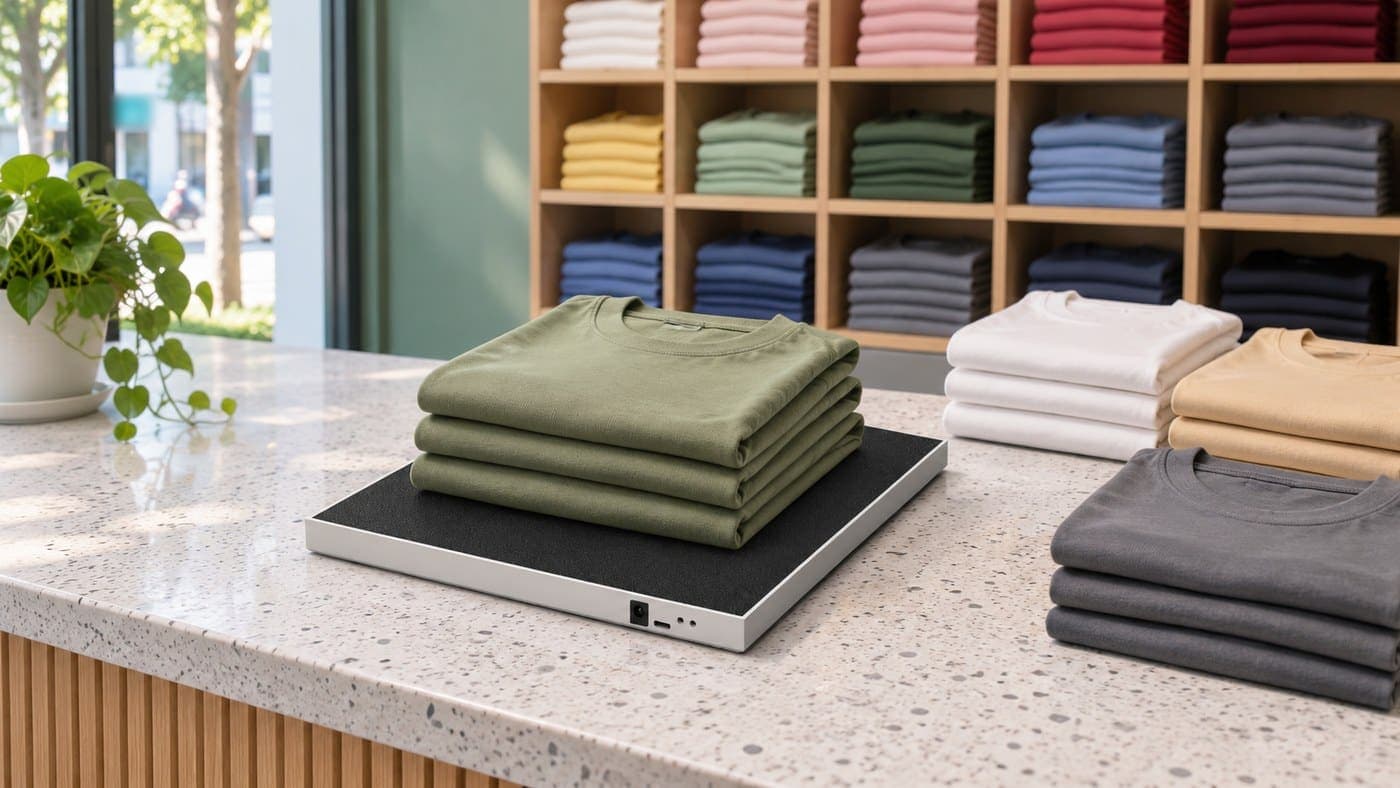
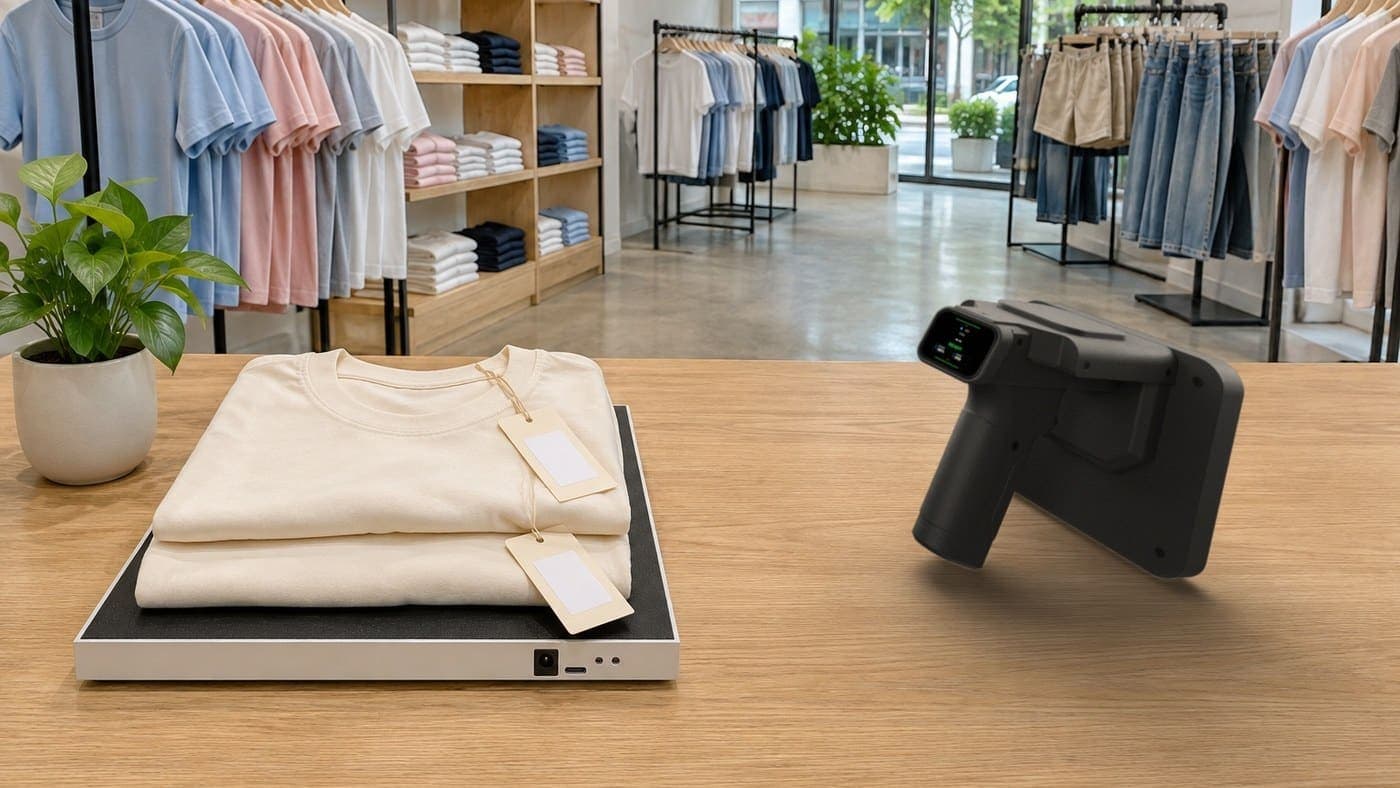
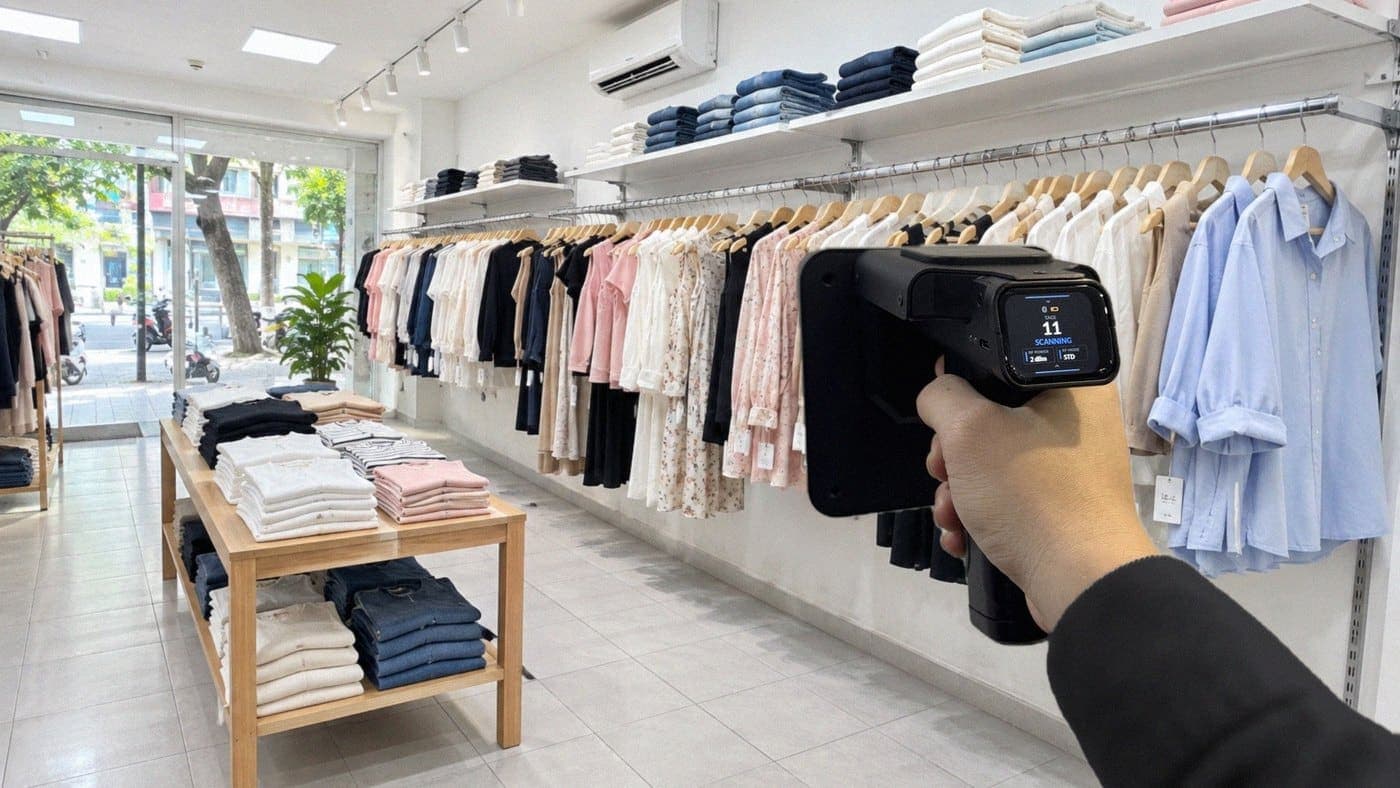
The kit has two devices, each with its own job. The handheld RFID scanner reads from a distance, so you carry it around the shop to count and find stock. The desktop RFID reader only reads what sits on it, so it handles receiving and goods out. Why the jobs are split that way is covered in Handheld RFID scanner vs desktop RFID reader.
Nextwaves sells the two devices as one kit at $1,199 excluding VAT. That price also covers 2,500 tags, Sense Inventory Essentials, shipping in Vietnam, setup and training at handover. The full list is at the end.
Two things aren't in the box, so you bring them: a computer with Chrome or Edge to plug the desktop reader into by USB, and an iPhone or Android phone to pair the handheld scanner over Bluetooth. If the shop already has a computer at the counter and phones for staff, this costs nothing extra.
An RFID label printer isn't in the kit either, and you don't need one to start: the kit's tags already carry their codes. You only need to budget for a printer if you want to print your own product details on the tags.
RFID tags: the cost that follows your item count
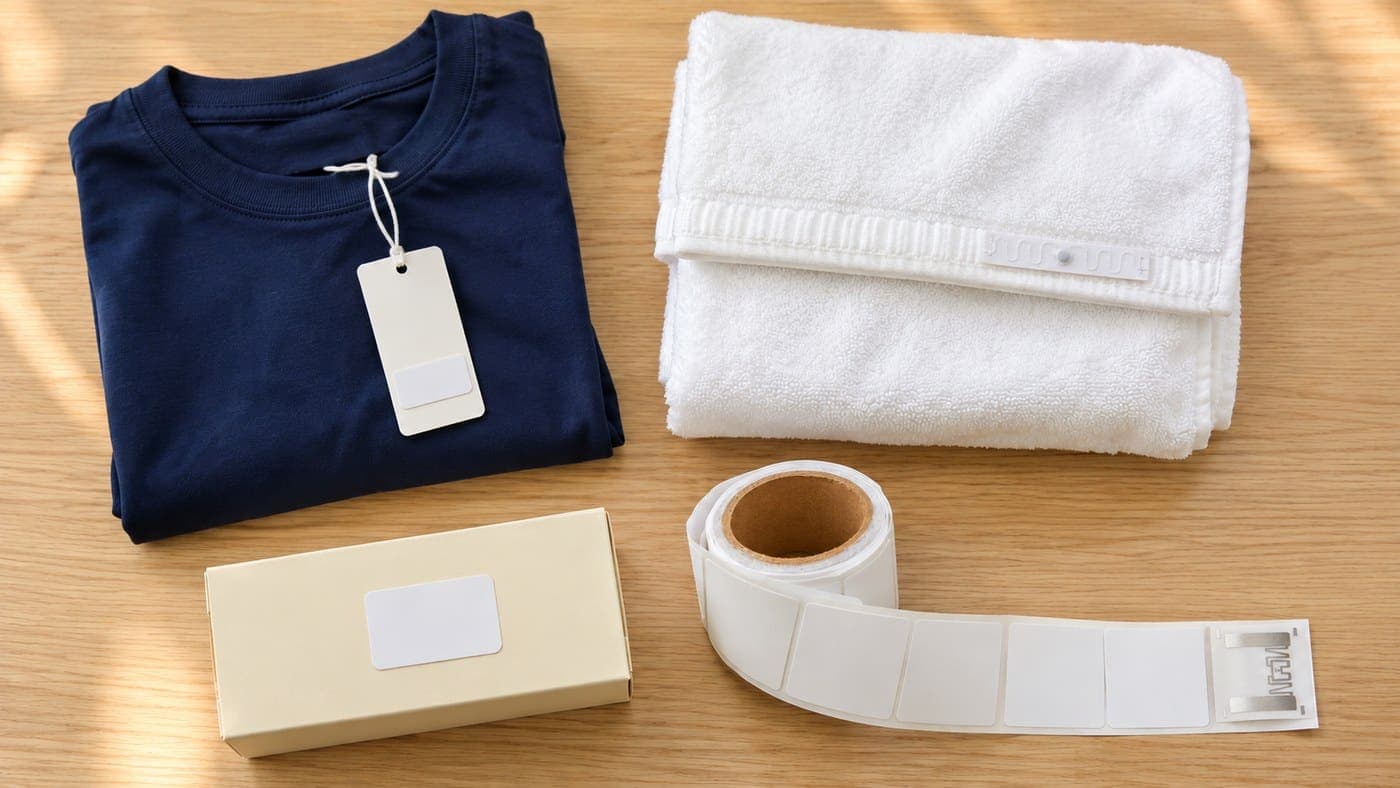
Every item needs its own tag. Each tag carries its own code, so the software knows which shirt it is, not just "a shirt of that style". The number of tags you need is the number of items you want to manage with RFID.
The kit comes with 2,500 tags, enough for 2,500 products. If you have more, you buy more. Standard sticker tags, 45 × 20 mm or 54 × 34 mm, blank or printed, are 890đ each excluding VAT, sold in rolls of 2,500 tags.
Sticker tags can only be used once. So tags aren't paid once and done: every new delivery needs more of them. Per item, each new item adds 890đ in tags, but you still buy them by the roll of 2,500.
With barcodes this cost is far smaller, because printed labels are cheap. What you pay extra for with RFID is reading a whole shelf in one pass instead of scanning item by item; the two are compared in RFID vs barcodes.
Why are some tags cheap and others expensive?
The tag price depends on the kind of tag, and the kind of tag depends on your goods. The Nextwaves kits for gold shops and for hotels each have a handheld scanner and a desktop reader like the retail kit, but different tags, and both kits cost more. A jewellery tag is 100 × 17 mm, with the antenna sitting outside the piece so it still reads on gold. A laundry tag is sewn into towels, sheets and uniforms and made to go through repeated washing. Both cost more per tag than a regular sticker tag. The hotel kit also comes with different software, the Sense Assets asset management software. So when you compare kit prices, don't just count devices: look at the kind of tag, the number of tags and the software too.

Metal goods or bottles of liquid may also need another kind of tag, because metal and liquid make ordinary tags harder to read, above all when the tag sits right against them. In that case Nextwaves advises on the tag and where to put it based on your actual goods, and the tag price follows the kind chosen.
Buy more tags in a year and the price comes down
Extra tags you buy from 1 January to 31 December add up toward a level in the Tag Rewards program. After the year ends, Nextwaves sets your level. The difference between what you paid and your level's price comes back as credit for later tag orders.
| Level | Tags bought in the year | Price per tag after credit |
|---|---|---|
| Member | From 2,500 | 890đ |
| Bronze | From 50,000 | 880đ |
| Silver | From 100,000 | 870đ |
| Gold | From 250,000 | 850đ |
| Platinum | From 500,000 | 830đ |
| Diamond | From 1,000,000 | 810đ |
The program counts extra 54 × 34 mm and 45 × 20 mm sticker tags. The 2,500 tags in the kit don't count. Credit starts at 50,000 tags a year, so a small shop should simply budget 890đ per tag.
Software: $0 a month on Essentials
The third part is software, the one usually paid monthly. The kit comes with Sense Inventory Essentials, stock software at $0 a month. It has the core stock jobs: assigning tags to products, stock in, stock out, RFID counts and item finding, and viewing stock on a computer and a phone. Sales, invoices and customers stay in the sales software you already use.
Sense Inventory has two plans: Essentials at $0 a month, and Premium, quoted separately. It's one shared version, updated for every customer at the same time, so before you buy, check that Essentials fits the way your shop receives, ships and counts stock. If you need something beyond that, ask Nextwaves whether it's in the Premium plan.
One thing to ask before you order: if you want Sense Inventory to connect with Sapo, KiotViet or Haravan, ask which plan includes that connection. A connection only works when your software plan includes it.
The cost no quote lists: tagging your stock the first time
This one is easy to forget, because nobody writes it on a quote. Once the kit arrives and the devices are connected, four jobs take staff time before your first count:
- Import your product list into the software with an Excel file.
- Put one RFID tag on every product you want to count.
- Use the desktop reader to link each tag to the right product code, colour and size.
- Walk the shelves with the scanner for your first count.
Steps 2 and 3 are done item by item, so that's where most of the work goes. A shop with 2,000 items and one with 10,000 items are far apart here. There's no minutes-per-item figure that fits every shop: it depends on the goods, where the tag goes and how you split the work. The closest estimate is to tag and link one whole product code, time it, and multiply by your item count.

Two ways to make this lighter. One, link tags on the desktop reader in groups of the same code, colour and size, and don't mix several codes in one pass. Two, after the first round, tag new goods as they arrive and go into stock. Tagging becomes part of receiving instead of piling up into one big job.
RFID system cost for a shop with 2,000 to 10,000 items
Put the parts together at list prices and this is what one store selling regular sticker-tagged goods needs at the start, excluding VAT and the tagging work:
| Items in the shop | Kit | Extra tags | Software |
|---|---|---|---|
| 2,000 items | $1,199 | None, the kit's 2,500 tags are enough | $0 a month |
| 5,000 items | $1,199 | 1 roll of 2,500 tags | $0 a month |
| 10,000 items | $1,199 | 3 rolls, 7,500 tags | $0 a month |
After that, the running cost is tags for new goods: every 2,500 new items is one more roll. A shop taking in about 1,000 items a month uses a roll roughly every two and a half months on average, so order the next roll before you run out and new goods always have tags waiting. The 2,000-item shop still has 500 spare tags from the kit for its first new delivery.

These prices exclude VAT, which is added on the invoice. If the shop doesn't yet have a computer at the counter or phones for staff, add those.
When does the cost go up?
The table above is for one store, regular sticker tags and the Essentials plan. Step outside that and the cost rises in these places:
- Several stores or stockrooms. One set of devices can only be in one place at a time. Any location that receives goods and counts stock regularly should have its own. How many devices depends on how you run things; Nextwaves advises based on your item count and number of stores.
- A big shop that wants faster counts. Several handheld scanners can work in the same count session, so a big shop can split the count by area. Each extra scanner is extra device cost.
- Goods that need special tags. Jewellery and laundry use their own kinds of tag, which cost more per tag than regular stickers. Metal goods or liquids may also need a different tag, priced by the kind chosen.
- Fixed readers. If you want a fixed read point that nobody has to carry a scanner to, you need a fixed reader, antennas, installation and the technical setup that goes with them. That's quoted separately and isn't part of the kit.
- Connecting your own software. If you use custom-built or industry-specific software, the connection is done by whoever makes that software, through the Nextwaves API/SDK. Ask them what it costs.
- Needing more than Essentials. Ask about the Premium plan, quoted separately.
- Printing your own tags. To print your own RFID tags, budget for an RFID label printer. The printer isn't in the kit.
For the order to go in when you grow from one store to several, see RFID implementation from A to Z.
For a close quote, have these numbers ready
- How many items you hold now, counted piece by piece, not by product code.
- How many new items come in each month.
- How many stores and stockrooms you have, and which ones receive goods or need counting.
- Your goods: any metal, bottled liquids, jewellery or items that get washed.
- The sales software you use: Sapo, KiotViet, Haravan, Excel or your own.
- Whether you need to print your own tags.
With these numbers you can work out most of the cost from the tables above. Whether it's worth spending is a different question, covered in should you invest in RFID.
Start with the $1,199 kit
The Nextwaves retail starter kit costs $1,199 for the full kit, excluding VAT. In the box:
- 1 handheld RFID scanner that connects to a phone over Bluetooth.
- 1 desktop RFID reader that plugs into a computer by USB.
- 2,500 RFID sticker tags, 45 × 20 mm or 54 × 34 mm, enough for 2,500 products.
- Sense Inventory Essentials stock software, $0 a month.
Nextwaves makes both devices, and both carry Vietnam's conformity certification. The price includes free shipping in Vietnam, setup support, training at handover with guides and videos, phone and chat support after handover, and a 12-month device warranty.
Gold shops and jewellery stores can see the RFID kit for gold shops (page in Vietnamese). Hotels can see the RFID kit for towels, sheets and uniforms (page in Vietnamese).
Want to know how many tags your shop needs and what it all comes to? Answer 9 questions on the kit page, which takes about 30 seconds, or fill in the form below. Nextwaves will call you back, estimate the tags and cost for your shop's size, and tell you straight if the kit isn't right for your shop.
Frequently asked questions
How much does an RFID system cost for a small shop?
With the Nextwaves retail kit, $1,199 excluding VAT, covering two devices, 2,500 tags and the Essentials software at $0 a month. Shops with more than 2,500 items buy extra tags at 890đ each, in rolls of 2,500.
Beyond the kit, what do I pay each month?
On Essentials, the software is $0 a month. The regular cost is tags for new goods. Need more than Essentials? Ask about the Premium plan, quoted separately.
How much is one RFID tag?
A standard 45 × 20 mm or 54 × 34 mm sticker tag, blank or printed, is 890đ excluding VAT, sold in rolls of 2,500. Jewellery tags, laundry tags and anti-metal tags are other kinds, at other prices.
Can sticker tags be reused?
No. Sticker tags are single-use, so every new delivery needs new tags. Hang tags and hard tags can be taken off and reused.
Do the prices here include VAT?
No. The kit and tag prices exclude VAT, which is added on the invoice.
What's in the free software?
Sense Inventory Essentials is stock software at $0 a month with the core stock features: assigning tags to products, stock in, stock out, RFID counts and item finding, and viewing stock on a computer and a phone. Sales, invoices and customers stay in the sales software you already use.
What if I need more features later?
Sense Inventory is one shared version, and new features reach every customer at the same time. If you need something beyond Essentials, ask Nextwaves whether it's in the Premium plan, which is quoted separately. Best of all, walk Nextwaves through how your shop receives, ships and counts stock before you buy, so you know whether Essentials is enough.