RFID (Radio Frequency Identification) is a technology that uses radio waves to read an ID number stored on a small chip attached to an object, without touching it and without needing to see it. An RFID system has four parts: a tag that holds the chip and an antenna, a reader that sends radio waves, the reader’s antenna (built into handheld and desktop readers), and software that turns the ID into useful information. A barcode has to be scanned one at a time. A UHF RFID reader can read hundreds of tags in one sweep, even when they sit inside cartons, plastic bags or under fabric.
This guide explains RFID from first principles. It covers where a chip with no battery gets its power, and why a label on a carton reads from several meters away while a door access card has to be held right up to the reader. It also explains what the chip actually stores, which standards and frequency bands apply, and where RFID struggles. At the end there is a table for choosing an RFID kit by industry, from clothing stores and warehouses to hotels.
The 30-second version
- RFID = a chip + an antenna on an object, read by radio, no line of sight needed.
- Three main bands: LF at 125–134 kHz (pet microchips, car keys), HF at 13.56 MHz (contactless cards, passports, NFC on phones), UHF at 860–960 MHz (goods, warehouses, road tolls).
- Passive tags have no battery. They harvest energy from the reader’s own signal and send their ID back (UHF tags by backscatter, LF and HF tags by load modulation).
- The most widely used standard for goods is GS1 EPC UHF Gen2 / ISO/IEC 18000-63, also known as RAIN RFID.
- Each country sets its own UHF band and power limit: 902–928 MHz in the US, 865–868 MHz in Europe, 918.4–923 MHz in Vietnam. Metal and liquids are the hardest materials to tag, and there are special tags and mounting methods for both.
What is RFID? A plain definition and the formal one
Put simply, an RFID tag is a barcode that can answer back over radio. A barcode stores a number as black and white bars, and the scanner has to see it. An RFID tag stores the number on a chip, and the reader asks for it by radio. When the chip hears the question, it replies with that number. Radio waves pass through paper, plastic and fabric, so the reader does not need to see the tag.
The ISO/IEC vocabulary for automatic identification and data capture (AIDC) defines RFID along these lines: the use of electromagnetic or inductive coupling in the radio frequency range to exchange data with a data carrier (the tag) in order to identify it. The two words that matter are identification and radio. RFID answers the question “what is this, and which one is it?”, and it does so over the air.
RFID belongs to the same AIDC family as barcodes, QR codes and biometrics. RFID differs from them in that it needs no contact and no line of sight, and it can read many tags at once.
You probably use RFID every day
- Electronic toll collection: in many countries, including Vietnam, the sticker on the windshield is a passive UHF RFID tag. The toll lane reads it as the car drives through.
- Passports and chip-based ID cards: e-passports and many national ID cards, such as Vietnam’s chip-based citizen ID, carry a contactless 13.56 MHz chip that an NFC phone can read with a suitable app, using the access code printed on the document.
- Hotel key cards and building access cards: usually low-frequency 125 kHz or 13.56 MHz RFID, held close to the reader.
- Contactless bank cards and phone wallets: these use NFC, a branch of 13.56 MHz RFID.
- Pet microchips: low-frequency 134.2 kHz RFID under ISO 11784/11785.
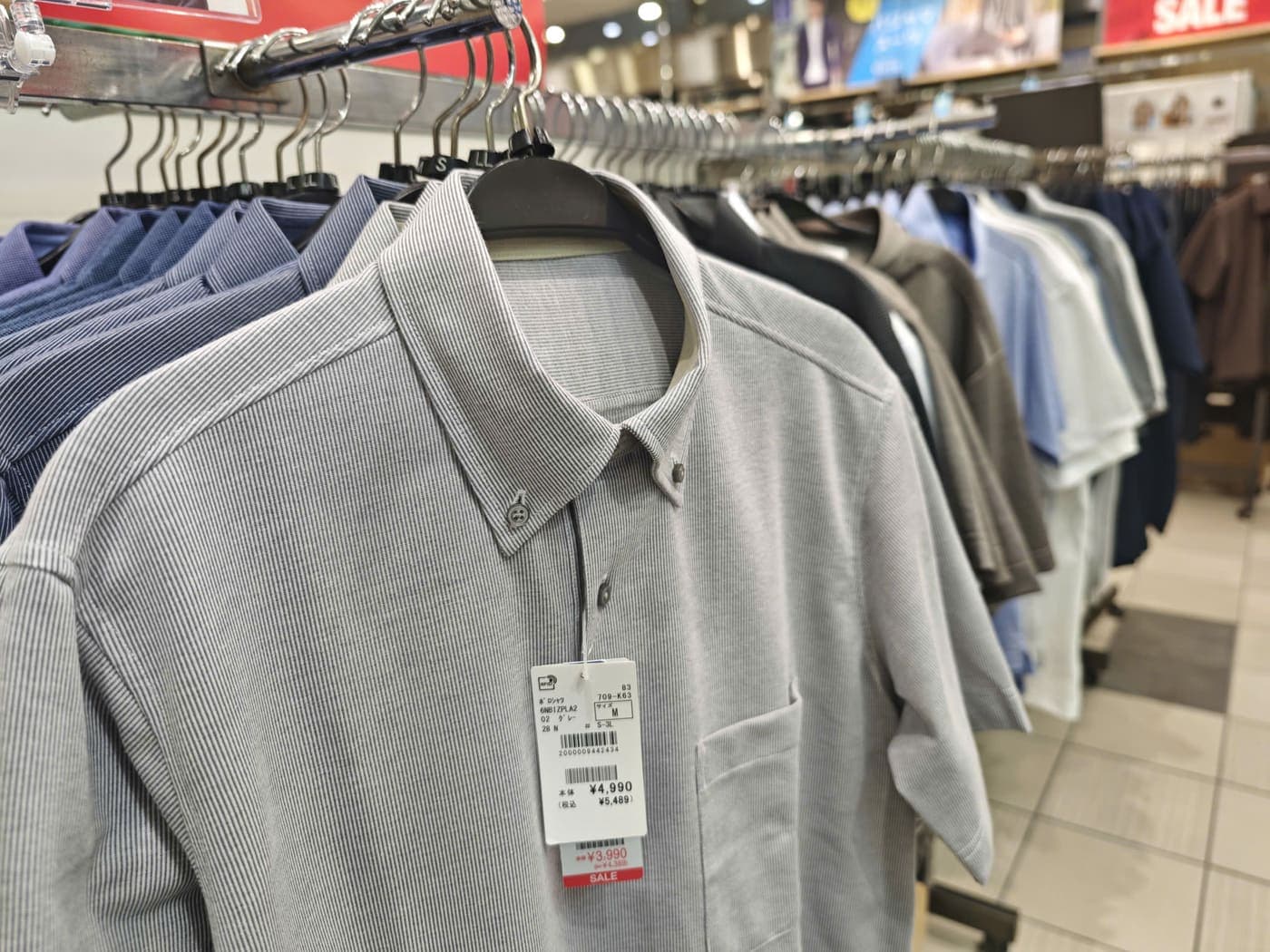
- Clothing tags at large fashion chains: UHF RFID tags let a store count thousands of items in minutes.
A common misconception is that the anti-theft tags on supermarket goods (the ones that beep at the exit) are RFID. Most of them are not. They are EAS (Electronic Article Surveillance) tags, which only signal “tag present” and carry no unique ID per item. Some newer systems use UHF RFID tags for both stock counting and theft prevention, but the two technologies are not the same.
What are the parts of an RFID system?
Every RFID system has the same four parts, from a single elevator card to stock control across a whole store chain. Knowing what each part does helps you avoid two common buying mistakes: cheap tags that the reader doesn’t read well, or a good reader with no software to use its data.

1. The RFID tag: chip and antenna
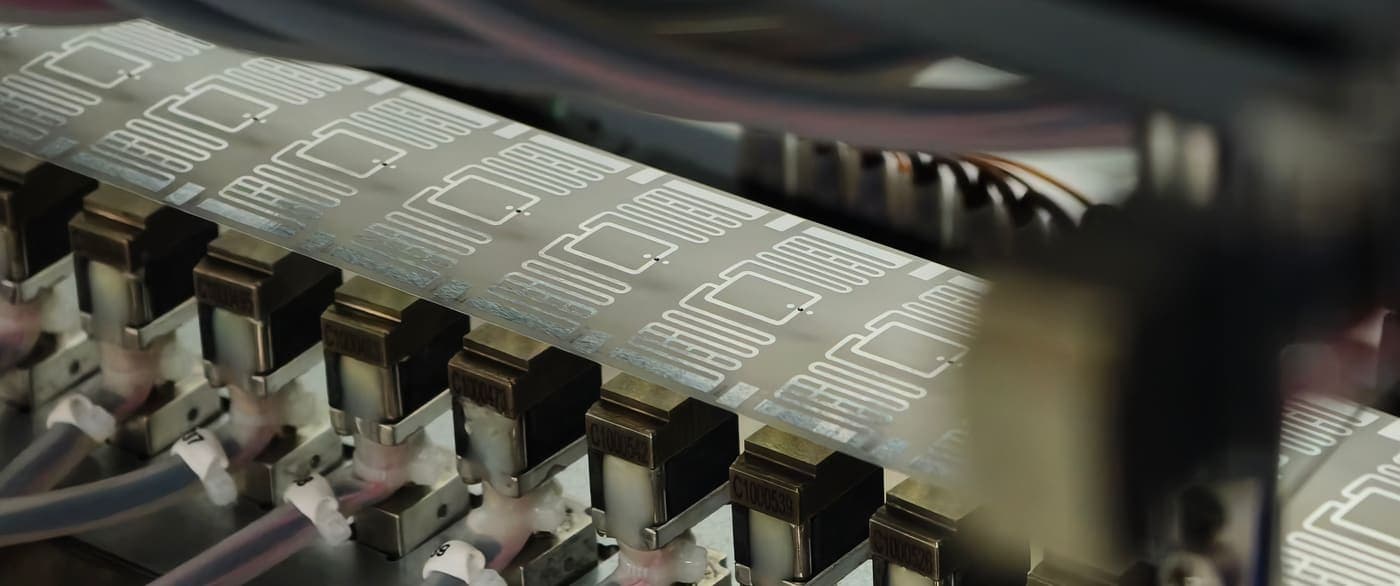
An RFID tag is a chip (IC) about the size of a grain of sand plus an antenna made of aluminum, copper or conductive thread. The chip stores the ID and handles commands. The antenna does two jobs: it harvests energy from the reader’s signal and it sends the reply back. The chip and antenna sit on a thin PET film called an inlay. Inlays are converted into many forms: paper labels, clothing hangtags, woven labels sewn into seams, laundry tags and rigid on-metal tags. Most of the size of an RFID label is the antenna, not the chip.

For a closer look at the differences between inlays, labels and tags, see RFID inlay vs. label vs. tag.
2. The RFID reader
A reader is a radio transceiver. It sends out a carrier wave that delivers energy and commands, then listens for the very weak signal the tag sends back and decodes it into a number. There are three common types:
- Handheld readers: staff carry them along shelves to count stock and find items.
- Desktop readers: placed at a counter or receiving desk to encode tags and read small batches.
- Fixed readers: mounted at warehouse doors, conveyors and gates, reading automatically with no one involved.


3. The reader antenna
The antenna sets the read zone: how far, how wide and in which direction. Handheld and desktop readers have built-in antennas. Fixed readers take external antennas. A circularly polarized antenna reads tags whether they are turned horizontally or vertically, at the cost of somewhat shorter range than a linear antenna lined up with the tag. A near-field antenna reads only right at its surface, which is useful at a counter so it doesn’t pick up the item next to the one you want.

Antenna choice is a subject of its own. There is a detailed guide to UHF RFID antenna polarization, gain and durability.
4. Software and middleware
A reader only returns a list of numbers. The software is what knows that 3034…01A3 is “white shirt, size M, received on October 12, last counted on shelf A3”. The software removes duplicates (a tag can be read several times per second), compares what was read against what should be there, and reports what is missing, extra or in the wrong place. Without this part, RFID is just a counter.

For stores and warehouses, Nextwaves uses its Sense Inventory stock control software. For fixed assets and hotel linen there is the Sense Assets asset management app.
How does RFID work?
An RFID label has no battery. The energy to run its chip and send a reply comes from the reader’s own signal. How the tag collects that energy and answers depends on the frequency band, and that is why an elevator card has to be held right up to the reader while a label on a carton can be read from several meters away.
The common steps: ask, power, answer
- The reader transmits. The signal carries both energy and a command (for example, “any tag here, report in”).
- The tag wakes up. The tag antenna captures a tiny share of that energy, and a rectifier in the chip turns it into DC power. Modern UHF chips need only a few microwatts to run.
- The tag answers. The chip sends its ID back to the reader. It does not transmit its own signal. Instead, it changes how its antenna interacts with the reader’s signal.
- The reader decodes the reply and passes it to the software.
Step 3 is where the two mechanisms part ways.

Mechanism 1: inductive coupling in the near field (LF and HF)
At 125 kHz and 13.56 MHz the wavelength is very long: about 2,400 m and 22 m. The reader and the tag sit very close together compared with the wavelength, so energy moves mainly through the magnetic field between the two coils, not through a traveling wave. The reader coil and the tag coil behave like the two windings of a transformer pulled apart, with no wire between them. Alternating current in the reader coil creates a magnetic field, and that field induces a current in the tag coil.
To reply, the chip switches a small load on and off across its coil in step with the data. This is called load modulation. It slightly changes the current in the reader coil, just as switching a lamp on and off on a transformer’s secondary winding is “felt” on the primary. The reader reads those changes as 0s and 1s.
The drawback is that once the distance is larger than the coil, the magnetic field strength falls with the cube of distance (1/r³). Double the distance and the field drops to one eighth. That is why LF and HF tags usually read from a few centimeters up to about one meter. For payment cards, ID documents and access cards, the short range is a feature: the user has to tap on purpose, and reading them from a distance is much harder, though not impossible.
Mechanism 2: backscatter in the far field (UHF)
At 915 MHz the wavelength is only about 33 cm, much shorter than typical read distances. A common rule of thumb puts the edge of the near field at λ/2π, roughly 5 cm. The real boundary depends on antenna size and lies farther out for a large reader antenna. At read distances of a few meters, the reader and the tag communicate through a propagating electromagnetic wave.
A passive UHF tag has no transmitter. It answers by backscatter: the chip switches its antenna between two impedance states. In one state the antenna absorbs energy, in the other it reflects more of it. The reader keeps transmitting a continuous wave, and it hears the reflected part rise and fall with the data.
Here is an easy way to picture it. Someone far away shines a flashlight at you, and you hold a small mirror. You have no light of your own, but you tilt the mirror so the reflection flashes bright and dark at them, like Morse code, and they read your message. The person with the flashlight is the reader, the mirror is the tag antenna and the hand tilting it is the chip. Harry Stockman described this idea, “communication by means of reflected power”, in 1948. It is the foundation of UHF RFID today.

The reflected signal is extremely weak. The energy reaching the tag falls with the square of distance, and the reflection falls by another square on the way back, so the total loss grows with the fourth power of distance. A UHF reader has to hear a signal billions of times weaker than the one it is sending, while it is still sending. That is why a good UHF reader is much harder to build than an HF reader.
How can a reader count hundreds of tags at once?
If 500 tags all answered at the same moment, their signals would pile up into noise. The Gen2 standard solves this with an anti-collision algorithm called slotted ALOHA with a Q parameter. Picture a classroom. The teacher says: “Everyone pick a random number from 0 to 15. When I call your number, stand up.” Most of the time only one student stands, so the teacher writes down that name and tells the student to stay seated for the rest of the lesson. When two students stand at once, the teacher skips that number and they pick again in the next round.

This way, a good reader in good conditions can count hundreds of tags per second. The Gen2 commands and the read range math are in the “Technical deep dive” section near the end, for anyone who wants the details.
RFID frequencies: how do LF, HF, NFC and UHF differ?
“RFID” is not one technology but a family of technologies, split by frequency. The band sets the physical mechanism described above, and that mechanism largely sets the read range, read speed and the jobs it suits. Pick the wrong band and you have to replace both the tags and the readers. Software can’t make up for it.

| Feature | LF (low frequency) | HF / NFC (high frequency) | UHF / RAIN (ultra-high frequency) |
|---|---|---|---|
| Frequency | 125–134.2 kHz | 13.56 MHz | 860–960 MHz (varies by country) |
| Wavelength | ~2,400 m | ~22 m | ~33 cm |
| Mechanism | Inductive coupling (magnetic field) | Inductive coupling (magnetic field) | Backscatter (electromagnetic wave) |
| Typical passive read range | A few cm to a few tens of cm | A few cm (NFC, ISO 14443) to ~1 m (ISO 15693) | A few cm to about 10 m, depending on tag, reader and environment |
| Many tags at once | Limited | Yes, in moderate numbers | Hundreds of tags per second in good conditions |
| Near water and metal | Best | Fair | Weakest without special tags |
| Main standards | ISO 11784/11785, ISO 14223 | ISO/IEC 14443, ISO/IEC 15693, NFC Forum (ISO/IEC 18092) | GS1 EPC UHF Gen2, ISO/IEC 18000-63 |
| Readable by a phone? | No | Yes, if it has NFC | No (needs a UHF reader) |
| Familiar examples | Pet microchips, car keys with chips, older access cards | E-passports, contactless payment cards, library cards, transit cards | Product labels, windshield toll tags, laundry tags, warehouse tracking |
Is NFC a type of RFID?
Yes. NFC (Near Field Communication) is a branch of 13.56 MHz HF RFID, standardized so that a phone can read a tag, act as a tag, and talk to another phone. NFC deliberately limits its range to a few centimeters so that the user has to tap on purpose. That is why a phone can read a chip-based passport (with the right app and the access code printed in it) but not the UHF RFID tag on a shirt: different bands, different antennas.
What about active RFID at 433 MHz and 2.45 GHz?
Active tags have a battery and transmit on their own. They read from tens to hundreds of meters and are used for containers, vehicles and indoor positioning. In exchange, they are bulky, cost far more than passive tags, and need new batteries. For indoor positioning, projects usually move to UWB or BLE: UWB is more precise, BLE is cheaper. See our comparison of GPS, RFID, UWB and Bluetooth. The rest of this guide focuses on passive RFID, which accounts for the vast majority of tags made each year.
Which UHF band does each country use?
Every country divides its radio spectrum differently, so there is no single worldwide UHF RFID frequency. Europe uses 865–868 MHz with up to 2 W ERP, and some European countries also open 915–921 MHz. The United States uses 902–928 MHz with up to 4 W EIRP. Japan uses 916.7–920.9 MHz, and China uses 920–925 MHz under rules that took effect in November 2024. When you buy an imported reader, check that it is set to the right region. A reader set for one region may transmit outside the band allowed in another.
Passive tags are more flexible. Many UHF labels are designed to work across the whole 860–960 MHz range (often called “global” labels), but each design is still tuned to read best in one part of that range. If one label design goes on goods shipped to several countries, check the read range versus frequency chart in its datasheet.
UHF RFID in Vietnam: 918.4–923 MHz
In Vietnam, Circular 08/2021/TT-BTTTT (Annex 6) allows RFID equipment to operate without a spectrum license in the 918.4–923 MHz band, at up to 500 mW ERP (about 0.82 W EIRP). Channels can be at most 500 kHz wide, and equipment must use frequency hopping (FHSS), listen-before-talk (LBT) or a duty-cycle limit. Electronic toll collection may use 920–923 MHz at higher power, up to 2,000 mW ERP, but it needs a spectrum license.
Many sources online give Vietnam’s RFID band as 920–925 MHz (that is actually China’s band) or as 920–923 MHz for all uses. Under the regulation in force, the correct band for ordinary RFID equipment is 918.4–923 MHz. Vietnam sits between Japan and China, with lower power limits than the US and Europe.
Radio equipment sold in Vietnam also needs a conformity certificate under the national technical regulation QCVN 47:2015/BTTTT. Three Nextwaves readers hold one, issued by the Vietnam Telecommunications Authority: the desktop reader and the handheld scanner in the starter kits, and the NR155 fixed reader. If you buy a reader elsewhere, ask the seller for the certificate for that exact model.
What is RAIN RFID?
RAIN RFID is the brand name for passive UHF RFID under the GS1 EPC UHF Gen2 / ISO/IEC 18000-63 standard. The RAIN Alliance coined it in 2014 so the market could use one common name. When a document says “RAIN”, read it as UHF Gen2. Nextwaves is a member of the RAIN Alliance. For more on the standard and its frequencies, read What is RAIN RFID?
What types of RFID tags are there?
There are two ways to classify RFID tags: by power source and by form factor. The first decides read range and price. The second decides whether the tag can be attached to your product and will last there.
By power source: passive, semi-passive, active
| Type | Power source | How it answers | Read range | Relative price |
|---|---|---|---|---|
| Passive | Harvested from the reader’s signal | Backscatter or load modulation | A few cm to ~10 m | Lowest: UHF labels cost a few US cents |
| Semi-passive (BAP) | Battery powers the chip, not a transmitter | Still backscatter | Longer and more sensitive than passive | Medium |
| Active | Battery powers both chip and transmitter | Transmits on its own | Tens to hundreds of meters | High, and batteries need replacing |
By form factor: inlays, labels, hangtags, woven labels, laundry tags, on-metal tags
- Dry and wet inlays: the chip and antenna on PET film. Wet inlays come with adhesive, ready to stick. Dry inlays go to printers and label makers, who build them into their own products. Nextwaves makes inlays in Vietnam. See the RFID inlay catalog.
- RFID labels: an inlay laminated between paper or film, with a barcode and text printed on the face. This is the most common form for goods, cartons and cosmetics boxes. Prices and selection tips are in UHF RFID labels from 700 VND, made in Vietnam.

- RFID hangtags: paper tags that hang on clothing, shoes and bags, with an inlay inside. See RFID hangtags.
- RFID woven labels: sewn into a seam like a size label, so customers can’t easily remove them. See RFID woven labels.
- Laundry tags: a woven fabric strip with a conductive-thread antenna, sewn into sheets, towels and uniforms. They survive industrial washing, drying and ironing. The laundry tag guide explains how they are built.

- On-metal (anti-metal) tags: a spacer layer and an antenna designed to sit directly on metal, for machinery, molds, gas cylinders and server racks. See the guide to UHF on-metal tags.
- Rugged and specialty tags: ABS, ceramic or silicone housings for pallets, poles, pipes, chemicals or high temperatures.
Choose the tag for the material and the mounting spot, not for the price. The same label design that reads from several meters on a cardboard box may read only a few tens of centimeters on a water bottle. Before you order in volume, test sample tags on your own products.
How is an inlay made?

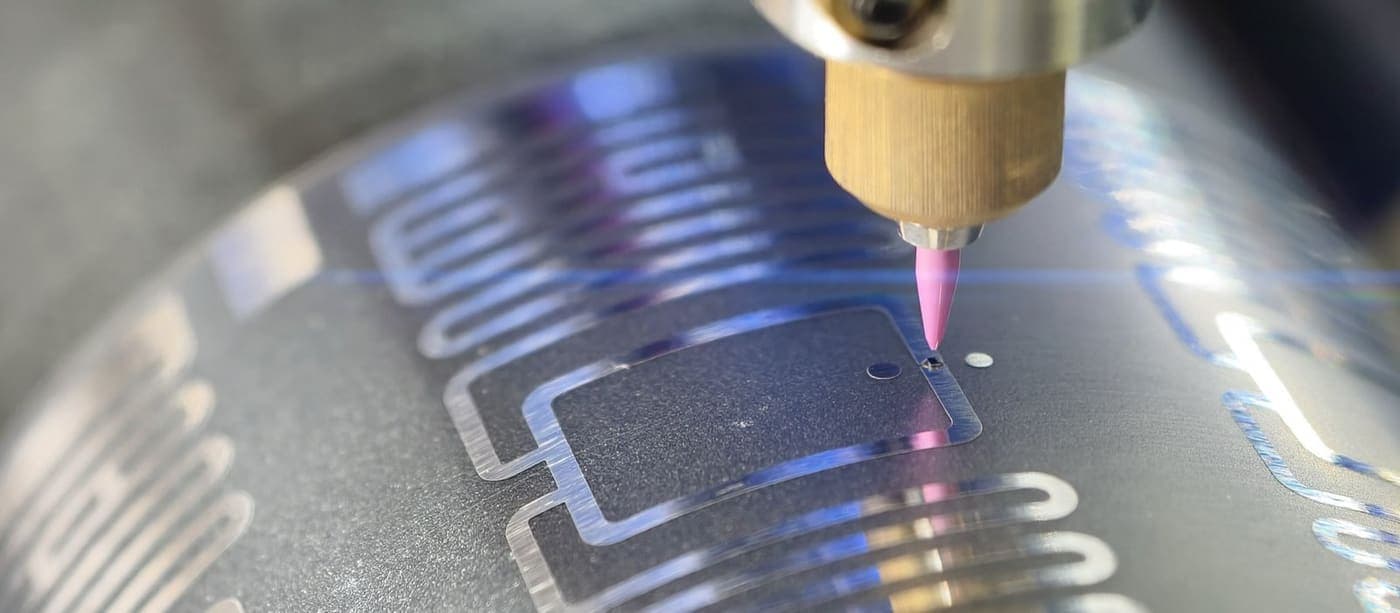
A typical industry process goes like this. The antenna is formed from thin aluminum foil on PET film by etching or cutting. The chip is flipped over and attached to the antenna’s two contact pads with conductive adhesive (flip-chip), then heat-pressed to cure the adhesive. Each inlay is tested before it is wound onto a roll, coated with adhesive as a wet inlay, or laminated into a paper label. The chip is the size of a grain of sand, so placement accuracy and the match between chip and antenna decide how far the tag can read.

Nextwaves runs an inlay chip-bonding facility in Vietnam with a capacity of 100 million tags a year, and designs the antennas for its own inlay lines. The design theory is covered in far-field and near-field antenna design.
What is stored on an RFID chip? Gen2 memory and the EPC
Many people assume an RFID tag stores “product information” such as the name, price or expiry date. In practice, a UHF tag on goods usually stores only an ID number. Everything else lives in the software. The tag only says “this is item number so-and-so”, and the software looks up what that item is. A Gen2 chip divides its memory into four banks:

| Memory bank | Contents | Written by | Used for |
|---|---|---|---|
| Bank 00: Reserved | Kill password (32 bits) and access password (32 bits) | The user | Locking writes, or permanently disabling the tag to protect privacy |
| Bank 01: EPC | CRC-16, Protocol Control (PC), EPC (usually 96 or 128 bits) | The user | The item ID, which the reader returns during an inventory |
| Bank 10: TID | Chip maker code, model number; many chips add a unique serial number (optional in the standard) | The chip maker (permanently locked) | Identifying the chip type; with a unique serial, telling apart two tags written with the same EPC by mistake |
| Bank 11: User | Any data, from 0 to a few thousand bits depending on the chip | The user | Extra data such as service dates or batch numbers, readable without a network |
What is an EPC? Anatomy of an SGTIN-96
The EPC (Electronic Product Code) is an identifier defined by GS1 in its Tag Data Standard (TDS). The key difference from an EAN-13 barcode is this. The barcode only says “this is a white shirt, size M” (a product code). An SGTIN-type EPC says “this is white shirt, size M, number 1,024” (product code + serial number). Every item gets an identity of its own. Some 2D codes, such as GS1 DataMatrix, can carry a serial number too, but they still have to be scanned one at a time.

An SGTIN-96 has six fields. The header is 8 bits (always 0x30 for SGTIN-96). The filter is 3 bits (the unit type: item, case or pallet). The partition is 3 bits (how the length is split between the next two fields). Then come the GS1 Company Prefix (20–40 bits, the company number), the Item Reference (24–4 bits, the product number) and the Serial (38 bits). The 38-bit serial alone allows 2^38 ≈ 275 billion different numbers per product. Because the header is 0x30, an SGTIN-96 written in hex always starts with “30”. Other schemes have their own headers: SSCC-96 (cases and pallets) starts with “31”, and GIAI-96 (assets) starts with “34”.
To see which GTIN a hex EPC maps to, or the other way round, use Nextwaves’ free GS1 TDS EPC converter or the RFID code converter.
Do you need an RFID printer to encode tags?
Not always. There are two approaches. You can write a GS1-standard EPC to each tag, which needs a printer or a reader that can encode. Or you can keep the ID the tag already has and “bind” that number to a product in your software. The second approach is faster for small and mid-size stores and warehouses, as long as the existing IDs don’t repeat. The factory EPC on many labels is not always unique, so ask your tag supplier which ID is. Do I need to buy an RFID printer? explains when to choose which.
Key RFID standards
Standards are the reason a label made in Vietnam can be read by a reader in Japan, and an EPC written in a factory can be understood by a retailer’s software in Europe. There are three layers to keep apart: the air interface (how tags and readers talk), the data (how the ID is written) and each country’s spectrum rules. The first two let equipment from different makers understand each other. The third decides whether a reader is allowed to transmit in a given country.
| Layer | Standard | What it defines |
|---|---|---|
| UHF air interface | GS1 EPC UHF Gen2 Air Interface Protocol (latest release 3.0.1, February 2026), aligned with ISO/IEC 18000-63 | Modulation, encoding, Query/ACK commands, the Q algorithm, the four memory banks, passwords, security |
| HF air interface | ISO/IEC 14443 (payment cards, ID documents), ISO/IEC 15693 (library cards, tickets), ISO/IEC 18092 and NFC Forum | Short-range 13.56 MHz cards, encoding and authentication |
| LF air interface | ISO 11784/11785, ISO 14223 | Animal identification at 134.2 kHz |
| Data | GS1 EPC Tag Data Standard (TDS) | EPC structures: SGTIN, SSCC, GRAI, GIAI… |
| Events | GS1 EPCIS | How companies share “what, where, when and why” event data |
| Spectrum rules | US: FCC 47 CFR §15.247. Europe: ETSI EN 302 208. Vietnam: Circular 08/2021/TT-BTTTT, QCVN 47:2015/BTTTT | Permitted bands, transmit power and emission requirements for equipment |
How is RFID different from barcodes, QR codes and NFC?
RFID does not replace barcodes everywhere. Each technology is good at one job. The table compares four technologies on the same criteria, with RFID meaning passive UHF tags for goods.
| Criterion | 1D barcode | QR code | NFC (HF) | UHF RFID |
|---|---|---|---|---|
| Line of sight needed? | Yes | Yes | No, but must be close | No |
| Reads per scan | 1 code | 1 code | 1 tag | Hundreds of tags in one sweep |
| Distance | A few cm to a few tens of cm | A few cm to a few tens of cm | Under ~4 cm | Up to about 10 m |
| Unique ID per item | Usually product level only | Yes, if a unique code is printed | Yes (the chip’s UID) | Yes (EPC with a serial number) |
| Rewritable | No | No | Depends on the tag | Yes, unless locked |
| Copes with dirt, tears, being covered | Poor | Fair (error correction) | Good | Good |
| Readable by a phone | Yes | Yes | Yes | No |
| Cost per label | Almost zero (print cost) | Almost zero (print cost) | Usually more than a UHF label | A few US cents and up |
| Best for | Selling item by item, low-value goods | Marketing, payments, consumer traceability | Authentication, payments, phone interaction | Stock counts, bulk receiving and shipping, finding items, loss prevention |
Instead of asking “RFID or barcode?”, look at which step in your process takes the most labor. If it is counting and finding goods, that is where RFID pays off. If it is selling item by item at the checkout, barcodes are still good enough, and both can be printed on the same label. RFID vs barcode: you are probably asking the wrong question has a detailed decision matrix.
RFID limits: metal, liquids and common myths
RFID reads tags by radio, so the material, the way the tag is attached and the way goods are stacked all affect the result. Knowing the limits below in advance helps you pick the right tags and set the right expectations.
Metal reflects, water absorbs
Metal reflects almost all UHF energy. Stick an ordinary label flat on a metal surface and the currents induced in the metal nearly cancel the tag antenna’s radiation and detune its impedance, so the label reads very poorly or not at all. The usual fixes are on-metal tags, which are built to sit on metal, or mounting the label a few millimeters to a few centimeters off the metal. Water and the human body absorb energy at 900 MHz and shift the resonant frequency of the tag antenna. Water bottles, cases of drinks and ice trays are difficult, and the tag and its position should be chosen after real-world tests.
There are measurements for this. A 915 MHz study at Georgia Tech (Griffin, 2005) found that, compared with free air, a tag antenna loses 0.3–1 dB of gain on cardboard, 5.5–6.4 dB on water and 5.9–12 dB on metal. Going by the Friis equation in the “Technical deep dive” section, a 6 dB loss in gain cuts the theoretical read range roughly in half. Decathlon, which tags every product it sells, has also reported that tags struggle near water and metal, and it redesigned some packaging, such as replacing aluminum packaging.

Tag orientation and dead zones
A dipole tag antenna reads worst when its axis points along the direction of the incoming wave, that is, when the end of the tag points straight at the reader antenna. A circularly polarized antenna reads tags whether they lie horizontally or vertically, but it cannot fix a tag pointing straight at it. In warehouses full of steel racks there are also spots where reflected waves cancel each other out, called dead zones. Counting with a handheld reader gets around most of this, because the person holding it keeps changing the angle.
Reading too much is also a problem
At a receiving desk you want to read only the carton in front of you, not the shelf behind it. The main fix is to limit the read zone: lower the reader power or use a near-field antenna, so the reader only covers what sits on the desk. Software can also drop tags with a weak signal (low RSSI), but RSSI changes with tag angle and material, so treat it as a secondary filter.
“RFID can track location anywhere, anytime”? No.
A passive RFID tag has no GPS, no battery and no transmitter. It only “speaks” inside a reader’s field, within a few meters. The system only knows where and when an item was last read, because it knows which reader read it. A reader at a warehouse door, for example, tells you a carton just passed through the door, not which corner of the warehouse it ended up in. Continuous tracking outdoors usually uses GPS, and indoors UWB or BLE.
Security and privacy
A UHF tag on goods usually holds just an ID number, with no name, price or customer data. Sensitive data lives in the software, behind access controls. Gen2 has an access password to lock writes and a kill password to disable a tag permanently once the item is sold. Gen2v2 (2013) added cryptographic authentication commands to fight counterfeits, and an Untraceable command that hides part of the memory or shortens the read range to protect privacy. These commands work only when the chip supports them, and not every chip does. Bank cards and e-passports use HF chips with their own encryption and authentication, set by the standards of each field (EMV for bank cards, ICAO 9303 for passports).
RFID by industry: which kit fits?
All of these use UHF RFID, but a clothing store, a fabric warehouse and a hotel tag different things, count at a different pace and need different software. The table groups the most common cases, with the Nextwaves kit or product that fits each one. Prices are list prices on nextwaves.com, excluding VAT, at the time of writing.
| You run | The most labor-heavy task | Tag to use | Suggested kit |
|---|---|---|---|
| Clothing store | Stock counts, finding a size for a customer | Hangtag or 45 × 20 mm label | Retail Starter Kit, $999 |
| Footwear and bags | Counting box by box, pair by pair | Box label, hangtag | Retail Starter Kit, $999 |
| Online and marketplace seller | Recounting stock after every sale or livestream; returns | Label on the bag or box | Retail Starter Kit, $999 |
| Fabric, mattress and bedding stockroom | Unstacking goods to count them | Label on the roll core or the wrapping | Retail Starter Kit, $999 |
| Cosmetics, pharmacy, electronics, accessories, furniture, sporting goods | Inventory counts, receiving and shipping | Labels chosen for the material | Retail Starter Kit, $999 |
| Warehouse, distribution center | Finding goods, counting by shelf location | Item labels + shelf location tags | Warehouse Starter Kit, $1,490 |
| Hotel, resort | Counting towels, sheets and uniforms | Laundry tags sewn into each piece | RFID laundry tags |
| Office, bank, server room | High-value assets leaving the building, asset audits | On-metal labels | Security Starter Kit, $2,590 |
| Factory, exporter | Tagging on the production line when overseas customers require it, preparing traceability data | Inlays in volume | RFID inlays made in Vietnam |
Fashion stores: count the whole store in one pass
Clothing is one of the clearest cases for RFID: many sizes and colors, moderate prices, and fabric that radio waves pass through easily. Instead of turning over every item to find its tag, staff walk the shelves with a handheld scanner. The Nextwaves benchmark for the kit is one person counting about 3,000 items in 15 minutes. When a customer asks for a size, staff pick the item in the software and sweep the handheld around the shelf or stockroom to find it.
This is also the sector with the clearest data. The Auburn University RFID Lab in the US found average inventory accuracy at retailers of only about 60%, rising to over 95% with RFID. Uniqlo has tagged almost all of its products with RFID since 2018, and Decathlon has tagged 100% of its products at the factory since 2019.
The Retail Starter Kit contains a desktop reader, a handheld scanner, 2,500 RFID labels and the Sense Inventory software, which is free with the kit. Sense Inventory covers the core stock tasks: assigning tags, receiving, shipping, inventory counts and finding items. It is inventory software, not a point-of-sale system, so sales stay in the POS you already use. See the Retail Starter Kit.
Fabric and mattress stockrooms: count without unstacking
Stacked fabric rolls and vacuum-packed mattresses piled high are two cases where counting by hand usually means moving the goods. UHF waves pass through fabric and plastic wrap, so one sweep along the row also reads the rolls inside the stack, as long as the labels sit in a spot you have tested. For fabric stores, the Nextwaves benchmark is about 3,000 rolls in 20 minutes. One caveat: RFID tells you which roll it is, and the software knows that roll’s code, color and batch, but RFID cannot measure how many meters are left on it. The length printed on the label is the length recorded at receiving.

Warehouses and distribution centers: know which shelf it’s on
The Warehouse Starter Kit adds 200 location tags for shelves, bins and zones. With these tags, each count tells the software which items are there and which shelf each one was on at the time of the scan. The box holds a desktop reader, 2 handheld scanners so two people can count in parallel, 2,500 RFID labels and Sense Inventory. Details are on the Warehouse Starter Kit page.
Hotels and resorts: towels, sheets and uniforms
Towels, sheets and uniforms move constantly between rooms, storage and the laundry, which makes them hard to count accurately. An RFID laundry tag is a plain woven fabric strip, sewn into a hem, that goes through washing, drying and ironing with the item. Staff count a whole linen cart with a handheld scanner instead of counting piece by piece. In Vietnam, Nextwaves offers a hotel package that comes with the Sense Assets asset management app on the Essentials tier, at no monthly cost (details in Vietnamese).
Offices, banks and server rooms: assets must not leave the room
Laptops, hard drives and test equipment are small, valuable and often in metal cases. The Security Starter Kit includes an RFID security gate, on-metal tags, a handheld scanner, the Hyperion Security Verifier desk reader and Sense Inventory. See the Security Starter Kit.
Manufacturers and exporters: tag at the factory
For garment, footwear and furniture exporters, RFID starts with an inlay built into the label on the production line. It then travels with the product to the retailer’s warehouse abroad. The EU Digital Product Passport is being rolled out product group by product group. It does not require RFID, but RFID is one of the ways to attach a traceability ID to a product. See the guide to the EU Digital Product Passport. Nextwaves runs an inlay chip-bonding facility in Vietnam and offers more than 70 UHF inlay models in its RFID inlay catalog.
Not sure which kit fits your business? Leave your details in the form just below. The Nextwaves team will ask what you count, how many items you have and what material the tags go on, then suggest the right kit and tag.
Where to start with RFID, and what it costs
RFID projects usually go wrong at the very start: buying hardware before knowing what to count, or tagging materials nobody has tested. The five steps below put the cheap checks first, so mistakes show up before they get expensive.
- Pick exactly one problem to solve. For example stock counts, finding items, moving whole batches in and out, or counting linen after washing. Pick one clear job, measurable in labor hours or lost items.
- Test tags on your actual products. Put a few tag types on a few typical items, especially ones with metal, liquids or dense stacks. Measure the real read range with the reader you plan to use.
- Decide how items get their IDs. Buy labels that come printed and encoded, or use the IDs already on the tags and bind them to products in software. This decision affects whether you need an RFID printer.
- Run one site first. One store, one warehouse aisle, one hotel floor. Compare the RFID count with a manual count so you can trust the numbers.
- Expand step by step. Add hardware and tags for each new site, and move tagging into receiving so every new item has a tag from day one.

What does RFID cost?
| Cost item | One-off or ongoing | Notes |
|---|---|---|
| Tags and labels | Per new item | UHF labels made in Vietnam start from about 700 VND each (roughly 3 US cents), depending on type and volume. On-metal and laundry tags cost more. |
| Readers and antennas | One-off | Handhelds for stock counts, desktop readers for receiving, fixed readers for gates and conveyors. |
| Software | Depends on the vendor | The Nextwaves starter kits include Sense Inventory, free with the kit. |
| Tagging labor | Per item | Cheapest at the factory or at receiving, most expensive when tagging stock that is already on the shelf. |
A quick way to estimate: work out the yearly labor cost of stock counts (hours per count × counts per year × hourly wage). Add the value of goods lost, and the margin on sales missed because nobody knew the item was in stock, if you can measure them. Compare that with the cost of hardware, software, tags and tagging labor for the year’s new stock. The math usually favors RFID when you have a lot of stock and count often. With a few hundred items counted once a quarter, barcodes may still be cheaper.
To start with everything in one box, the RFID Starter Kits bundle the reader, tags and software for retail, warehouses and security. With the Retail kit, Nextwaves includes setup support and staff training at handover, plus free shipping within Vietnam.
Technical deep dive: read range math and the Gen2 protocol
This section is for engineers and anyone who wants the numbers behind UHF RFID. You can skip it and still pick the right tags and readers.
How is UHF read range calculated? The Friis equation
For passive tags, the range limit is usually on the forward link: the tag has to receive enough power to wake up. With very sensitive chips, the return link can become the limit too, because the reader has to hear and decode the reflected signal. On the forward link, the power the tag receives in free space follows the Friis transmission equation:
P_tag = EIRP × G_tag × τ × p × (λ / 4πr)²Here EIRP is the reader’s equivalent isotropically radiated power, G_tag is the tag antenna gain, τ is the impedance matching factor between chip and antenna (0 to 1), p is the polarization matching factor between the reader and tag antennas, λ is the wavelength and r is the distance. The tag works when P_tag is greater than the chip’s sensitivity, P_min. Solving for the maximum distance:
r_max = (λ / 4π)
      × √(EIRP × G_tag × τ × p / P_min)
Let’s plug in numbers for the United States, where the FCC allows up to 4 W EIRP. At 915 MHz, λ ≈ 0.328 m. Assume a dipole-type tag with G_tag ≈ 1.64 (2.15 dBi), good matching with τ ≈ 0.8, a circularly polarized reader antenna meeting a linearly polarized tag so p = 0.5, and a chip sensitivity of −24 dBm (about 4 microwatts). The result:
4 × 1.64 × 0.8 × 0.5    ≈ 2.62
2.62 / 0.000004         ≈ 656,000
√656,000                ≈ 810
λ / 4π = 0.328 / 12.57  ≈ 0.026
r_max ≈ 0.026 × 810     ≈ 21 m
Under Europe’s limit of 2 W ERP (about 3.3 W EIRP, at 866 MHz) the same tag reaches about 20 m. Under Vietnam’s limit of 500 mW ERP (about 0.82 W EIRP) it reaches about 9.5 m. These are ideal free-space figures, not the rated range of any device. In real buildings, reflections from shelves, floors and ceilings add and cancel, and the material under the tag detunes its antenna. So the practical range of a UHF label with a fixed reader is usually a few meters to around 10 m. Handheld readers have smaller antennas and usually read closer.
This formula explains most of the practical rules of thumb:
- A more sensitive chip reads farther. Each time P_min drops by 6 dB (to a quarter), the theoretical range doubles. According to their datasheets, NXP UCODE 9 has a read sensitivity of −24 dBm, Impinj M800 −25.5 dBm and NXP UCODE X −26.2 dBm. In the example above, swapping the −24 dBm chip for a −26.2 dBm chip raises the theoretical range from about 21 m to about 27 m. That is why each new chip generation is marketed on sensitivity. See our comparison of UHF RFID chips.
- A larger, well-matched tag antenna reads farther. A small tag for jewelry reads closer than a long label for cartons. Impedance matching is usually checked through the reflection coefficient, or S11 referenced to the chip impedance, covered in S11 and antenna performance.
- The material under the tag detunes the antenna. Plastic, wood, water and metal all change τ and G_tag. The section on RFID limits above has measured figures.
- Reader power is capped by law. You cannot raise EIRP at will, and each country sets its own ceiling. That is why the same tag reads about 21 m in theory in the US, but less than half that in Vietnam.
How does the Q algorithm work in Gen2?
In Gen2, the reader sends a Query command with Q (0 to 15). Each tag picks a random slot out of 2^Q slots. When its slot comes up, the tag sends a 16-bit random number (RN16). If the reader receives the RN16 cleanly, it sends an ACK and the tag returns its EPC. The reader counts empty and collided slots and raises or lowers Q with the QueryAdjust command, so the number of slots stays close to the number of tags still unread. A tag that has been read flips its “inventoried” flag from A to B and stays quiet until the reader asks again.
The standard has four sessions (S0 to S3), each with its own flag. Two readers inventorying the same tags in different sessions won’t flip each other’s flags. Radio interference between readers placed close together is a separate problem, handled by layout and by the reader modes described below.
What signals do the reader and the tag use?
On the reader-to-tag link, Gen2 uses amplitude-shift keying (ASK) with pulse-interval encoding (PIE) at about 26.7 to 128 kbps. A passive chip needs only a simple envelope detector to understand it. On the tag-to-reader link, the tag uses FM0 or Miller encoding (M = 2, 4, 8) on a backscatter link frequency (BLF) of 40 to 640 kHz. Miller with a higher M is slower but more robust against noise, and the reader picks the mode to suit the environment. When many readers work close together, “dense reader” mode places the tag signals away from the carrier frequency so readers don’t drown each other out.
A short history of RFID
RFID is not new. Its core idea, communicating with reflected radio waves, is almost 80 years old. What is new is a chip cheap enough to put on a T-shirt.
- 1945: Léon Theremin built “The Thing”, a listening device hidden in a carved wooden Great Seal of the United States given to the US ambassador in Moscow. It had no battery and was powered only by radio waves beamed at it from outside. It was a forerunner in principle, not an identification device.
- 1948: Harry Stockman published “Communication by Means of Reflected Power” in the Proceedings of the IRE, laying the theoretical groundwork for communicating with reflected waves, that is, backscatter.
- 1973: Mario Cardullo and William L. Parks III received US patent 3,713,148 for a transponder with rewritable memory, powered by the reader’s interrogation signal itself.
- 1999: The Auto-ID Center was founded at MIT with the idea of putting a cheap chip on every product. Kevin Ashton, one of its co-founders, has said the phrase “Internet of Things” came from the title of a presentation he gave that year.
- 2003: The Auto-ID Center split into EPCglobal (part of GS1, for commercial standards) and the Auto-ID Labs (for research).
- 2004: EPCglobal published the UHF Gen2 standard, the basis of almost every UHF RFID label in use today.
- 2006: Gen2 became an international standard as ISO/IEC 18000-6 Type C, now ISO/IEC 18000-63.
- 2013: Gen2v2 added cryptographic authentication and privacy commands.
- 2014: The RAIN Alliance was formed and gave Gen2 UHF RFID the common name “RAIN RFID”.
- 2018–2019: Uniqlo tagged almost all of its products with RFID (2018). Decathlon tagged 100% of its products at the factory (2019).
- 2021: Vietnam’s Circular 08/2021/TT-BTTTT took effect on November 28, 2021, allowing UHF RFID to operate without a spectrum license in the 918.4–923 MHz band.
- 2026: GS1 ratified Gen2 release 3.0.1 (February 2026), the latest version of the UHF air interface standard.
The scale today: according to the RAIN Alliance, the four largest chip makers alone shipped 42.7 billion RAIN RFID chips in 2025, an average of more than 100 million chips a day. In 2024, when five makers reported, the figure was 52.8 billion.
RFID FAQ
What does RFID stand for?
RFID stands for Radio Frequency Identification. The technology uses radio waves to read an ID number stored on a chip attached to an object, with no contact and no line of sight needed.
Do RFID tags need a battery?
Passive RFID tags, the kind used on goods, access cards and toll stickers, need no battery. They draw their power from the reader’s own signal. Only active and semi-passive tags have batteries.
How far can RFID be read?
It depends on the band. LF tags read from a few centimeters to a few tens of centimeters, HF and NFC tags from a few centimeters to about 1 meter, and passive UHF tags from a few centimeters to about 10 meters with a fixed reader. The real range also depends on the tag antenna size, the chip sensitivity, the reader’s power and the material under the tag.
Can a phone read RFID tags?
A phone with NFC can read 13.56 MHz HF tags that follow the NFC standards, such as contactless cards, and e-passports with a suitable app and the access code printed in the passport. Phones cannot read the UHF RFID tags used on goods. Those need a dedicated UHF reader.
Does RFID need the internet to read tags?
No. The reader and the tag talk directly by radio, with no network involved. Internet or Wi-Fi is needed only when the software syncs data to a server or between devices, and each software handles a lost connection in its own way.
What is the difference between RFID and NFC?
NFC is a branch of 13.56 MHz HF RFID. It limits the read range to a few centimeters and lets a phone both read tags and act as one. RFID is the broader term and covers LF, HF and UHF. UHF RFID reads far and in bulk, while NFC reads close and one tag at a time.
What is RFID anti-theft?
RFID anti-theft means placing a reader gate at the exit. When an item or asset with a UHF RFID tag passes through, the gate reads its unique ID and checks it against the software to see whether that item may leave. Unlike an EAS tag, which only signals that a tag is present, RFID knows exactly which item just went through. The Nextwaves Security Starter Kit includes an RFID security gate, on-metal tags and a handheld scanner.
Can RFID read through metal and water?
UHF waves pass through paper, fabric, plastic and wood, but metal reflects them and water absorbs them. A tag placed directly on metal must be an on-metal type. For items containing liquid, choose the tag and its position after real-world tests. LF tags cope better with water and metal but read only at very short range.
Can RFID miss tags?
Yes. A tag flat on metal, covered by liquid, buried deep in a dense stack or pointing end-on at the antenna may not be read in a single sweep. That is why you test tags on your own products before rollout, and why, when counting with a handheld, you slow down and change the angle where goods are packed tight. Stock software compares the scan with the stock list and flags the items it did not read, so staff can check just those. A missed read does not always mean the item is gone.
How much does an RFID tag cost?
Passive UHF RFID labels made in Vietnam start from about 700 VND each (roughly 3 US cents), depending on size, chip and volume. Specialty tags such as on-metal tags and laundry tags cost more. HF/NFC tags usually cost more than UHF labels.
Do you have to tag every single item?
It depends on what you need to count. To track each item, such as each shirt or each fabric roll, every item needs its own tag. If you only need to count cartons or pallets, tagging the carton or pallet is enough, but then RFID can’t tell how many items are left inside.
How long do RFID tags last?
Passive tags have no battery, so they never “run out”. Their life depends on the housing and the environment: a paper label lasts as long as the packaging, laundry tags are built to survive many industrial wash cycles, and rugged tags last for years. Datasheets for common UHF chips usually state data retention of 10 years or more.
Can you rewrite data on an RFID tag?
Yes, on tags with writable memory, which includes almost all UHF Gen2 tags. The EPC and User banks can be rewritten many times and locked with a password. The TID bank is written and permanently locked by the chip maker, so it cannot be overwritten.
Is RFID safe for health?
RFID readers emit non-ionizing radio waves, the same kind as mobile phones and Wi-Fi. Their transmit power is capped by law, for example 4 W EIRP under FCC rules in the US and 500 mW ERP for ordinary RFID devices in Vietnam. These spectrum rules (FCC Part 15, ETSI EN 302 208, QCVN 47:2015/BTTTT) govern radio emissions; human exposure limits are set separately. Passive tags do not transmit on their own.
Will RFID replace barcodes?
Not entirely. Barcodes cost almost nothing and are good enough for selling item by item. RFID wins at counting, finding and recording goods in bulk. Many businesses print both a barcode and RFID on the same label.
Should a small business use RFID?
It is worth considering when you carry a lot of stock and spend many labor hours counting and searching for stock. A kit with a reader, tags and software is enough for one store or one warehouse to start, and you can expand from there.
RFID glossary
| Term | Meaning |
|---|---|
| Inlay | A chip and antenna on a thin plastic film, the core of most RFID labels, hangtags and tags. |
| Tag / label | An inlay converted into a usable product: a sticker label, hangtag, woven label or rugged tag. |
| Passive | A tag with no battery that draws its power from the reader’s signal. |
| Backscatter | How a UHF tag answers: by reflecting the reader’s wave instead of transmitting its own. |
| Inductive coupling | How LF and HF tags talk to a reader: through the magnetic field between two coils. |
| EPC | Electronic Product Code, the GS1 identifier for one specific physical object: an item, a carton, a pallet or an asset. Stored in the EPC memory bank. |
| TID | Tag Identifier, the memory bank holding the chip type code, written and permanently locked by the chip maker; many chips add a unique serial number. |
| SGTIN | Serialized GTIN: a GS1 product code plus a serial number, the most common EPC type in retail. |
| Gen2 | The GS1 EPC UHF Gen2 air interface standard, aligned with ISO/IEC 18000-63. |
| RAIN RFID | The common name for passive UHF RFID under the Gen2 standard. |
| NFC | Near Field Communication, the branch of 13.56 MHz HF RFID that phones use. |
| EIRP / ERP | Equivalent isotropically radiated power / effective radiated power of the reader, the quantities regulators use to set limits. EIRP ≈ ERP × 1.64. |
| Chip sensitivity | The minimum power a chip needs to operate, in dBm. The more negative the number, the more sensitive the chip and the farther it reads. |
| RSSI | The strength of the tag signal the reader receives. Used to filter out distant tags, but it changes with tag angle and material, so it cannot measure distance accurately. |
| Q | The Gen2 anti-collision parameter that sets the number of slots (2^Q) in each read round. |
| Read zone | The space in which a reader can read tags, set by the antenna and the power level. |
| Conformity certificate | Proof that radio equipment meets a country’s technical rules before it is sold. In Vietnam this is “hợp quy” certification to QCVN 47:2015/BTTTT. |
References
Sources for the regulations, standards, research and datasheets cited in this guide (accessed October 2026).
Regulations
- Ministry of Information and Communications (Vietnam), Circular 08/2021/TT-BTTTT on radio equipment exempt from spectrum licensing, Annex 6 (RFID), 2021 (in Vietnamese). thuvienphapluat.vn
- Ministry of Information and Communications (Vietnam), Circular 12/2015/TT-BTTTT issuing QCVN 47:2015/BTTTT on radio spectrum and emissions, 2015 (in Vietnamese). caselaw.vn
- 47 CFR §15.247, Operation within the bands 902–928 MHz, 2400–2483.5 MHz, and 5725–5850 MHz (United States). law.cornell.edu
- TÜV SÜD, China Announcement No. 76 (2024) of radio management regulations for the 900 MHz band, 2024. tuvsud.com
Standards
- GS1, EPC UHF Gen2 Air Interface Protocol, Release 3.0.1, 2026. ref.gs1.org
- GS1, EPC Tag Data Standard, Release 2.3, 2025. ref.gs1.org
- ISO/IEC 18000-63, Parameters for air interface communications at 860 MHz to 960 MHz Type C. iso.org
- ISO/IEC 18092:2023, Near Field Communication Interface and Protocol (NFCIP-1). iso.org
- ETSI EN 302 208 V3.4.1, RFID equipment operating in the band 865 MHz to 868 MHz and 915 MHz to 921 MHz, 2023. etsi.org
Research and history
- H. Stockman, “Communication by Means of Reflected Power,” Proceedings of the IRE, 36(10), 1196–1204, 1948. doi.org
- M. W. Cardullo, W. L. Parks III, Transponder apparatus and system, US Patent 3,713,148, 1973. patents.google.com
- J. Landt, “The history of RFID,” IEEE Potentials, 24(4), 8–11, 2005. doi.org
- P. V. Nikitin, K. V. S. Rao, S. Lazar, “An Overview of Near Field UHF RFID,” IEEE RFID, 2007. uw.edu
- P. V. Nikitin, K. V. S. Rao, R. Martinez, S. F. Lam, “Sensitivity and Impedance Measurements of UHF RFID Chips,” IEEE Transactions on Microwave Theory and Techniques, 57(5), 1297–1302, 2009. doi.org
- J. D. Griffin, A Radio Assay for the Study of Radio Frequency Tag Antenna Performance, MS thesis, Georgia Institute of Technology, 2005. gatech.edu
- B. Hardgrave, J. Cromhout, Key Considerations for RFID Pilots and Deployments, Auburn University RFID Lab, 2014. auburn.edu
- Crypto Museum, The Thing: Great Seal bug. cryptomuseum.com
- K. Ashton, “That ‘Internet of Things’ Thing,” RFID Journal, 2009. rfidjournal.com
Industry data and datasheets
- RAIN Alliance, RAIN Alliance reports 42.7 billion tag chip shipments in 2025, 2026. therainalliance.org
- RAIN Alliance, Shipments of 52.8bn RAIN tag chips globally in 2024, 2025. therainalliance.org
- GS1, What is the read range for a typical RFID tag? support.gs1.org
- NXP, SL3S1206 UCODE 9 datasheet, Rev 3.5, 2025. nxp.com
- NXP, UCODE X. nxp.com
- Impinj, M800 Series product brief. impinj.com
- Fast Retailing, Annual Report 2019. fastretailing.com
- Decathlon, Product traceability and RFID technology at Decathlon. decathlon.com