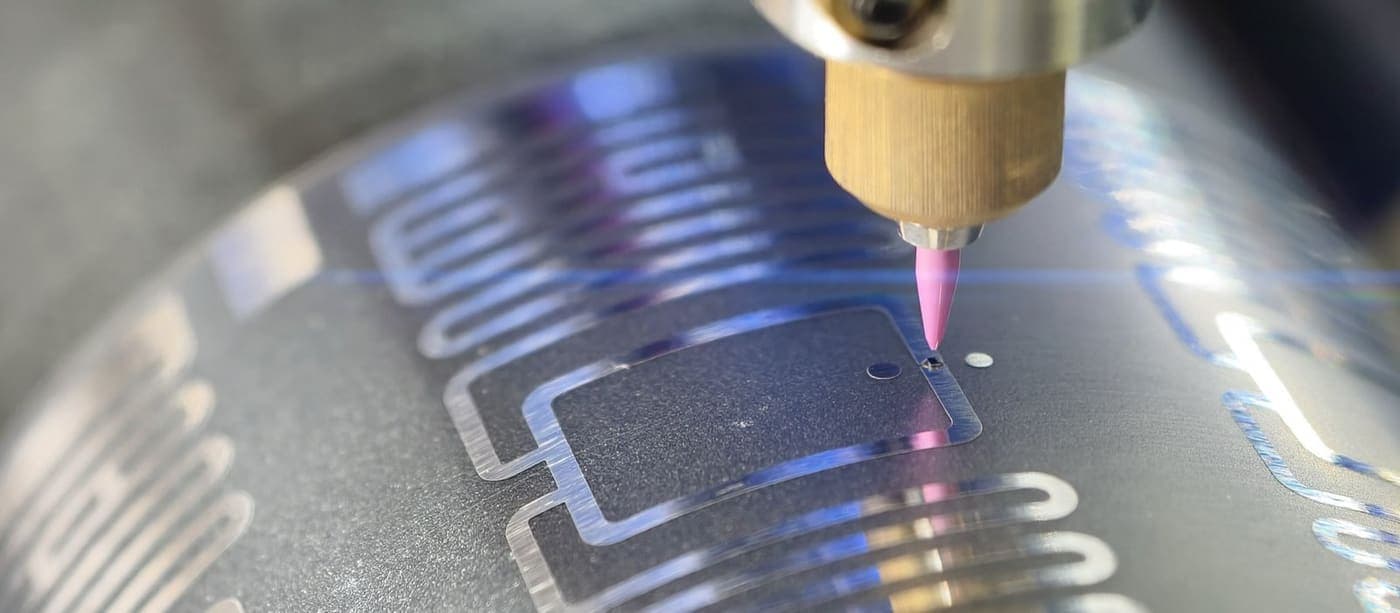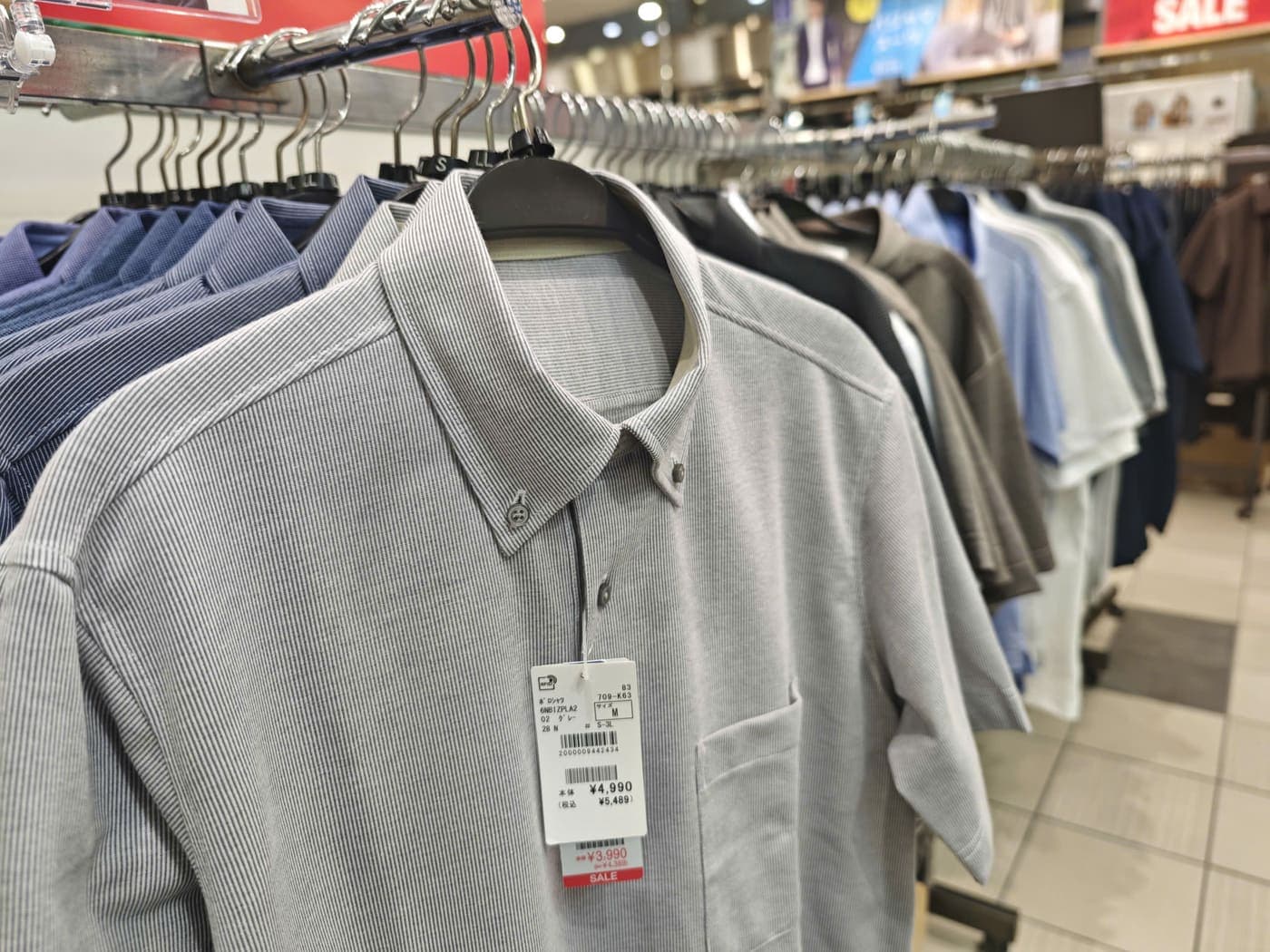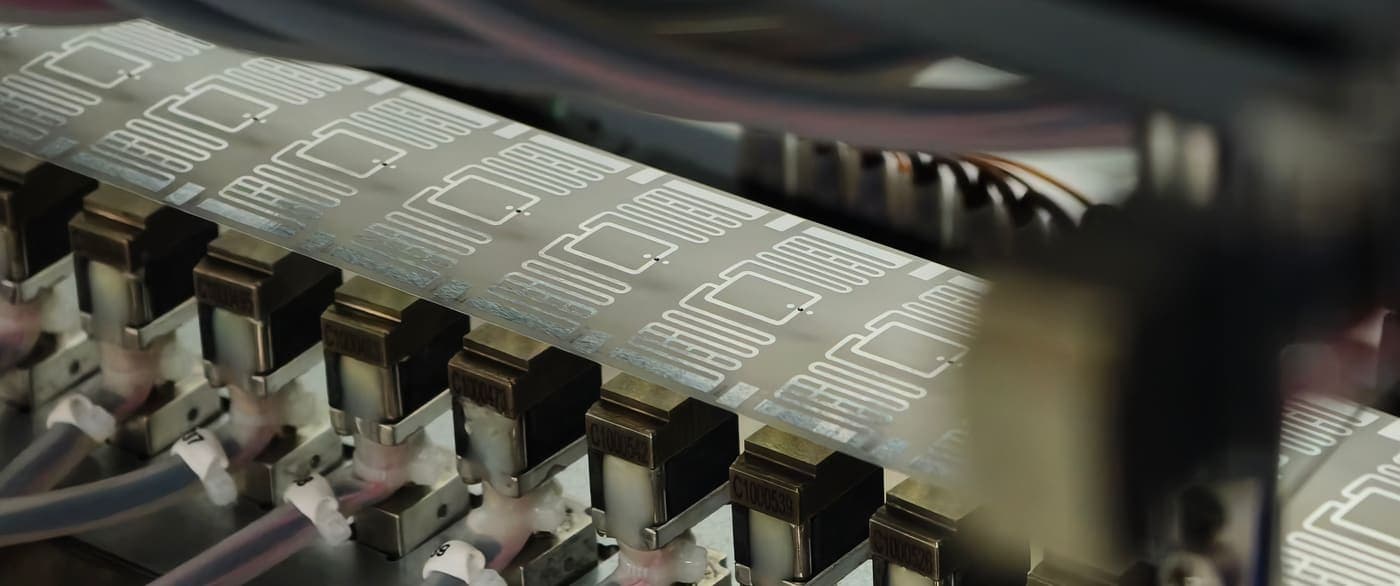
RFID in fashion means putting a UHF RFID tag (a hangtag, an adhesive label or a sewn-in label) on every item, so a scanner can read many tags in one pass along a rail, a shelf or a stack, instead of scanning barcodes one by one. Each tag carries its own EPC number. Once that number is linked to a product in the software, a store can count stock by style, size and colour. The scanner only records the tags it reads during the pass, so any gaps still need a person to check them. The most labour-heavy jobs for a clothing seller are stock counts, checking deliveries, finding the right size for a customer and checking orders before they ship. That is exactly where RFID speeds things up the most.
This article is written for fashion sellers and apparel businesses in Vietnam. It covers why fashion is the biggest user of RFID, what the big brands have done, how RFID helps in stores, online-seller stockrooms, fabric warehouses and garment factories, where to put the tag on a product, what it costs a shop in Vietnam, and what RFID cannot do.
The 30-second summary
- Fashion suits RFID for three reasons: one style comes in many sizes and colours, so the number of SKUs is large; fabric and paper do not block UHF signals; and a tag is cheap compared with the price of the garment.
- The biggest speed-up is the stock count. Nextwaves’ benchmark for its kit: one person counts about 3,000 items in 15 minutes. Counting the same stock by hand usually takes 2–3 people most of a day.
- According to the Auburn University RFID Lab (US), average inventory accuracy at the US retailers it studied was only about 60%, rising to over 95% with RFID.
- Uniqlo, Zara and Decathlon have put RFID on almost all of their products.
- A shop in Vietnam can start with one kit: a desktop reader and a handheld scanner, with tags and inventory software. Sales stay in KiotViet, Sapo or Haravan, as they are today.
Why is fashion the biggest user of RFID?
Apparel retail is where UHF RFID was adopted earliest and most widely. According to ABI Research, apparel retail accounted for 77% of all UHF RFID tags shipped worldwide in 2024. The reason is not the technology itself but the nature of fashion goods.
One style becomes dozens of SKUs
A T-shirt in 5 sizes and 4 colours is already 20 different SKUs (variants). Every season brings dozens or hundreds of new styles, so even a mid-sized shop has a few thousand variants. Counting the total number of shirts is easy; counting each size and each colour correctly is the hard part. In a manual count, staff have to turn every item over to find the label, read the size and colour and write it down. Barcodes make reading faster, but each item still has to be scanned on its own. RFID reads every item’s own number in one pass, and the software groups them by style, size and colour. In a 2009 trial at Bloomingdale’s in the US, barcode scanning managed about 209 items an hour, while RFID managed about 4,767 items an hour.
Fabric, paper and plastic do not block UHF
UHF RFID can read tags through fabric, paper, plastic bags and cardboard boxes. That is why a scanner can read the tags on folded shirts in bags, stacked trousers on a shelf or shoe boxes in a carton without opening them. It is the main reason RFID works far better on clothing than on metal goods or liquids. Even so, where the tag sits and how the goods are stacked still affect whether every tag gets read.
A tag is cheap compared with the garment
UHF RFID labels made in Vietnam start at around 700 VND each, depending on the type and quantity. On a shirt that sells for a few hundred thousand dong, the tag is a tiny share of the price. For cheap, high-volume goods such as socks or underwear at a few tens of thousands of dong, the cost of the tag and the labour to attach it needs a closer look.
Stock in the software often differs from stock on the shelf
The sales software deducts stock every time something sells. But it does not know when a delivery arrives short, a wrong size is shipped, an item is returned, stolen or put in the wrong place. The Auburn University RFID Lab worked with many large US retailers and found average inventory accuracy of only about 60%. Auburn measures accuracy by SKU, so this means roughly 4 out of every 10 SKUs had a system count that differed from the real count. In RFID trials and early rollouts, the figure rose to over 95%. Macy’s has said that without regular recounts, inventory accuracy falls by about 2–3% a month. With frequent RFID counts, it kept accuracy at 97% or better.
Project Zipper, run by Auburn and GS1 US (2017–2018, more than 1 million items, 5 retailers, 8 brands), looked at goods received from brands at retailers. When advance shipping notices were checked with barcode (UPC) data from the old systems, 69% of orders were recorded as not matching. When they were checked with RFID data, the rate was under 0.01% of orders.
Selling on many channels needs accurate stock
Fashion shops in Vietnam often sell in the store, on a website, on Shopee, on TikTok Shop and through livestreams at the same time. With wrong stock figures, a shop either sells items it no longer has and has to cancel orders, or leaves goods sitting in the stockroom because it does not dare to list them. Fast stock counts let a shop recount more often, for example after every big sale instead of once a quarter.
How do the big fashion brands use RFID?
RFID in fashion is no longer an experiment. The brands below have described their use of RFID in annual reports or on their official websites.
| Brand | Started | Published scale |
|---|---|---|
| Uniqlo (Fast Retailing) | Fall/Winter 2017 range | Tags every product with RFID at the point of manufacture. By the end of May 2018, every Uniqlo store had readers. |
| Zara (Inditex) | 2014 | Zara completed RFID in all its markets in 2017. According to Inditex, stock management became 80% faster as a result. By 2020, every brand in the group used RFID with one shared inventory system. |
| Decathlon | 2008, in France | Since 2019, 100% of products are tagged at the factory. By 2024 it had about 50,000 readers in operation. |
| Walmart | Around 2020, apparel | Required suppliers to put RFID on every apparel item, then extended the requirement to many other categories from 2022. |
What these brands have in common is that they started with inventory: knowing exactly which item is where, counting stock fast and receiving goods correctly. Decathlon also published its difficulties: tags read poorly close to water or metal, so it had to change packaging and some product designs, for example dropping aluminium packaging.
In Vietnam, IVY moda says every one of its products has had an RFID chip since 2018, tracked from its factory in Hưng Yên to its stores. Overall, though, RFID in Vietnam’s fashion industry is still at an early stage: a 2022 study by RMIT University found adoption was in its infancy and cost was the biggest barrier.
A shop in Vietnam does not need to work at the scale of the big brands. It is the same technology and the same GS1 EPC UHF Gen2 tag standard, but you can start with one handheld scanner, one desktop reader and a few thousand tags. If you are new to RFID, our article What is RFID? explains how it works, the frequencies and the tag standards from the ground up.
How does RFID help a fashion shop? 4 jobs in the store and stockroom
A fashion shop uses RFID for four main jobs. All of them rest on the same thing: every item has its own EPC number, and the software knows which style, size and colour that number belongs to.

Stock counts: sweep the whole rail instead of turning over each item
In a manual count, staff take each item down, find the label, read the size and colour, count and write it down. With RFID, staff choose the area to count in the software, then walk the handheld scanner along the rails, the shelves and the back room. The scanner reads the tags on the items within range, including shirts folded in bags and stacked trousers. Nextwaves’ benchmark for the kit is about 15 minutes for 3,000 items, one person. Real times depend on how the goods are arranged and how many there are.
After the scan, the software compares the numbers it read with the stock in the system and sorts them into: missing items (the system thinks they are there but they were not scanned), extra items (scanned but not on the list) and tags not yet linked to a product. An item reported as missing is not necessarily lost: its tag may be covered or out of range. The result does not change stock on its own. Someone with the right permission reviews the list of differences, rescans the doubtful spots and only then confirms.
Because counting is fast, a shop can count more often: every week, after every sale, or before listing a new collection on a marketplace.

Receiving: put a whole stack on the desktop reader
When goods arrive from the workshop or a supplier, staff put each stack on the desktop reader instead of scanning barcodes one by one. The software shows the count by style, size and colour, so the shop can check the delivery is complete as it arrives, instead of counting by hand and only later finding out it was short or the wrong sizes were sent. A tip: put only the group you are receiving on the reader and keep everything else away, because the reader also picks up tags lying right next to it.
Finding items: track down the right size and colour
When a customer asks for a size, staff select that item in the software and sweep the handheld around the shelves or the back room to locate it. This helps most in shops with a cramped back room, stacked goods and many near-identical styles.
Shipping, transfers and returns
When goods leave the stockroom for a customer, another store or back to a supplier, the software records exactly which items left, by each item’s EPC number. Transfers between stores: put the whole stack on the desktop reader and check it is complete before it goes. For online sellers, when the marketplace sends an order, the shipping label is printed as usual, then the goods go on the desktop reader to be shipped out of stock: the whole stack is read at once, with the right code, size and quantity. Returns from the marketplace also go on the reader to be put back into stock, without hunting for labels or typing codes. Order handling stays in the marketplace and the sales software; RFID only records goods going in and out of the stockroom.

RFID for each type of fashion business
It is all fashion, but a shop with a store, an online seller, a fabric warehouse and a garment factory count goods in different places and put tags in different places. The table below sums up each case.
| Your business | The most labour-heavy job | Where the tag goes | Suggested kit |
|---|---|---|---|
| Clothing shop or store chain | Stock counts, finding sizes for customers, transfers between stores | Hangtag or adhesive label | Retail Starter Kit |
| Online seller on Shopee, TikTok Shop | Recounting stock after every sale or livestream; shipping; returns | Label on the bag or box | Retail Starter Kit |
| Footwear and bags | Counting box by box, pair by pair, size by size | Label on the box, hangtag | Retail Starter Kit |
| Fabric and trims warehouse | Checking the right code, colour, lot and number of rolls | Label on the roll | Retail Starter Kit |
| Bedding and mattress stockroom | Unstacking goods to count them one by one | Label on the packaging | Retail Starter Kit |
| Garment factory, exporter | Counting finished goods, tagging to an overseas customer’s requirements | Inlay inside the label, hangtag | RFID inlays made in Vietnam |
Clothing shops and store chains
In a store, RFID is used most for stock counts and finding items. Chains with several stores also use it for transfers: checking the goods are complete when they leave and when they arrive. THE C.I.U, a womenswear brand with 6 stores in Ho Chi Minh City, uses RFID to keep stock in sync between its stores and its online channel. Push Push, a womenswear brand selling in store and online, uses it for store stock-takes and for checking online orders before packing.
Online sellers on Shopee and TikTok Shop
Online sellers without a store can use it too: the kit works wherever the goods are, in a rented stockroom or at home. Goods are usually bagged, so the tag goes on the outside of the bag. The biggest gain is recounting stock after every sale or livestream, when the marketplace figure and the stockroom figure drift apart the most.
Footwear and bags
Each shoe style comes in many sizes, one box per size, so a manual count means reading the label on every box. A tag on the outside of the box lets you scan a whole shelf of boxes in one pass. Bags and wallets have metal clasps and eyelets, so put the tag away from the metal parts and test-read before tagging a whole batch.
Fabric and trims warehouses
Fabric rolls are heavy and stacked high, so counting by hand often means moving them. UHF can read tags through fabric and plastic wrap, so staff can scan along the aisle without moving each roll. Rolls buried deep in a stack, or labels in awkward spots, may need a second pass. Nextwaves’ benchmark for fabric warehouses is about 3,000 rolls in 20 minutes, one person. Note: RFID identifies each roll; the metre count is the figure recorded at receiving. RFID cannot measure how many metres are left.

RFID in apparel manufacturing: garment factories and exporters
Tagging at the factory is the cheapest option, because each item passes through a worker’s hands exactly once. NINUNAPZ, a kidswear and womenswear brand in Huế, tags its products at the workshop and then counts stock with a handheld scanner. Malbon Golf Vietnam tags every piece, then keeps stock in sync between its warehouse and stores.
For export garment factories, overseas customers such as large retail chains may require RFID tags to their own specification, applied on the production line. The EU Digital Product Passport will be rolled out product group by product group, and textiles are among the priority groups. It does not require RFID, but RFID is one of the ways to attach a traceability ID to a product. See the guide to the Digital Product Passport.

Where do you put the RFID tag on clothing, shoes and bags?
Fashion RFID tags come in three main forms. Inside each one is a UHF inlay (a chip and antenna on a thin film). Only the outer layer and the way it is attached differ.
| Tag type | Where it goes | Best for | Notes |
|---|---|---|---|
| RFID hangtag | Hung with a string or pin, like a normal price tag | Clothing sold in stores, goods with a branded price tag | The customer cuts it off after buying. The face can carry the logo, price, barcode and QR code |
| Woven or sewn-in RFID label | Sewn into a seam like a size or brand label | Goods where the tag must stay on the product, applied at the factory | Has to be ordered before sewing. Not every label survives washing |
| Adhesive RFID label | Stuck on a bag, a box, an existing price tag or a secondary label | Bagged goods sold online, shoe boxes, stock already in the stockroom | Stick it on a flat spot, unfolded, and never stack two labels |

Nextwaves supplies RFID hangtags in the standard apparel sizes of 75 × 50 mm and 87 × 41 mm, printable in colour, with variable data printing and pre-encoding, as well as woven RFID labels. The label in the kit for fashion sellers is a 45 × 20 mm adhesive label, small enough to stick on a price tag or a secondary label.

Five rules for tags that read reliably
- One tag per item, one number per tag. With barcodes, all items of the same size and colour share one code. With RFID, every item needs its own EPC number, or the software cannot count each piece correctly.
- Keep away from metal. Zips, metal buttons, studs, shoe eyelets, bag clasps, bra underwires, metal hanger clips and foil packaging weaken the signal. Stick or hang the tag on fabric or paper, away from the metal parts.
- Use a flat spot that will not fold. An antenna that is folded in half or creased reads worse. Never staple through the inlay of the tag.
- Same position for the same type of goods. For example, always hang the tag at the left side of the collar. Staff know where to scan, and the tags on items hanging next to each other do not sit on top of one another.
- Test-read before tagging a whole batch. Put a few tags on a few typical items, especially ones with metal or thick fabric, and read them with the same reader you will use.
Rolling out RFID in a fashion shop: 5 steps
Fashion shops usually trip up in two places: tagging before the product data is clean, and tagging old stock but forgetting to make tagging part of receiving. The five steps below go in the order that avoids both mistakes.
- Clean up the product list. Every combination of style, size and colour you want to track separately must be its own variant. A black shirt in size M and a black shirt in size L are two variants. An existing product list can be imported into the software from an Excel file, with no retyping.
- Tag the stock you already have. Select the right variant in the software, then put the tagged items on the desktop reader to link their tags to that variant. Work in small groups, one variant at a time, so sizes do not get mixed up.
- Make tagging part of receiving. From then on, new goods are tagged and received into stock at the same time. If you make your own garments or order from a workshop, tagging at the workshop is cheapest.
- Do a first count and compare it with a hand count. Pick one shelf or one area, scan it with the handheld, then count the same area by hand. When the two figures match, staff will trust the RFID count.
- Keep the sales software you use today. Sales, invoices and customers stay in KiotViet, Sapo or Haravan. Sense Inventory syncs stock with these systems, so there is no change to how you sell and no retraining for sales staff.
If you have a lot of old stock, you do not need to tag it all in one day. Start with one area or the product group that drifts most often, then expand. Just remember: an RFID count only counts tagged items, so set the count to cover exactly the area or product group you have tagged.
How much does RFID cost a fashion shop?
RFID costs come in four parts: readers are a one-off purchase, software depends on the vendor, and tags and tagging labour scale with the number of items you need to tag.
| Item | How you pay | Notes |
|---|---|---|
| Readers: handheld scanner, desktop reader | One-off | Handheld for stock counts and finding items. Desktop for linking tags, receiving and shipping. |
| Inventory software | Depends on the vendor | Some charge monthly, some include it with the hardware. |
| RFID tags | Per new item | UHF RFID labels made in Vietnam start at around 700 VND each, depending on type and quantity. Branded hangtags and woven labels cost more than plain labels. |
| Tagging labour | Per item | Cheapest at the factory or at receiving, most expensive when tagging stock that is already on the shelves. |
A quick way to estimate: take the labour cost of one stock count (people × hours × hourly wage) and multiply it by the number of counts a year, then add the value of lost goods and of sales missed because you did not know an item was in stock, if you can measure them. Do not treat guesses as guaranteed savings. On the cost side, add the readers, the tags and the tagging labour for both the stock you have now and the new stock arriving during the year. For example, a shop that receives 1,000 items a month needs about 12,000 tags a year; at 890 VND per tag that is about 10.7 million VND in tags, before tagging labour.
The sums usually favour RFID when there is a lot of stock, in many sizes and colours, counted often. With a few hundred items counted once a quarter, barcodes may still be cheaper.
The Nextwaves kit for fashion sellers
The Retail Starter Kit costs $999 and contains a desktop reader, a handheld scanner, 2,500 printed and encoded RFID tags and the Sense Inventory inventory software, free with the kit. The software covers the core stock tasks: linking tags to products, receiving, shipping, stock counts and finding items with RFID, and viewing stock on a computer or phone. It is inventory software, not a point-of-sale system, so sales stay in the system you already use. Staff training at handover is included. Once the 2,500 included tags are used up, new stock needs more tags.

The price above is the list price on nextwaves.com at the time of writing.
What can’t RFID do in fashion?
RFID is very good at counting and finding, but it has limits. Knowing them in advance avoids false expectations.
- Items without a tag cannot be counted. Tags that fall off or get cut off, and new goods not yet tagged, will not appear in the count. That is why tagging has to be a mandatory step in receiving.
- Metal and liquids weaken the signal. Metal accessories, bag clasps and belts with metal buckles need a careful tag position and a test read. If the shop also sells perfume or cosmetics, test those items separately too.
- The reader may also read items nearby. UHF signals do not stop exactly at the edge of a shelf. When receiving on the desktop reader, keep other items away. When counting, set a clear count area and follow a fixed scanning route.
- RFID does not fix stock on its own. A count produces a list of differences. A missing item may have been stolen, misplaced, or may simply have a covered tag. Someone with the right permission still has to review it, rescan the doubtful spots and then confirm.
- RFID does not replace the sales software. The kit is for the stockroom: linking tags, receiving, shipping, counting and finding items. Sales, invoices and customers stay in the software you already use.
- A stock count is not theft prevention. A count tells you which items are missing after each count; it does not raise an alarm when goods leave through the door. Exit theft prevention is separate equipment.
Frequently asked questions about RFID in fashion
What is RFID used for in fashion?
Mainly for inventory: fast stock counts, receiving and shipping whole stacks at once, finding the right size and colour in the stockroom, and checking transfers between stores. Every item carries a tag with its own number, so the software knows exactly which items are there and which are missing.
How much faster is an RFID stock count than counting by hand?
Nextwaves’ benchmark for its kit is about 15 minutes for 3,000 items, one person. Counting the same stock by hand usually takes 2–3 people most of a day. Real times depend on the quantity and how the goods are arranged.
How much does an RFID tag for clothing cost?
UHF RFID labels made in Vietnam start at around 700 VND each, depending on type and quantity. Tags for the Nextwaves kit cost 890 VND each on a 2,500-tag order. Branded hangtags and woven labels are priced differently, depending on the material and order size.
Should a small shop use RFID?
Do the sums first. RFID pays off most when there is a lot of stock, in many sizes and colours, counted often, or sold on several channels at once. With a few hundred items counted once a quarter, barcodes may still be cheaper.
I only sell online, without a store. Can I use it?
Yes. The kit works wherever the goods are, in a rented stockroom or at home.
Do I have to stop using KiotViet, Sapo or Haravan?
No. Sense Inventory syncs stock with Sapo, Haravan and KiotViet, so you keep your current sales software. An existing product list can be imported from an Excel file, with no retyping.
Do I have to drop barcodes when I use RFID?
No. Barcodes stay on the price tag, and the sales software keeps scanning them as it does now. RFID is added for the stockroom jobs: every item has its own EPC number for stock counts and for receiving and shipping whole stacks.
Can an RFID tag on clothing track the buyer?
According to GS1, in most cases a UHF RFID tag holds only a product number, not information about the buyer. A passive tag has no battery and only answers when it is within range of a reader. The number on the tag can still be read again, so if it is linked to buyer information in another system, there is a privacy risk. That is why GS1 recommends telling customers that a product carries an RFID tag, using the EPC symbol, and giving them the choice to remove or disable it. Hangtags are usually cut off after purchase.
Can RFID tags be washed?
Paper hangtags and adhesive labels do not survive washing; they are cut off or sit on the packaging. If the tag has to stay with the item through many washes, as with uniforms or hotel linen, you need a dedicated RFID laundry tag.
If the scanner does not find an item, does that mean it is lost?
Not necessarily. The tag may be covered, sitting against metal, out of range, or have fallen off the item. Items reported as missing should be rescanned in the doubtful spots and checked by eye before the stock adjustment is confirmed.
Can RFID read goods inside plastic bags and cardboard boxes?
Yes. UHF signals pass through plastic bags, paper, cardboard and fabric. What you need to avoid is metal or liquid right next to the tag.
Can staff who are not good with technology use it?
Yes. With the Nextwaves kit, the devices are set up before handover, and the daily work is just scanning and reading the numbers. The price includes staff training at handover, documentation and video guides. After that, Nextwaves still supports you by phone and chat.
What do Uniqlo and Zara use RFID for?
Uniqlo tags every product with RFID at the point of manufacture, and every Uniqlo store has had readers since 2018. Zara completed RFID in all its markets in 2017, and according to Inditex, stock management became 80% faster. Both started from the same goal: knowing exactly which item is where, in the stockroom or on the shelf.
References
Sources for the figures and company information cited in this article (accessed October 2026).
Research and market data
- B. Hardgrave, J. Cromhout, Key Considerations for RFID Pilots and Deployments, Auburn University RFID Lab, 2014. auburn.edu
- Auburn University RFID Lab and GS1 US, Project Zipper, 2018 (summary on Supply Chain Dive). supplychaindive.com
- University of Arkansas RFID Research Center, Item-Level RFID for Apparel: The Bloomingdale's RFID Initiative, 2009. auburn.edu
- Modern Materials Handling, RFID the Macy's way, 2013. mmh.com
- ABI Research, 52.9 billion UHF RFID endpoint ICs shipped, 2025. abiresearch.com
- RMIT University, Sustainability benefits of RFID technology in Vietnamese fashion supply chain, Cleaner Logistics and Supply Chain, 2022. rmit.edu.au
Companies
- Fast Retailing, FY2018 third-quarter results, 12 July 2018. fastretailing.com
- Fast Retailing, investor briefing, 11 October 2018. fastretailing.com
- Inditex, Annual Report 2017. inditex.com
- Inditex, Full Year Results 2020. inditex.com
- Decathlon, Product traceability and RFID technology at Decathlon. decathlon.com
- RFID Journal, Walmart Re-commits to RFID With Supplier Mandates, 2022. rfidjournal.com
- CafeF, interview with IVY moda CEO Nguyễn Lê Vũ Linh, 26 November 2024 (in Vietnamese). cafef.vn
Tagging guides, privacy and regulation
- GS1, EPC/RFID Guidelines (consumer privacy guidelines). gs1.org
- GS1, What about consumer privacy concerns in RAIN RFID tags?, 2024. gs1.org
- Academy Sports + Outdoors, Private Brand RFID Playbook v1.2, 2025. academy.com
- Checkpoint Systems, RFID General Merchandise Placement Guide, 2023. checkpointsystems.com
- European Union, Regulation (EU) 2024/1781 on ecodesign for sustainable products (ESPR), 2024. eur-lex.europa.eu