
Navigating the EU Digital Product Passport (DPP)
A Sector-Specific Guide to Compliance and the Power of RFID. Prepare for the EU Ecodesign for Sustainable Products Regulation (ESPR) with Nextwaves' end-to-end data carriers and connectivity solutions.


Strategic Foundation: The ESPR Legal Framework
Understanding the regulatory landscape driving DPP adoption
Legal Foundation
The Ecodesign for Sustainable Products Regulation (ESPR) establishes the legal framework for Digital Product Passports across the EU. This regulation mandates standardized digital records for product lifecycle data, creating a unified approach to sustainability reporting.
Zero Market Access
Products without compliant Digital Product Passports will be blocked from EU market access starting 2026-2027. Non-compliance means zero market access for affected product categories.
Cradle-to-Cradle Transparency
DPP enables full product lifecycle transparency from raw material extraction through manufacturing, use, and end-of-life recycling. This cradle-to-cradle approach supports circular economy objectives.
What is DPP?
At its core, the Digital Product Passport is a standardized collection of data points including material composition, manufacturing origin, and environmental metrics such as carbon and water footprints. It also provides essential instructions for repair, reuse, and recycling. The purpose of this system is to foster accountability and transparency throughout the supply chain. For consumers, it offers a way to verify sustainability claims and avoid products associated with greenwashing. For recyclers, it provides the technical data necessary to handle materials safely and efficiently at the end of their useful life.
Industry-Specific Deadlines (2025-2030)
Batteries: The First Mover
Mandatory for EV and industrial batteries over 2kWh capacity by February 2027.
- Battery Chemistry and Composition tracking
- State of Health (SoH) metrics and degradation monitoring
- Recycled content percentage declaration
- Carbon Footprint declaration per PEFCR methodology
- Safety requirements and extinguishing instructions
Why RFID for DPP Compliance
Bulk Data Capture
Scan 500+ items on a pallet in seconds without line-of-sight. RFID enables automated inventory verification at warehouse dock doors and retail receiving areas.
Seamless Automation
Integrate DPP checks into warehouse conveyor systems and retail point-of-sale. Automated verification eliminates manual scanning bottlenecks.
Lifecycle Durability
RFID woven labels survive the entire product lifecycle including harsh washing cycles and recycling processes. Data remains accessible from manufacturing to end-of-life.
Anti-Counterfeiting Security
UID encryption ensures the digital twin matches the physical product. Cryptographic authentication prevents cloning and verifies product authenticity.
Technical Architecture
Implementation will occur in stages, with the first mandatory requirements expected to take effect between 2026 and 2027. Initial focus will be placed on high-impact categories such as batteries, textiles, and electronics. Operationally, the system functions through a physical carrier attached to the product. Technologies like QR codes or RFID tags act as the link to a decentralized digital registry, ensuring data follows the item from the factory floor to the recycling center.
Data Carriers Comparison
| Feature | Interaction | Cost | Durability | Bulk Reading |
|---|---|---|---|---|
| UHF RFID | Long Range / Automated | Low (~$0.05-0.10) | High (Embeddable) | |
| QR Code / Data Matrix | Camera Scan / Line-of-sight | Very Low (Printing) | Low (Surface only) | |
| NFC | Tap / Consumer | Medium (~$0.15+) | High |
Physical Layer
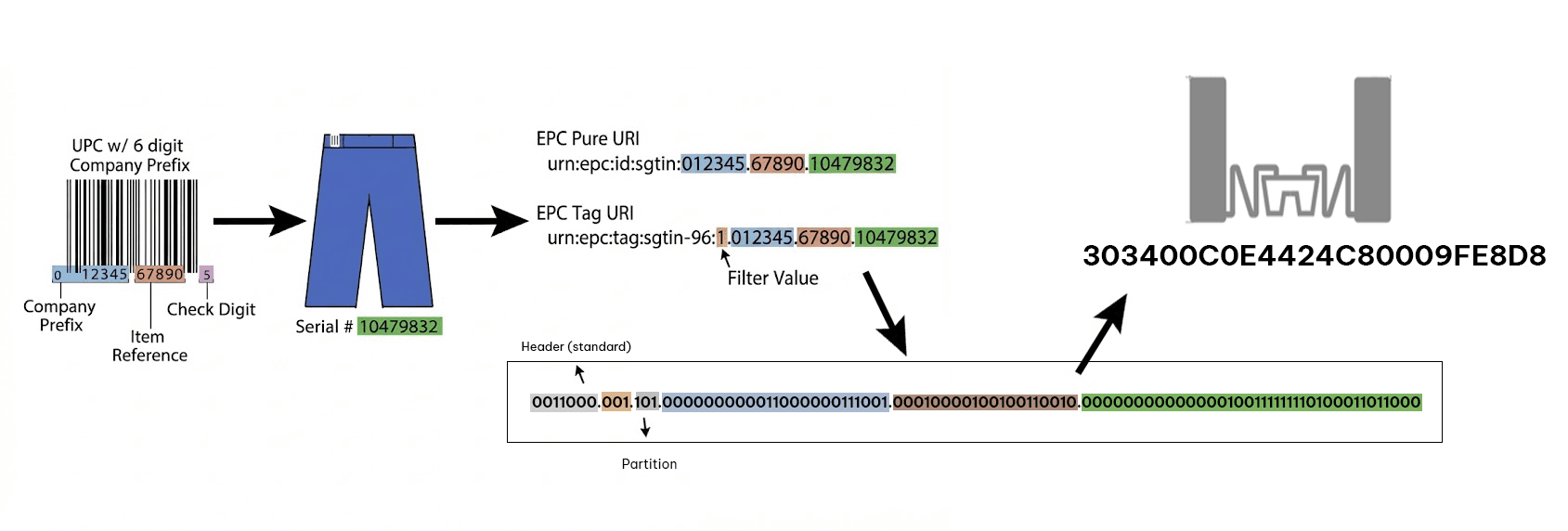
The Unique ID (UID) attached to the product via RFID inlay, QR code, or NFC tag.
Data Layer
Decentralized or centralized cloud storage following GS1 Digital Link standards. Ensures data persists even if the manufacturer disappears.
Access Layer
Role-based access control (RBAC). Consumers see repair guides; Recyclers see chemical breakdowns; Customs see compliance docs.
Three-Phase Implementation Plan
Phase 1: Readiness & Assessment
Prepare for the entry into force of the Ecodesign for Sustainable Products Regulation (ESPR).
- Conduct comprehensive supply chain audit to identify data gaps against ESPR requirements
- Map existing product data to the new DPP technical standards (part of ESPR delegated acts)
- Evaluate data carrier technology (RFID fully supports bulk scanning vs QR)
- Launch pilot program for high-priority product lines
Phase 2: Integration & Infrastructure
Deploy legislative-compliant infrastructure ahead of the first Delegated Acts.
- Integrate ERP systems with authentic DPP registries using standard APIs
- Install RFID hardware at manufacturing and logistics points for automated data capture
- Deploy middleware to filter and format data for the Digital Product Passport
- Train workforce on new compliance processes and hardware usage
Phase 3: Mandatory Compliance
Full compliance required for first product groups under EU law.
- Full-scale mandatory rollout for Batteries (Regulations apply from Feb 2027)
- Deployment for Textiles & Apparel (Pending final Delegated Acts adoption)
- Establish continuous monitoring for real-time carbon footprint reporting
- Scale system to additional product categories as new Delegated Acts are released
Nextwaves Industries: Your DPP Partner
Pioneering 'Make in Vietnam' RFID technology with full-stack R&D, design, and high-precision manufacturing capabilities.
Request ConsultationFull Stack R&D
Complete in-house research and development from antenna design to chip integration. We manage the entire RFID technology stack.
RFID Woven Labels
Specially designed for textile industry DPP requirements. Our woven labels survive washing cycles and maintain readability throughout the product lifecycle.
Readers and Antennas
99.9% read accuracy in complex logistics environments. Our readers and antennas are optimized for high-volume DPP verification.
Scalability
Help global brands transition from barcodes to automated DPP ecosystems. We support the full journey from pilot to enterprise-scale deployment.
Ready to Prepare for DPP Compliance?
Contact Nextwaves Industries for a comprehensive RFID audit and prepare your supply chain for the 2027 EU mandates.
Frequently Asked Questions
- The DPP is a centerpiece of the Ecodesign for Sustainable Products Regulation (ESPR), which entered into force in July 2024. The ESPR is a framework regulation that provides the 'skeleton', while 'muscles' (specific requirements) are added through Delegated Acts.
- The Battery Regulation (EU 2023/1542) is the 'pilot' for the DPP. It mandates that from February 2027, every industrial and EV battery above 2 kWh must have a unique Battery Passport.
- The European Commission is developing a Central Information Registry. It stores Unique Identifiers (UIDs), not the actual product data (which stays with the company). It redirects scans to the correct data source.
- The DPP must track chemicals that hinder circularity. Companies must disclose the presence, location, and concentration of hazardous substances to ensure safe handling during recycling.
- The regulation acknowledges Trade Secrets. Data is categorized into Public (consumers), Restricted (repairers), and Confidential (authorities). Not everyone sees everything.
- The DPP is decentralized. Data is hosted by the manufacturer but accessible through a standardized web entry point so different systems can communicate.
- The ESPR is technology-neutral but favors QR Codes (consumer scanning), RFID/NFC (industrial logistics), and Digital Watermarking (high-speed sorting).
- Identifiers must follow ISO/IEC 15459 (unique ID) and ISO/IEC 19987 (EPCIS) for tracking product history.
- It depends on the product: Model Level (same for all units), Batch Level (production run), or Item Level (unique ID for every unit, mandatory for batteries).
- Using Verifiable Credentials and decentralized identifiers. While blockchain isn't mandated, it ensures records like carbon footprints cannot be retroactively altered.
- Standardized fields for each category. For textiles: Fiber composition, Microplastics presence, Manufacturer location, and Recycled content.
- Manufacturers must use Data Exchange Protocols to request data from Tier 2/3 suppliers. Missing supplier data can make the final product non-compliant.
- Calculations must use the Product Environmental Footprint (PEF) method, a strict EU methodology to ensure comparable 'CO2 neutral' claims.
- It includes instructions on disassembly sequences, spare part compatibility, and tools required for repair.
- The entity placing the product on the market (Brand/Importer) is legally liable for data accuracy, even if the error comes from a supplier.
- Conduct a Gap Analysis. Identify what data exists in your ERP vs. what is missing from your supply chain.
- Costs include one-time (software integration, printers) and recurring (data hosting, audits, supply chain data fees).
- National bodies (e.g., Customs) that use digital scanners to verify the DPP link is active and matches the physical product.
- The EU Single Window Environment for Customs will automatically check the UID. Missing UIDs will block shipments at the border.
- A Digital Twin focused on the 'birth-to-rebirth' lifecycle of materials, rather than just performance metrics.
- By verifying authenticity and repair history, companies can launch Buy-back programs and boost resale value in second-hand markets.
- Using GS1 Digital Link allows one code to serve multiple users: consumers see marketing, repairers see manuals, recyclers see material breakdowns.
- Data must persist for the product's lifespan (10-20 years). Bankrupt companies must have a backup plan or decentralized storage.
- It enables independent repair shops by providing the same technical schematics and parts lists as authorized dealers.
- Before activation, high-risk products may require third-party verification to confirm recycled content or carbon claims.
- By tracking composition, the EU ensures hazardous materials are processed in authorized facilities rather than being dumped abroad.
- Static: Manufacturing date, materials. Dynamic: Repair history, ownership, battery health.
- Carriers must be durable (wash-proof for textiles). Manufacturers must provide a backup retrieval method (e.g., serial number).
- Released in waves: Wave 1 (Batteries, Textiles, Steel), Wave 2 (Furniture, Tires), Wave 3 (Electronics).
- The DPP digitizes the Life Cycle Assessment, turning 50-page PDF reports into machine-readable fields.