From 16 October 2026, Decree 390/2026/ND-CP takes the production, processing and trading of gold jewellery and fine-art gold out of Vietnam's list of conditional business lines. Gold shops still have duties on invoices, documents, product labels, measurement and tax. At the same time, the non-cash payment threshold falls from 20 million VND to 5 million VND a day per customer.
In short, there are fewer conditions for entering the trade, while the goods on display, the paperwork behind them and the money still have to follow the rules. This article sums up what has changed, what a shop should review, and where technology helps and where it does not.
30-second summary
- Gold jewellery and fine-art gold are no longer a conditional business line. Gold bars still need a licence.
- Buying or selling gold worth 5 million VND or more in a day, per customer, must be paid by non-cash means.
- Invoices, documents, product labels, price display and tax remain the shop's job.
- RFID makes stock counts faster and easier to repeat, but it does not prove where gold came from and does not replace invoices.
What does Decree 390/2026 change for gold shops?
Decree 390/2026/ND-CP amends Decree 24/2012/ND-CP on the management of gold trading and took effect on the day it was signed, 16 October 2026.
| Item | Before | From 16 October 2026 |
|---|---|---|
| Gold jewellery and fine-art gold | Conditional business line | No longer a conditional business line |
| Certificate of eligibility to produce gold jewellery | Issued by the State Bank of Vietnam | No longer a condition for production |
| Payment | From 20 million VND a day: through payment accounts | From 5 million VND a day per customer: by non-cash means such as bank transfer, card or e-wallet |
| Gold bars | State Bank licence required | Licence still required |
The 5 million VND clause refers to "buying and selling gold" in general, without separating bars from jewellery. According to the State Bank of Vietnam, the threshold is based on a customer's total for the day, not on each transaction. The transaction that brings the total to 5 million VND, and any after it that day, must be paid by non-cash means. Ask your accountant or the tax office how it applies to your shop.
Which duties do gold shops still have?
Removing business conditions does not remove oversight. The newspaper Dân trí describes the change as a move from checks before entry to checks afterwards, and organisations and individuals trading gold jewellery and fine-art gold must still follow the related laws. For a gold shop, that means:
- Invoices and documents: shops issue invoices where the rules require them, and keep suitable documents for incoming goods.
- Goods bought back from customers: when a company buys gold from an individual without an invoice, it needs to establish whether the transaction qualifies for a purchase list (form 02/TNDN) and keep proof of payment. Household businesses follow the document rules that apply to them.
- Labels, measurement and quality: the labels on goods on display, and the stated weight and gold content, must be correct.
- Price display: prices must be shown publicly.
- Tax: revenue must be recorded in full. From 2026, household businesses no longer use lump-sum tax, and whether a household files tax returns or a revenue notice depends on its revenue. Either way, small shops need clearer figures than before.
- Anti-money laundering, consumer protection and fire safety: current rules continue to apply.
In 2026, the Ho Chi Minh City market surveillance force published inspection cases that found gold jewellery lacking labels, invoices or documents, or of unclear origin. So three things need to go together: the piece in the case, its paperwork and the line in the book.
Five questions for shop owners
These questions are useful when the accountant closes the books, when inspectors call, and on ordinary days when an owner simply wants to know that everything in the case is there.
- How many pieces are in the cases today, and does that number match the book?
- Pick any piece from a tray: how long does it take to find its goods-in document?
- Are pieces out with the goldsmith or moved to another branch recorded?
- Have goods bought back from customers been recorded, with documents kept in the way that suits the shop's business type?
- When did the shop last count everything?
If question 1 or 5 is hard to answer, the first step is to count more regularly. In a gold shop, two rings of the same design can differ in weight, so counting by product code is not enough: the shop needs to know each piece. Each count also means going through tray after tray, piece by piece, so the more stock there is, the less often it gets done, and small differences build up.
How does RFID help keep stock and records aligned?
RFID identifies goods by radio. For a gold shop, the main benefit is counting fast enough to do it often while still knowing each piece. For a comparison with other counting methods, see What Is a Smart Stock Count?
One code for each piece
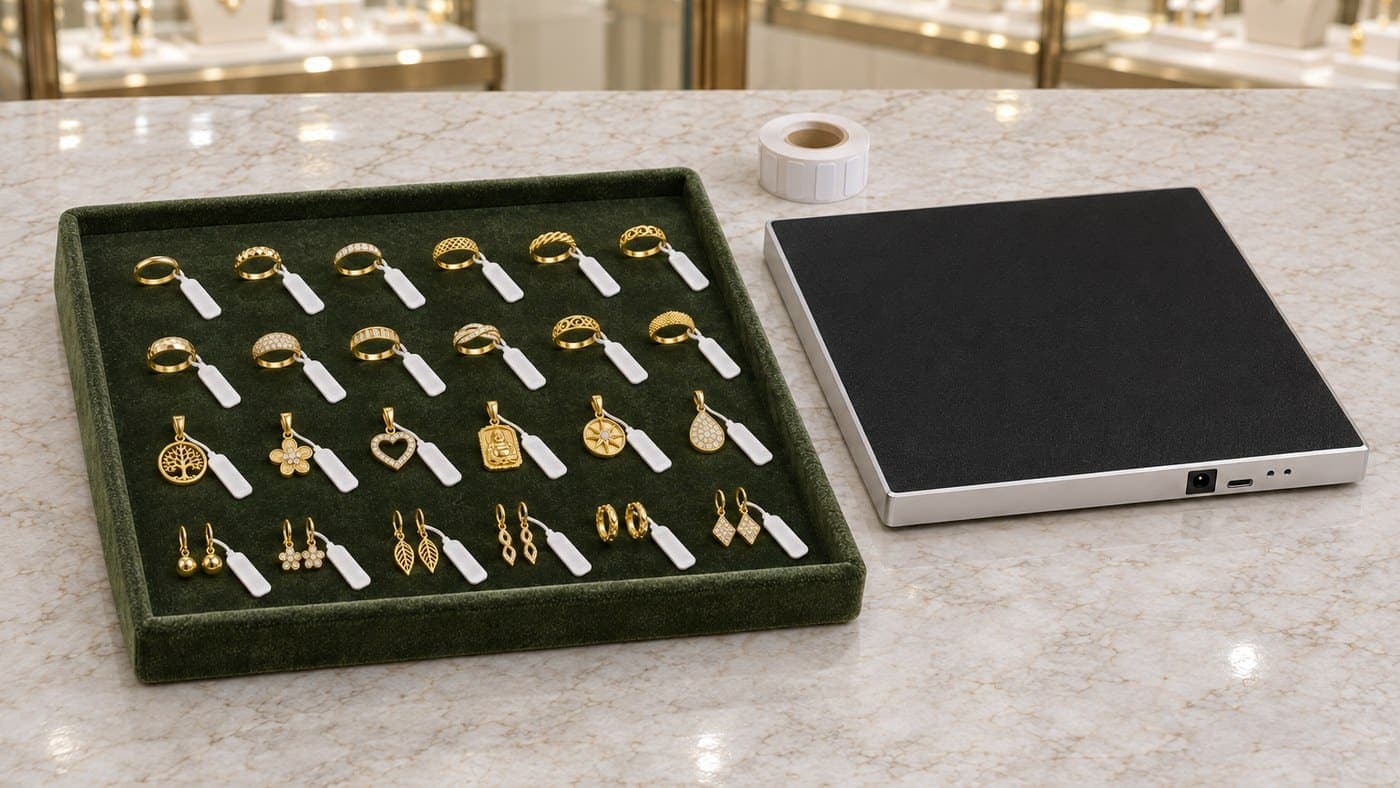
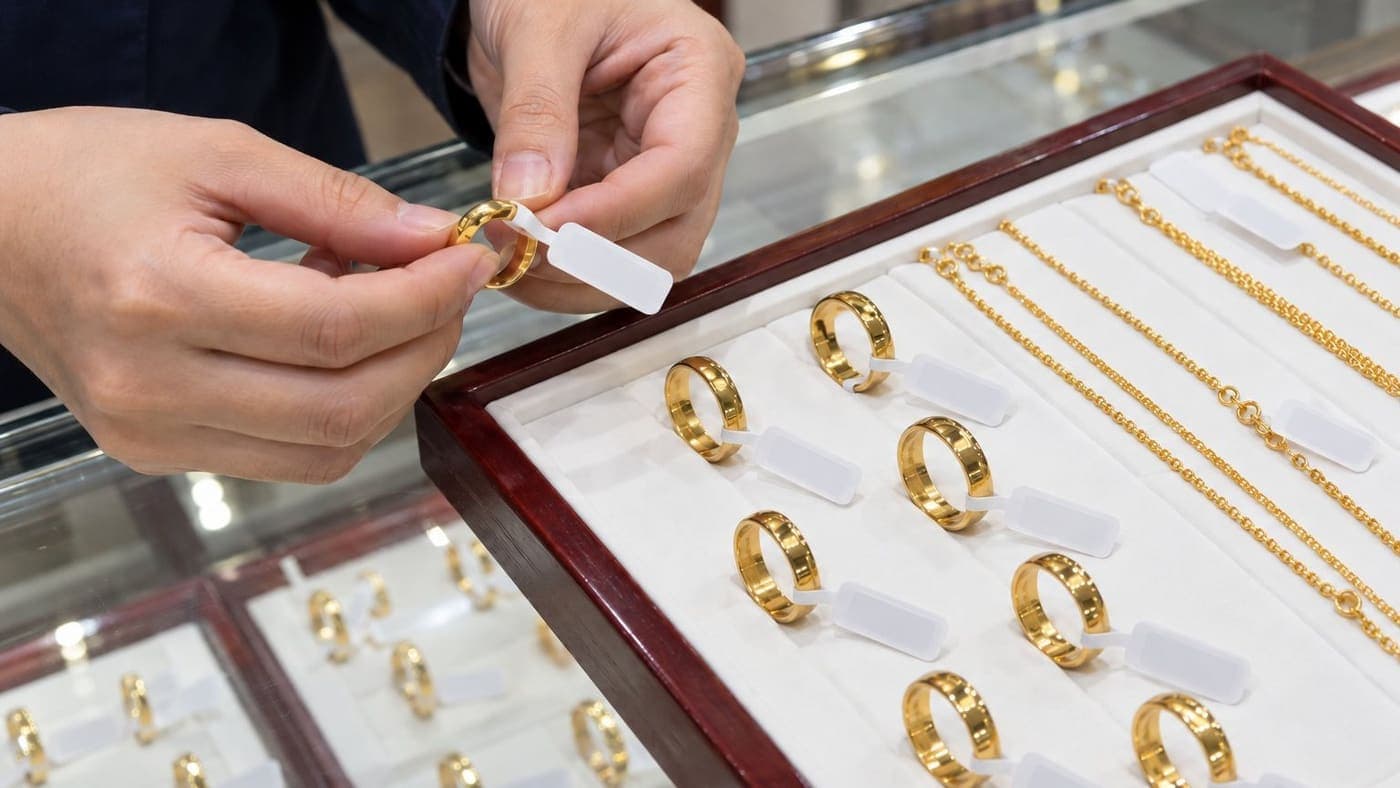
The shop attaches a jewellery RFID tag, 100 × 17 mm, to each piece. The antenna sits outside the piece and away from the metal, so the tag still reads on gold. Results also depend on how tags are attached and how pieces are arranged. Each tag carries its own EPC code and counts as one item in stock.

Goods in and out: place the whole tray on the reader
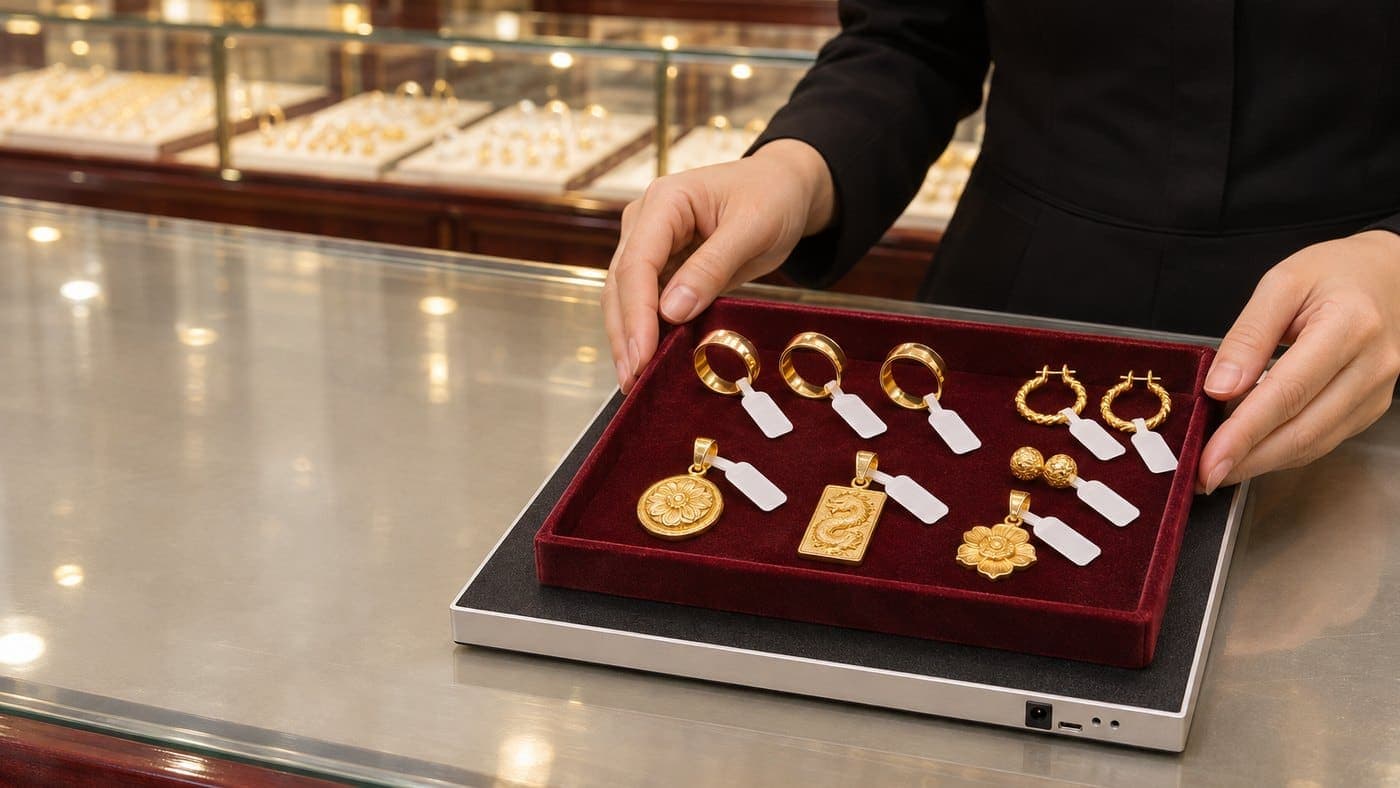
At the counter, staff place a tray on the desktop reader and every piece on it is read at once into the goods receipt or goods issue, instead of being scanned or written down one by one. Goods receipts in the software have a notes field, where a shop can record the invoice or purchase list number to make it easier to look up later.

End of day: count the whole shop or one product group
Staff open the case and scan inside with the handheld. Keep the case open while scanning, because scanning from outside the glass tends to miss pieces. Nextwaves estimates about 30 minutes for some 3,000 pieces with one person. That is scanning time only and does not include resolving differences.

Sense Inventory, the Nextwaves stock counting software, compares the result with stock on record and sorts it into Fully scanned, Missing (on record but not scanned) and Extra. A piece marked Missing is not necessarily lost: rescan and check before concluding. To find one piece, the handheld beeps as you get closer.

See how Nextwaves helps gold, silver and gemstone shops count stock on the RFID page for gold and jewellery shops (page in Vietnamese).
What can RFID not do?
- It does not prove where gold came from. A scan only shows which tags were read. Origin still rests on invoices, purchase lists and documents.
- It does not replace invoices or accounting records. Selling, weighing and pricing stay in the software the shop already uses.
- It does not measure weight or gold content. Those still take scales and gold content testing equipment that meets the rules.
- It does not fix wrong data. If a tag is attached to the wrong piece or details are entered wrongly, a fast count still gives a wrong number.
- It is not mandatory. Decree 390/2026 does not require gold shops to use RFID.
A draft circular put out for comment by the Ministry of Science and Technology in 2026 mentions encouraging gold traceability through QR codes, barcodes or electronic systems. As of 2 November 2026 we have not seen a final version, so it is not an obligation in force.
Where should a shop start?
Before buying any more equipment, a shop should review a few things it does every day:
- Review how you take payment. Have an account, card terminal or QR code ready for transactions from 5 million VND a day, both selling and buying back.
- Talk to your accountant. Confirm how invoices and purchase lists work for your business type, company or household business.
- Group paperwork by intake. Keep invoices and purchase lists together, searchable by date received.
- Do one full count to set an opening figure. Later counts are compared against it.
- Agree how to record the easy-to-miss cases. Pieces with the goldsmith, moved to a branch, or bought back from customers.
- Choose a counting rhythm. Daily, weekly or by product group.
If each count still takes so long that the shop struggles to do it regularly after these steps, that is when RFID is worth considering.
The RFID kit for gold shops
The Nextwaves RFID kit for gold shops (page in Vietnamese) costs 29,990,000 VND excluding VAT and includes:
- 1 desktop RFID reader that plugs into the counter computer by USB.
- 1 handheld RFID reader that connects to a phone over Bluetooth.
- 2,500 jewellery tags (1 roll).
- Sense Inventory Essentials stock counting software, with no monthly fee.
The price includes system setup, staff training at handover and a 12-month device warranty. A shop already using dedicated gold retail software does not need to change it. To bring RFID data straight into that software, its developer can check and connect through the Nextwaves API/SDK.
If you would like to see whether the kit suits your stock and way of working, leave your details below and Nextwaves will get in touch.
Frequently asked questions
Do gold shops still need a State Bank certificate of eligibility?
For producing gold jewellery and fine-art gold, certificates already issued stopped being a condition for operating on 16 October 2026. Gold bars still need a State Bank licence.
Must customers pay by bank transfer for gold from 5 million VND?
Under Decree 390/2026, buying or selling gold worth 5 million VND or more in a day, per customer, must use non-cash means, counted on the customer's total for the day. Besides bank transfer, these include bank cards, e-wallets and other means under the rules.
Do gold shops have to use RFID?
No. Decree 390/2026 does not require RFID. It is a shop's own choice for counting faster and more regularly.
Can an RFID tag prove where gold came from?
No. A tag only identifies each piece. Origin still rests on the shop's invoices, purchase lists and documents.
Gold is metal. Can RFID tags still be read?
Yes. Jewellery tags are a separate type with the antenna outside the piece. To count, place the tray on the reader or open the case and scan inside.
Does a shop using gold retail software have to change it?
No. Selling, weighing and pricing stay in the software the shop already uses, and counting is done in Sense Inventory.
References
This article covers information up to 2 November 2026. It is for reference only and is not legal advice.
- Government News (Báo Chính phủ), from 16 October 2026, buying and selling gold from 5 million VND a day must be non-cash (in Vietnamese). baochinhphu.vn
- Government News (Báo Chính phủ), Clarifying the non-cash payment threshold for buying and selling gold, 28 October 2026 (in Vietnamese). baochinhphu.vn
- LuatVietnam, 7 new points in Decree 390/2026/ND-CP (in Vietnamese). luatvietnam.vn
- Dân trí, Gold jewellery is no longer a conditional business line, 1 November 2026 (in Vietnamese). dantri.com.vn
- VietnamFinance, Tightening the origin of gold, 29 April 2026 (in Vietnamese). vietnamfinance.vn
- Nextwaves, Sense Inventory documentation: Inventory count. docs.nextwaves.com