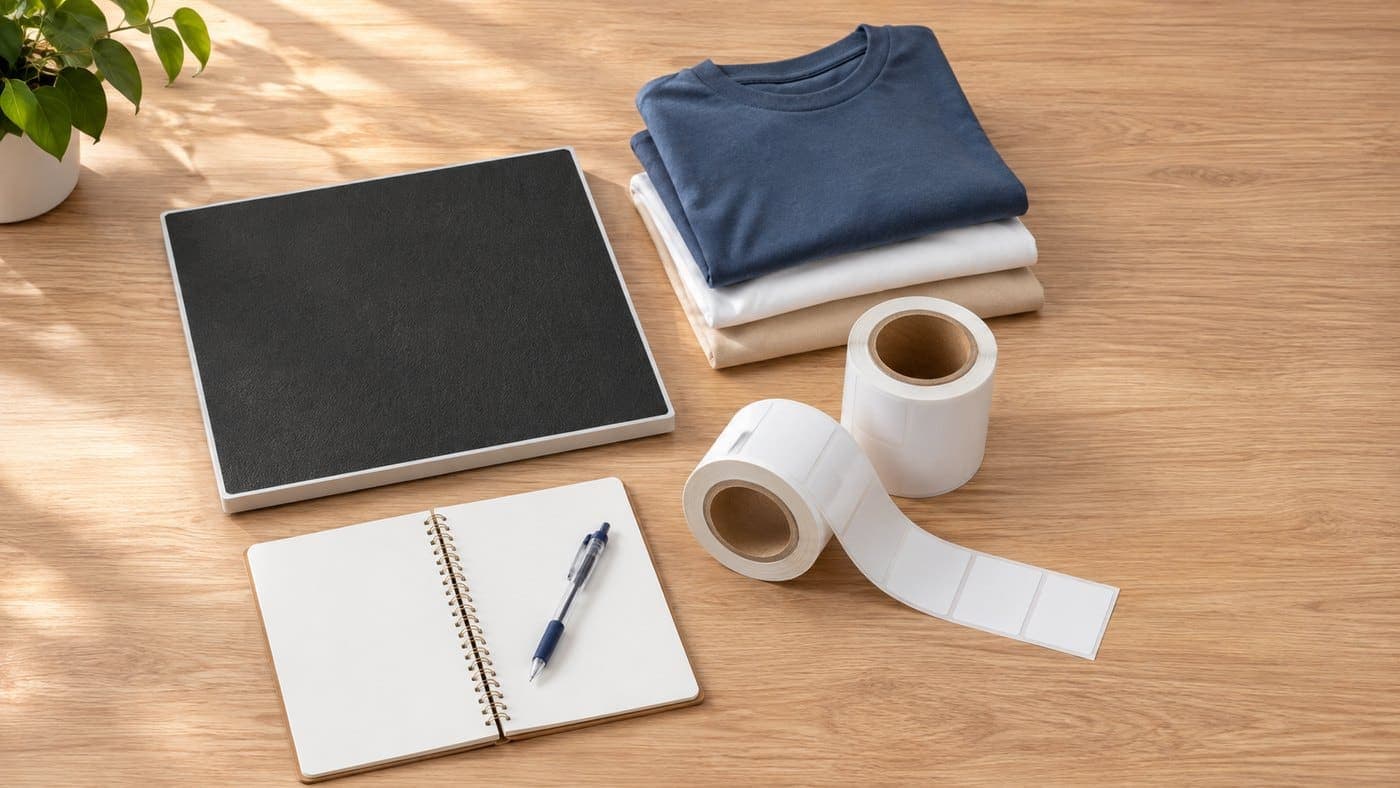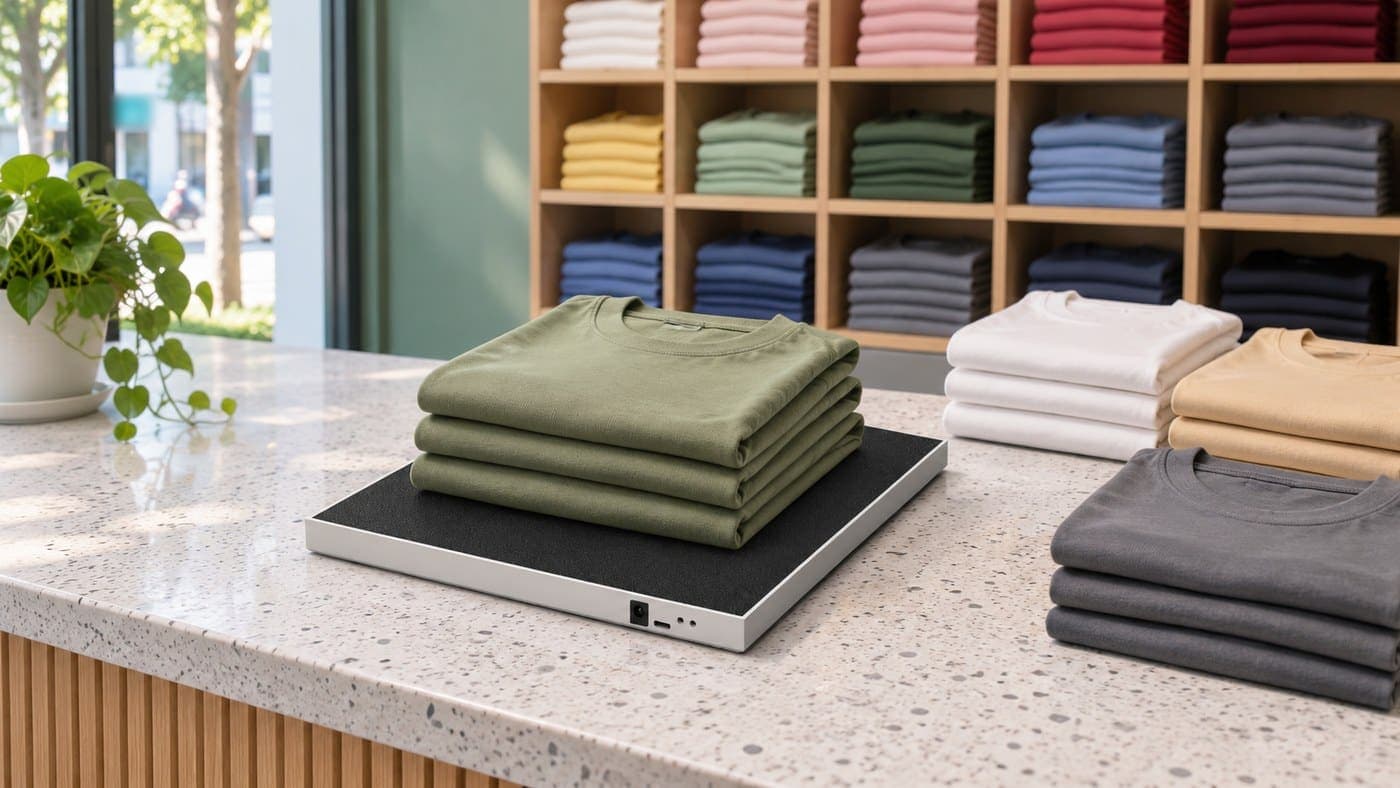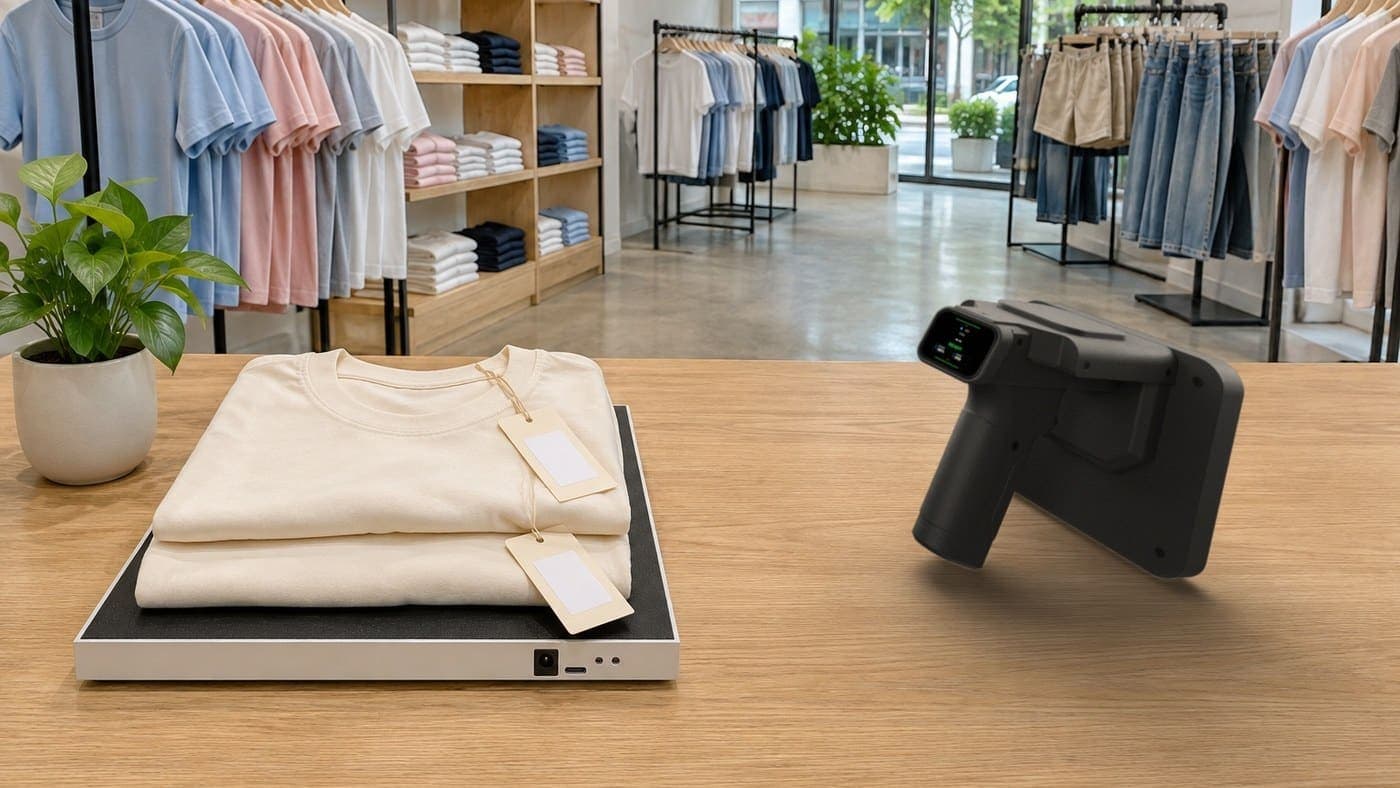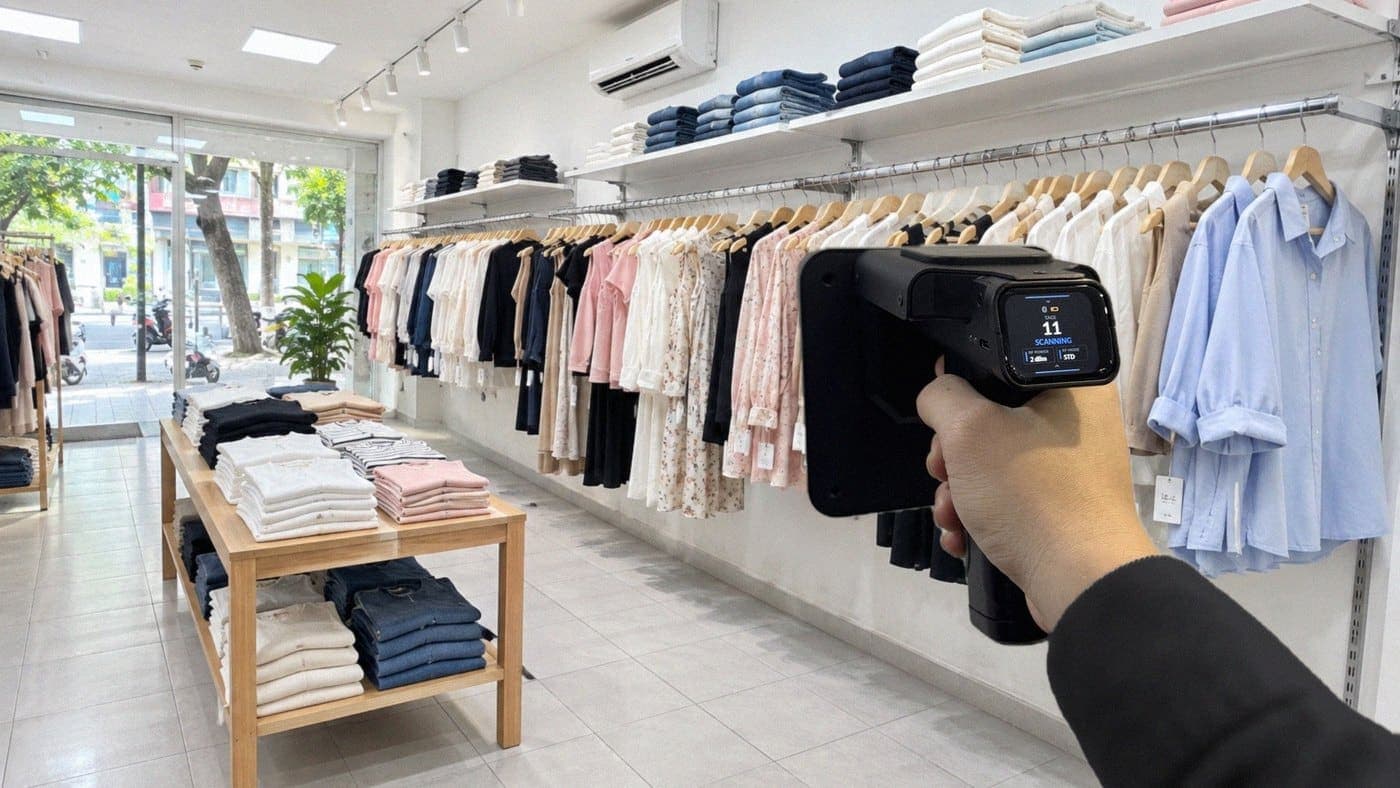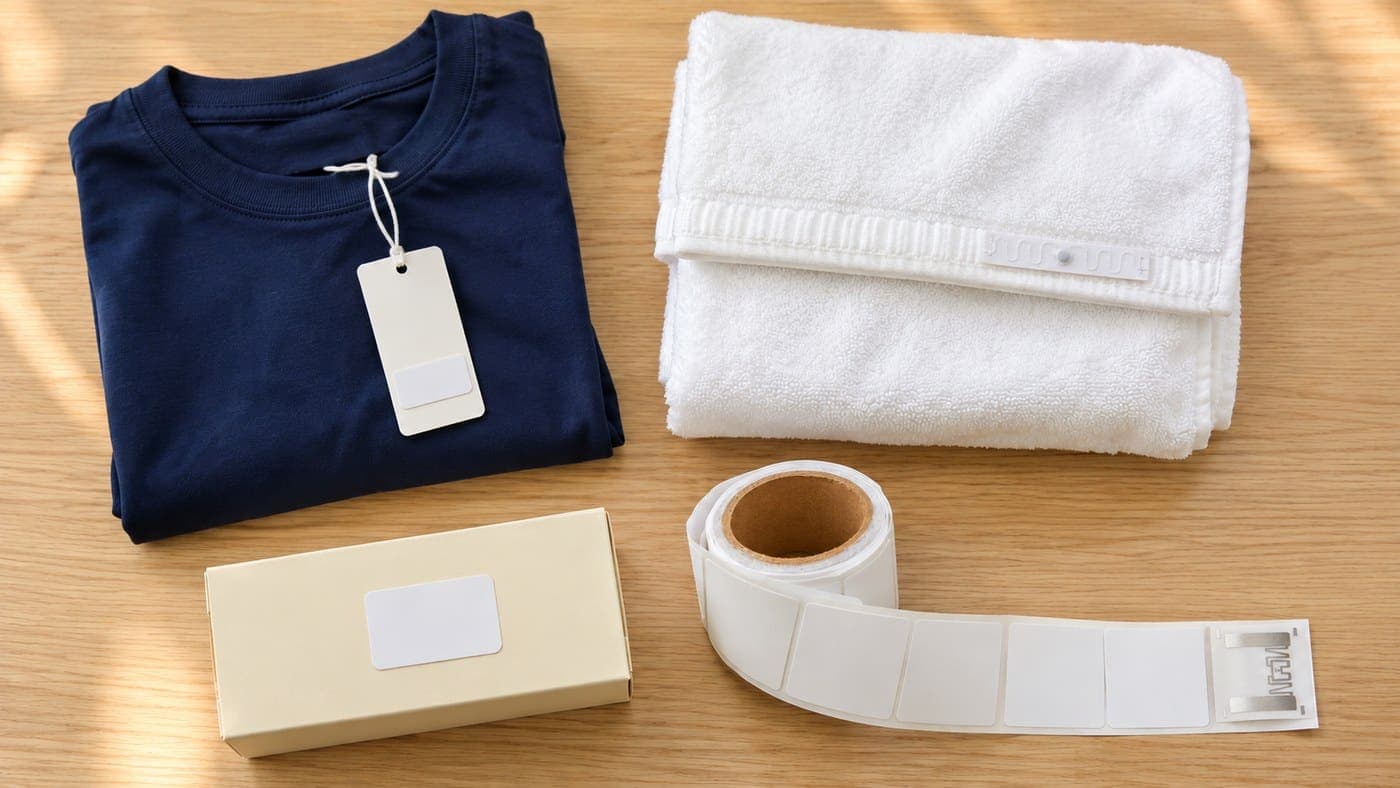
Unroll a reel of RFID tags and you'll see plain white stickers, each about the size of a matchbox. Peel one off and hold it up to the light: inside there's a thin antenna line with a tiny chip in the middle. People call it a UHF tag, a UHF card, an RFID label or an RFID sticker. Different names, same thing.
For a shop owner, the real question is: which tag goes on my goods? Look at the item first, think about price after. What it's made of, whether there's metal in it, whether it goes through the wash, how big it is. A T-shirt is fine with a paper sticker tag. A steel cabinet needs an on-metal tag. A gold ring needs its own jewellery tag.
30-second summary
- A UHF RFID tag is a chip connected to an antenna, with no battery. The reader sends out radio waves, and the tag uses that energy to answer with its own code.
- A reader picks up tags a few metres away, many at a time, without needing to see them.
- Clothing, shoes and bags, boxes, cartons: a 54×34 or 45×20 mm sticker tag, or a hang tag. Metal goods: an on-metal tag. Towels, sheets, uniforms: a sew-on laundry tag. Gold and jewellery: a jewellery tag.
- Standard sticker tags cost 890đ each (excl. VAT) and come in reels of 2,500. The RFID kit includes 2,500 tags.
What is a UHF RFID tag?
A UHF RFID tag is a chip connected to an antenna. In a sticker tag, both sit on a thin plastic film called an inlay: the antenna is aluminium, the chip is about the size of a grain of sand. Wrap that inlay in paper and you get a sticker tag; press it into card and you get a hang tag. Tags for special goods have a very different body: a laundry tag is a strip of fabric, an on-metal tag is a thick piece with a spacer layer.
There's no battery. The reader sends out radio waves and the tag uses that same energy to answer with its code. That's why tags are thin and light: stick one on and you're done, nothing to charge, nothing to replace.
UHF is the name of the frequency band these tags use. In this band a reader can pick up tags a few metres away, read many tags in one pass, and read goods sitting inside a cardboard carton, all without seeing the tag. That's the difference from NFC, which needs the tag held right up against the reader.
Every tag carries its own code, called an EPC. With barcodes, a whole product line shares one code. With RFID, every single item has its own, so whichever tag the reader picks up, the software knows exactly which item it is, down to colour and size. It's also why each product needs one tag. For more on frequencies, chips and EPC codes, read What is RFID.

UHF tag, label, sticker or card: is there a difference?
No. They're different names for the same thing. A "label" or "sticker tag" usually means the adhesive kind you stick on. A "hang tag" is the stiff card kind that hangs on a string like a price tag. The thick, rigid kind is often called a "card". When you order, just say what your goods are and how you want to attach the tag.
How to choose an RFID tag: which tag for which goods?
Find the row that looks like your goods. Every tag in the table is one Nextwaves sells:
| Your goods | Use | How to attach | Watch out for |
|---|---|---|---|
| Clothing | 54×34 or 45×20 mm sticker tag, or an RFID hang tag | Stick it on the paper price tag or label. A hang tag hangs like a normal price tag | Keep away from zips, buttons and metal studs |
| Shoes, bags | Sticker tag or hang tag | Shoes: on the box. Bags: stick or hang it on the fabric or leather part | Never stick it straight onto a metal clasp or handle |
| Cosmetics, pharmacy and other boxed goods | Sticker tag | On a flat part of the box | Foil blisters, aluminium tubes and foil-lined packs need testing first |
| Cartons | Sticker tag, preferably 54×34 | On the outside of the carton | Cartons holding metal or liquids need testing first |
| Machines, steel cabinets, metal racks | 80×40 mm on-metal tag | Straight onto the metal surface | Thicker and pricier than a sticker tag |
| Towels, sheets, uniforms | 70×15 mm sew-on laundry tag | Sewn into the hem | A plain white fabric strip, can't be printed |
| Gold, silver, jewellery | 100×17 mm jewellery tag | On each piece, with the antenna part outside the piece | Sold by the full reel of 2,500 |
| Furniture, office equipment | Wood, plastic: sticker tag. Metal: on-metal tag | On a flat spot | Check what the spot you're tagging is made of |
Clothing: sticker tag or hang tag
If your shop already uses paper price tags, a sticker tag is the easiest option. Stick it on the price tag or a paper label, and hang your stock the way you always do. The tags in the RFID kit are this kind. If your brand prints its own hang tags, you can get RFID hang tags printed with your brand, with the tag built in. And if you want the tag on the garment itself, there are woven RFID labels sewn into the product.

Where to stick it on the price tag and what to avoid is covered in the tagging rules of RFID in fashion retail.
Shoes and bags: sticker tag or hang tag
Shoes in a box get the tag on the box. The handheld scanner reads through cardboard, so a stock count doesn't mean opening or pulling out every box. Bags with metal zips or handles still scan when the tag hangs or sits on the fabric or leather part, not pressed straight onto metal. For bag styles with a lot of metal, try a few before tagging the whole batch. See how RFID works in a shoe and bag shop on RFID for shoe and bag shops (page in Vietnamese).
Boxes and cartons
Cosmetics, pharmacy boxes and other boxed goods get a sticker tag on a flat part of the box. What decides whether a tag reads is whatever sits right behind it. Foil blisters, aluminium tubes, metal sprays and foil-lined packs need a test first, and in some cases a foldable tag instead. Cartons get the tag on the outside, in the 54×34 size if there's room. If what's inside is bottled liquid or metal, test that too: liquid absorbs the signal and metal makes tags hard to read.
Metal goods and machines: on-metal tags
A normal tag stuck straight onto metal barely reads at all: metal reflects the signal, detunes the tag and leaves it without enough energy to answer. An on-metal tag has a spacer layer and an antenna made to sit directly on a metal surface, for machines, steel cabinets and racks. Nextwaves has an 80×40 mm on-metal tag, blank or printed and encoded. Which type suits which surface is in our guide to UHF RFID anti-metal tags.
Towels, sheets, uniforms: sew-on laundry tags
Anything that goes through the wash again and again will wreck a paper sticker. A laundry tag is a white woven fabric strip, 70×15 mm, with the antenna inside the fabric, sewn into the hem of towels, sheets or uniforms. It can't take any printing, text or logo. How it's built and sewn on is in RFID laundry tags. Hotels that want to count towels and sheets by area can see RFID for hotels (page in Vietnamese).

Gold, silver, jewellery: jewellery tags
The pieces are small and made of metal, so a normal sticker tag won't do. The 100×17 mm RFID jewellery tag is made for this: the antenna part sits outside the piece, away from the metal, so it still reads on gold. It's sold by the full reel of 2,500. For earrings and small pendants, Nextwaves works out how to attach it with the shop during setup. More on RFID for gold and jewellery shops (page in Vietnamese).
Furniture and equipment: go by the material
Assets get tagged the same way as stock: look at the spot you're tagging. Wooden tables and chairs, wooden cabinets and plastic-cased equipment are fine with a sticker tag. Steel cabinets, machines and metal-cased equipment need an on-metal tag.
54×34 or 45×20 mm sticker tag?
Clothing, shoes and bags, boxes and cartons all use sticker tags, so this is the choice you'll make most often. Nextwaves has two standard sizes, the same two that come with the RFID kit. Both are made by Nextwaves in Vietnam, follow the EPC Gen2 standard and cost the same.
- 45×20 mm: small and neat, fits small price tags, paper labels and small boxes.
- 54×34 mm: bigger, with a larger antenna, so it usually reads from further away. Good for shoe boxes, cartons and tightly packed goods. If there's room to stick it, go with this one, then test it on a few real items.
Each size comes blank or printed. The tags in the kit already carry their codes: you stick them on, then pair each tag with the right product code when you receive the stock. No printer needed. When a printer is worth buying is covered in Do I need to buy an RFID printer?
How much does a UHF RFID tag cost?
Nextwaves' standard UHF sticker tag costs 890đ per tag (excl. VAT), under a thousand đồng. On-metal tags, laundry tags and jewellery tags cost noticeably more, because they're built differently. What moves the price:
- Tag type: hang tags, laundry tags, on-metal tags and jewellery tags use their own materials and construction, so they cost more than sticker tags.
- Size and chip: a different size or chip means a different price. Nextwaves' two standard sticker sizes, 54×34 and 45×20, cost the same.
- Printed or blank: for these two standard sizes, blank and printed also cost the same.
- Quantity: standard sticker tags come in reels of 2,500, so 2,225,000đ a reel (excl. VAT). The more you buy in a year, the lower the price works out.
Extra tags you buy during the year add up toward a level in Tag Rewards:
| Level | Tags bought in the year | Price per tag after credit |
|---|---|---|
| Member | From 2,500 | 890đ |
| Bronze | From 50,000 | 880đ |
| Silver | From 100,000 | 870đ |
| Gold | From 250,000 | 850đ |
| Platinum | From 500,000 | 830đ |
| Diamond | From 1,000,000 | 810đ |
You still pay 890đ per tag when you buy. The difference comes back as credit, issued about 30 days after the year ends, to use on later tag orders. The program covers 54×34 and 45×20 mm tags, blank and printed. The 2,500 tags that come with the kit don't count.
Tags are only one part. The cost of the whole system, readers, software and tags, is in RFID system cost.
Common mistakes when choosing and attaching RFID tags
| Mistake | What happens | What to do instead |
|---|---|---|
| Sticking a normal tag straight onto metal: cans, tins, bag clasps, steel racks | The tag detunes and reads on and off, or not at all | Stick it on paper, fabric or plastic, away from metal. If there's only metal, use an on-metal tag |
| Sticking it right against bottles or anything with liquid inside | Liquid absorbs the signal, so a tag behind it is very hard to read | Try a few spots on the real item and keep the one that reads best |
| Sticking it on a curve or fold, or stapling through it | A folded or torn antenna reads poorly | Use a flat spot, smooth it down, staple outside the tag |
| Two tags on top of each other, or tags overlapping when items are packed tight | Reads come and go, items get missed | One tag per item. Put the tag in the same spot on every item of a line, so tags don't stack up |
| Stacking goods very thick and scanning once | Tags in the middle of the stack get missed | Scan again from a few angles. On the desktop reader, spread the goods out and do several rounds |
| Picking a tag that's too small for a spot that needs reading from a distance | You have to stand close to read it, so counts take longer | If there's room, use the 54×34 size, then test it on real items |
| Using sticker tags on things that get washed | Paper tags aren't made for a washing machine | Towels, sheets and uniforms get sew-on laundry tags |
| Ordering tens of thousands of tags before testing | You find out which items read badly only after tagging them | Put a few tags on a few typical items, especially ones with metal or thick fabric, and test them with the reader you'll actually use |
Start RFID stock counts with a kit that already has 2,500 tags
If you sell clothing, shoes and bags or boxed goods that suit sticker tags, you don't need to buy tags separately at the start. The Nextwaves Retail Starter Kit costs $1,199 for the full kit, excluding VAT. In the box:
- 1 handheld RFID scanner, for stock counts and finding items.
- 1 desktop RFID reader, for pairing tags with products as goods arrive.
- 2,500 RFID tags, 45×20 or 54×34 mm, enough for 2,500 products.
- Sense Inventory Essentials inventory software, $0/month.
When they run out, order more by the reel of 2,500. Not sure which tag suits your goods, or whether some items have metal or liquid in them? Answer 9 questions on the kit page, it takes about 30 seconds, or fill in the form below. On the call, Nextwaves asks how you count stock today and suggests the right tag for your goods.
Frequently asked questions
Does a UHF RFID tag need a battery?
No. The tag takes its energy from the reader's radio waves to answer, so there's no battery to charge or replace.
How far away can a UHF tag be read?
A few metres. How far depends on the tag, the reader, the power setting and the item the tag is on. Tags stuck right against metal or liquid, or on goods packed very tightly, read at a shorter distance. For a stock count you don't need to stand far back: walk along the shelf with the scanner pointed at the goods.
Can a phone read UHF tags?
Not on its own. A phone's NFC works on a different frequency and needs the tag held right up close. To use your phone, connect it to the handheld RFID scanner over Bluetooth: the scanner reads the tags and the phone runs the Sense Inventory app.
Can sticker tags be reused?
Sticker tags are single use. Hang tags and hard tags can be reused.
Do I need an RFID printer?
Not necessarily. The tags in the kit already carry their codes: stick them on, then pair them with product codes when you receive stock. You only need a printer if you want to print and encode tags yourself. A printer isn't included in the kit.
Are there heat-resistant RFID tags?
For items that get washed again and again, use sew-on laundry tags, made to be sewn into towels, sheets and uniforms and go through many washes. Heat from drying and ironing, or anything hotter like sterilising or drying ovens, has to be checked against the specs of the exact tag. Ask Nextwaves before you buy, and don't test it with a normal sticker tag.
How do I buy more tags?
Standard sticker tags are ordered by the reel of 2,500, at 890đ per tag (excl. VAT). Extra tags bought during the year add up in Tag Rewards toward a level.