Most of the AI systems that made headlines in the last few years work by predicting the next piece of data. A language model predicts the next word. An image generator predicts pixels. This approach has been astonishingly successful, but one of the most influential researchers in the field argues it has a ceiling, and that a different idea is needed to build machines that truly understand the world.
That idea is the Joint Embedding Predictive Architecture, or JEPA. Proposed by Yann LeCun in 2022, it is a way of learning that predicts in an abstract space of meaning rather than in the raw space of pixels or words. The bet behind it is large: that predicting what something means, while ignoring the details that cannot be predicted, is closer to how humans and animals learn, and is a better foundation for reasoning and planning than predicting every detail of the data. This guide goes deep. It explains what JEPA is, the energy-based idea behind it, the actual training objective, how the real models from I-JEPA to V-JEPA 2 are built, how a JEPA is used to plan and act, where it fits in a larger blueprint for machine intelligence, and why a billion dollars of new funding is now riding on it.
JEPA in one minute: the short answer
A Joint Embedding Predictive Architecture (JEPA) is a self-supervised learning method that predicts the abstract representation of part of an input from the representation of another part, instead of reconstructing the raw data. By predicting meaning rather than pixels, it can ignore unpredictable detail and focus on the structure that matters. Yann LeCun proposed it in 2022 as a step toward AI that builds an internal model of the world.
Key points:
- JEPA predicts in representation space, the space of embeddings, not in input space, the space of pixels or tokens.
- This lets it discard unpredictable noise and learn efficient, meaningful features.
- It uses an encoder to turn inputs into embeddings and a predictor to estimate a target embedding, with a latent variable to handle what cannot be known.
- It is non-generative: it never produces pixels or text, only predictions about representations.
- The main models are I-JEPA (images, 2023), V-JEPA (video, 2024), and V-JEPA 2 (a video world model used for robot planning, 2025).
- JEPA is the foundation of the world models that LeCun and others believe are the path beyond today's large language models.
What is a Joint Embedding Predictive Architecture?
The name is intimidating, but each word describes a simple part of the idea. Joint embedding means it turns two pieces of input into embeddings, which are compact lists of numbers that capture the meaning or features of the input rather than its raw appearance. Predictive means it predicts one of those embeddings from the other. Architecture just means it is a general design, not a single model.
Put together, a JEPA takes two related inputs, often two parts of the same image or two moments of the same video, and learns by predicting the embedding of one part from the embedding of the other. Crucially, it never tries to recreate the original pixels. It works entirely in the abstract space of representations. This is what people mean when they say JEPA predicts in latent space.
It belongs to a family called self-supervised learning, where a model teaches itself from unlabeled data by hiding part of the input and trying to predict it from the rest. No human labels are needed, only raw images, video, or other signals. What makes JEPA distinct within that family is the decision to predict representations instead of the data itself.
Why predicting pixels is the wrong goal
To see why JEPA exists, look at what came before it. A generative model learns by trying to reproduce the data. Hide part of an image and ask it to fill in the exact missing pixels, or give it a sentence and ask for the exact next word. The trouble is that the world is full of detail that cannot be predicted exactly.
Imagine a video of a ball rolling toward the edge of a table. You can predict with confidence that it will fall. What you cannot predict is the precise way it will bounce, the exact pattern of light on the floor, or the position of every speck of dust in the air. A model forced to predict pixels has to spend its effort trying to nail down all of that unpredictable detail, which wastes its capacity on noise rather than on the thing that matters, which is that the ball falls.
JEPA's answer is to stop predicting the detail. Instead of forecasting every pixel of the future frame, it forecasts an abstract representation of it, a summary that can capture the ball falls while discarding the parts that are impossible to know. The encoder is allowed to drop unpredictable information, so the prediction problem becomes easier and the features it learns become more meaningful. This single change, from predicting data to predicting representations, is the heart of JEPA.
JEPA as an energy-based model
LeCun frames JEPA inside a broader idea called the energy-based model, and that framing explains much of its design. An energy-based model does not output a probability or a label directly. Instead it learns an energy function that gives a low value to combinations that fit together and a high value to combinations that do not. For a pair of inputs x and y, the energy is low when y is a plausible partner or continuation of x, and high when it is not.
In a JEPA, that energy is the prediction error in embedding space: the distance between the predicted target embedding and the real one. When the model predicts well, the energy is low, and the pair is judged compatible. Training is the act of carving valleys into this landscape around the real data, so that correct pairings sit at the bottom and wrong ones are pushed up.
Seen this way, the collapse problem has a clear meaning. If the encoder outputs the same vector for everything, the landscape becomes flat and low everywhere, which is useless because nothing is distinguished from anything else. The whole craft of training a JEPA is shaping an energy surface that is low only where it should be, and the techniques described later exist precisely to keep that surface from going flat.
How JEPA works: inside the architecture
A JEPA has three main parts, and the easiest way to understand them is to follow a single training example through the system.
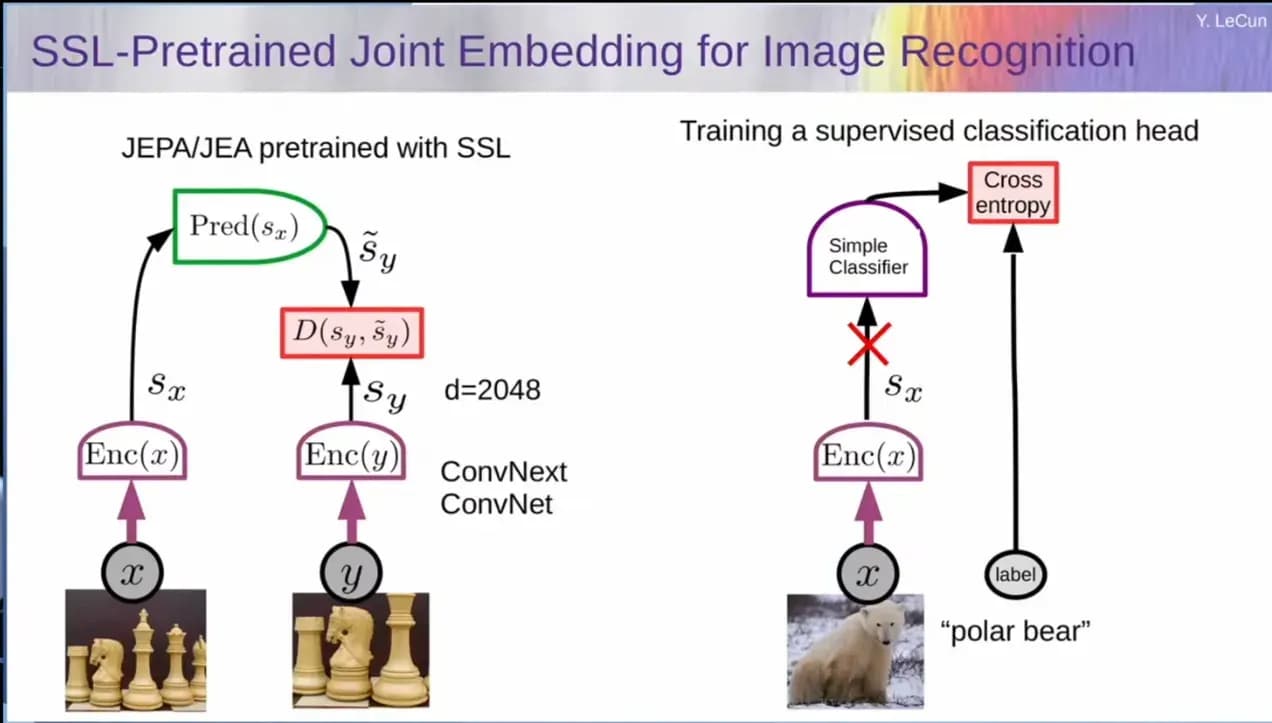
It starts with two related inputs. Call them x, the context, and y, the target. For an image, x might be a few visible patches and y a hidden region you want to predict. Each input passes through an encoder, a neural network that turns it into an embedding, written s_x and s_y. These embeddings are the abstract summaries of each part.
The second part is the predictor. It takes the context embedding s_x and tries to produce a prediction of the target embedding, written s_y with a hat. Because the context usually does not contain everything needed to know the target exactly, the predictor is also given a latent variable, written z, that stands for the missing information, such as where the target sits or which of several plausible outcomes occurred. In the image and video models, this latent is supplied in practice as tokens that tell the predictor where the target region is.
The third part is the learning signal. Training simply adjusts the encoder and predictor to make the predicted embedding as close as possible to the actual target embedding, measured by a distance D. There is no decoder and no attempt to rebuild pixels anywhere in the process. One important detail keeps the whole thing from cheating: the target side usually uses a separate target encoder whose weights are a slowly moving average of the main encoder. As a later section explains, that is what stops the model from collapsing into a useless shortcut.
The math of JEPA, in plain notation
The idea can be written down compactly, and seeing the pieces named makes the architecture concrete. There is no heavy mathematics here, just a few lines that capture the whole training loop. Using f for the encoder, g for the predictor, and θ for a network's weights:
- Encode the context: sx = f(x), where f is the encoder network.
- Encode the target: sy = ftarget(y), using a separate target encoder.
- Predict the target embedding: ŝy = g(sx, z), where g is the predictor and z carries the missing information, such as where the target is.
- Measure the error: the loss is the distance between the prediction and the real target embedding, averaged over all targets, so loss = average of D(ŝy, sy), with D usually a simple squared distance.
- Block the shortcut: gradients are not allowed to flow back through the target encoder, written as a stop-gradient on sy, so the model cannot trivially make both sides equal by changing the target.
- Update the target encoder slowly: its weights are an exponential moving average of the main encoder, θtarget ← τ · θtarget + (1 − τ) · θ, with τ close to one.
Two lines in that list do the heavy lifting. Predicting in embedding space, the third line, is what lets the model ignore unpredictable detail. The stop-gradient and the moving-average target, the fifth and sixth lines, are what keep it from collapsing. Everything else is ordinary neural-network training by gradient descent.
Three ways to learn: generative, joint-embedding, and JEPA
JEPA is easier to place when you compare it with the two approaches it draws from. LeCun frames all three in terms of how they handle a pair of inputs x and y.
A generative architecture predicts y directly, in the space of the data itself, and needs a decoder to turn its prediction back into pixels or tokens. A joint-embedding architecture, which includes contrastive methods, encodes x and y into embeddings and learns whether they belong together, but it does not predict one from the other. A JEPA sits between them: like a joint-embedding model it works in embedding space, and like a generative model it predicts, but it predicts the embedding of y rather than y itself.
| Core idea | Reconstruct or predict the data |
|---|---|
| Make embeddings of related inputs agree | Predict one embedding from another |
| Predicts in | Input space (pixels, tokens) |
| Embedding space (similarity) | Embedding space |
| Uses a decoder | Yes |
| No | No |
| Discards noise | No, models every detail |
| Yes | Yes |
| Handles uncertainty via | Hard, output is one fixed guess |
| Not directly | A latent variable z |
| Main failure mode | Wastes capacity on detail |
| Representation collapse | Representation collapse |
| Examples | Masked autoencoders, diffusion, most LLMs |
| SimCLR, BYOL, VICReg | I-JEPA, V-JEPA, V-JEPA 2 |
The table makes the trade clear. Generative models keep every detail and pay for it in wasted capacity. Joint-embedding and JEPA models throw detail away, which is more efficient but introduces a different danger, the collapse problem.
The collapse problem, and how JEPA avoids it
Predicting in embedding space creates a tempting shortcut. If the only goal is to make the predicted embedding match the target embedding, the easiest way to win is for the encoder to output the same constant vector for every input. The prediction is then always perfect, the distance is always zero, and the model has learned nothing. This failure is called representation collapse, and avoiding it is the central technical challenge of every method in this family.
There are three broad families of solution, and they differ in how they force the embeddings to stay informative.
| Contrastive | Pushes embeddings of unrelated inputs apart | Yes, often many |
|---|---|---|
| SimCLR, MoCo | Rarely | Regularized |
| Forces embeddings to stay varied and decorrelated | No | VICReg, Barlow Twins |
| In some variants | Distillation | Asymmetric target encoder updated by moving average, with stop-gradient |
| No | BYOL, DINO | Yes (I-JEPA, V-JEPA) |
Contrastive methods penalize a constant output by explicitly separating unrelated examples, but they need large numbers of negatives and a lot of data. Regularization methods such as VICReg add terms that keep each dimension of the embedding varied and keep the dimensions from duplicating each other, which stops the representation from shrinking to a point. Distillation methods, which JEPA's image and video models use, break the symmetry between the two sides: the target encoder is not trained directly but is set to a slowly moving average of the context encoder, and gradients are blocked from flowing through it. This asymmetry quietly removes the incentive to collapse, without negatives and without hand-crafted data augmentation.
That last point is part of why JEPA drew attention. Many earlier self-supervised methods depended heavily on augmentations, such as cropping and color-shifting the same image, to manufacture training pairs. JEPA's image model learns strong, semantic features without relying on those tricks, which makes it simpler and more general.
A short history of JEPA
JEPA did not appear from nowhere. It is the latest step in a long line of work on learning from unlabeled data.
Its roots reach back to the Siamese networks of the 1990s, which compared two inputs through twin encoders, and to the energy-based models that LeCun and colleagues formalized in the 2000s, which measure how compatible two things are. The wave of self-supervised learning from 2018 to 2021 brought contrastive methods like SimCLR and MoCo, then non-contrastive methods like BYOL, Barlow Twins, and VICReg that learned good representations without negative examples. These set the stage by showing that joint-embedding learning could work at scale.
In 2022, LeCun pulled these threads together in a position paper titled A Path Towards Autonomous Machine Intelligence, which laid out a broad blueprint for machines that perceive, predict, and plan, with JEPA as the predictive core. The first concrete model, I-JEPA, arrived in 2023 for images. V-JEPA followed in 2024 for video. In 2025 came V-JEPA 2, a much larger video world model able to plan robot actions. And in late 2025 LeCun left Meta to start a company built around these ideas, which raised over a billion dollars in early 2026, a sign of how seriously the approach is now taken.
I-JEPA in detail
I-JEPA, the first concrete model in the family, is worth examining closely because it set the template the others follow. Released by Meta in 2023, it learns from still images using three networks: a context encoder, a target encoder, and a predictor, all built on the Vision Transformer, a network that treats an image as a grid of patches.
The training recipe is distinctive. From each image the method samples several target blocks, large regions the model will try to predict, and a single context block, a separate region the model is allowed to see. The context and targets are kept from overlapping, so the model cannot simply copy the answer. The context encoder processes only the visible context patches and turns them into embeddings. The predictor, a smaller Vision Transformer, then takes those embeddings together with position information for each target block and predicts the embedding that the target should have. The actual target embeddings come from the target encoder, which sees the full image and whose weights are a slowly moving average of the context encoder.
Two design choices give I-JEPA its character. First, the targets are large and the context is informative but spatially spread out, which forces the model to capture the overall structure of a scene rather than local texture, and this is what makes the learned features semantic. Second, and unlike the contrastive methods before it, I-JEPA needs no hand-crafted data augmentation, no cropping or color jitter to create pairs. The result is a model that learns strong, general-purpose image features while being markedly more efficient to train than alternatives such as masked autoencoders. Meta described its predictor as a first, primitive world model, a network that fills in the missing part of a scene in representation space.
V-JEPA in detail
V-JEPA, released in 2024, carried the same recipe from images into video, which is a much harder and richer signal because it contains motion and the passage of time. Instead of patches of a single image, V-JEPA works with short tubes of video that span both space and several frames. It masks out regions of a clip, often the same spatial area across many frames so the answer cannot be copied from a neighboring moment, and predicts the representations of the masked regions from the visible ones.
As in I-JEPA, the prediction happens in embedding space, there is no pixel reconstruction, and the target representations come from a moving-average encoder. By learning to fill in missing pieces of video at the level of meaning, V-JEPA picks up an understanding of how things move and interact. It proved especially strong on tasks that require reading motion over time, the kind of task that pixel-prediction models tend to handle poorly, and it could be evaluated with its backbone frozen, a sign that the features it learned were genuinely general rather than tuned to one task.
V-JEPA 2 in detail
V-JEPA 2, released in June 2025, is where the approach grew from a representation learner into a usable world model, and it is the clearest evidence so far that the JEPA bet can pay off. The leap came from scale and from a second training stage.
The first stage is ordinary JEPA pre-training, but enormous. V-JEPA 2 was trained on more than a million hours of internet video together with around a million images, using a masked prediction objective in latent space. Meta reported four ingredients that made this scale work: a much larger dataset assembled for the purpose, a much larger encoder of roughly a billion parameters, a longer and more progressive training schedule, and an extension to higher resolutions and longer clips. The payoff was a model with a strong, general grasp of physical dynamics. It reached leading results on motion understanding, scoring 77.3 on the Something-Something v2 benchmark, and state-of-the-art results on anticipating human actions on the Epic-Kitchens-100 benchmark, and when its features were paired with a language model it performed at the top of several video question-answering tests.
The second stage is what makes it a world model for action. A variant called V-JEPA 2-AC, for action-conditioned, was trained on top of the pre-trained encoder using only about sixty-two hours of unlabeled robot video from a public dataset. This smaller network, around three hundred million parameters, learns to predict how the latent state of the world will change when the robot takes a given action. With that, the system can plan: given a goal specified as an image, it imagines the outcomes of different action sequences in latent space and chooses the one whose predicted result lands closest to the goal. Deployed this way on real robot arms in two different labs, with no training in those environments and no task-specific reward, V-JEPA 2 could reach for, grasp, and place objects it had never seen, planning each move on the fly.
| I-JEPA | 2023 | Images |
|---|---|---|
| Image datasets | Predict representations of masked target blocks from a context block | Strong features, efficient, no augmentation |
| V-JEPA | 2024 | Video |
| Internet video | Predict representations of masked spatio-temporal regions | Learns motion from raw video, no pixels |
| V-JEPA 2 | 2025 | Video, plus action |
| 1M+ hours video, 62h robot video | Scale into a world model, add an action-conditioned variant | Zero-shot robot planning, top motion and anticipation scores |
From prediction to planning
The robot results deserve a closer look, because turning a predictive model into a planner is the bridge between perceiving the world and acting in it. The method is a classic idea called model-predictive control, now powered by a learned world model rather than a hand-written physics simulator.
The loop works like this. The system observes the current scene and encodes it into a latent state. It is also given a goal, often a picture of the desired outcome, encoded the same way. It then imagines: using the action-conditioned world model, it rolls forward many candidate sequences of actions and predicts, entirely in latent space, the future state each one would lead to. It scores each imagined future by how close it lands to the goal state, keeps the most promising ones, and refines its guesses toward better and better sequences. Finally it takes the first action of the best plan, observes what actually happened, and repeats from the new state. Because all of the imagining happens in the compact representation space rather than in pixels, this search is fast enough to run in real time. This is the sense in which a JEPA is more than a perception model. It can be used to plan.
The bigger blueprint: autonomous machine intelligence
JEPA was never meant to stand alone. It was introduced as one component of a larger design for what LeCun calls autonomous machine intelligence, a sketch of how the pieces of a thinking, acting agent might fit together.
In that design, a handful of modules cooperate. A perception module reads the senses and estimates the current state of the world. The world model, the JEPA, predicts how that state will evolve and fills in what perception cannot see. A cost module measures how good or bad a situation is, combining hardwired drives with a learned critic that anticipates future cost, and it is this cost that the system tries to reduce. An actor module proposes sequences of actions and, using the world model to foresee their consequences and the cost module to judge them, searches for the sequence that leads to the best outcome. A short-term memory holds recent states and predictions, and a configurator sits above everything, tuning each module for the task at hand. JEPA is the engine of prediction at the center of this machine, and the rest of the architecture is what would turn prediction into purposeful behavior.
Hierarchical JEPA: planning across timescales
Real goals unfold over many timescales. Making a cup of coffee involves a high-level plan, walk to the kitchen, then a sequence of mid-level steps, then the fine motor control of grasping a handle, and no single predictive model operates well at all of these levels at once. LeCun's answer is to stack JEPAs into a hierarchy, an idea he calls H-JEPA.
The higher levels of the stack predict and plan abstractly and over long horizons, working with coarse representations that ignore detail. The lower levels handle fine, short-horizon prediction. Crucially, a high level does not specify every action; it sets subgoals that the level beneath it then works out how to achieve, and so on down to the bottom. This mirrors how people plan, deciding where to go before deciding how to move each muscle, and it is what would let a JEPA-based agent plan complex, extended tasks rather than only react moment to moment. Hierarchical planning of this kind remains one of the hardest and least solved parts of the whole program.
The expanding JEPA ecosystem
Although the headline models come from Meta and focus on images and video, the JEPA idea has spread quickly across research, because the core principle, predict representations rather than data, applies to almost any kind of signal. There are now JEPA-style models for audio, sometimes called A-JEPA, and a motion-content variant, MC-JEPA, that learns visual features and optical flow together. Researchers have applied the architecture to point clouds and 3D data, to graphs, to geospatial data, to time series, and even to recommendation systems, where it is used to learn representations of user behavior.
Not all of these are mature, and many are early experiments. But the breadth is a sign that JEPA is becoming less a single model and more a general design pattern for self-supervised learning, one that a researcher in a new domain can reach for and adapt. The pattern is always the same: encode two related views, predict one representation from the other, and use an asymmetry or a regularizer to keep the representations from collapsing.
JEPA vs large language models: how are they different?
Because large language models dominate the conversation, it helps to be precise about how JEPA differs from them, since this contrast is the heart of LeCun's case.
A large language model is trained to predict the next token in a sequence of text, in the space of words. It works extremely well for language, which is discrete, sequential, and largely man-made, and it has produced powerful systems for writing, coding, and answering questions. LeCun's criticism is not that this is useless, but that it is the wrong shape for understanding the physical world, which is continuous, high-dimensional, and full of detail that no model can pin down word by word or pixel by pixel.
| Predicts | The next token, in words | The representation of missing parts |
|---|---|---|
| Works in | Input space | Embedding space |
| Output | Generated text or data | No generation, an internal prediction |
| Strong at | Language, code, reasoning over text | Perception, physical dynamics, planning |
| Weaker at | Grounded physical understanding | Mature language and generation |
JEPA takes the opposite stance. It predicts in an abstract representation space, discards what cannot be known, and is designed from the start to model continuous reality and to support planning. The two are not strictly rivals, and many believe the future combines them, with a language interface on top of a grounded world model underneath. But the underlying philosophies are genuinely different: one predicts the surface form of data, the other predicts its abstract meaning, and the debate over which is the better foundation for general intelligence is one of the most important arguments in AI today.
Strengths and limitations of JEPA
Like any approach, JEPA has real advantages and equally real open questions, and an honest picture needs both.
Its strengths are efficiency, because it does not waste capacity predicting unpredictable detail; the quality of its features, which capture meaning rather than appearance and transfer well to new tasks; its independence from hand-crafted data augmentation, at least in the image and video models; and its natural fit for world models and planning, since it predicts how representations evolve. These are not just theoretical. V-JEPA 2 turning passive video into zero-shot robot control is a concrete demonstration that the approach can reach beyond perception into action.
The limitations are just as important. JEPA is still a young research direction compared with the mature, heavily deployed world of generative models, and much of LeCun's larger vision of autonomous, reasoning machines remains unproven. Preventing collapse and choosing the right level of abstraction take careful engineering. Planning with a learned world model is hard and works so far in fairly constrained settings. There is no rich language interface in the way there is for large language models, so JEPA models are usually paired with other systems to talk to people. And there is genuine scientific disagreement about whether predicting in representation space will deliver the leap in reasoning its advocates expect, or whether it will, like many promising architectures before it, prove harder to scale than it looks. JEPA is a serious bet, not a settled result.
Where JEPA is headed: AMI Labs and the world-model race
The clearest sign of how seriously JEPA is now taken is where its inventor went. In late 2025, Yann LeCun announced he would leave Meta after more than a decade leading its fundamental AI research, in part because he wanted to focus on world models rather than compete in large language models. He co-founded a startup, AMI Labs, short for Advanced Machine Intelligence, based in Paris, to pursue the JEPA-based world-model program directly.
In early 2026 the company raised over a billion dollars in seed funding at a valuation of around three and a half billion, reported as the largest seed round in European history, on the thesis that learning abstract models of reality, rather than predicting tokens, is the path to systems that can understand, remember, reason, and plan. Its stated belief is blunt: real intelligence does not start in language, it starts in the world. AMI is not alone. Other well-funded efforts, including Fei-Fei Li's World Labs and work at Google, are pursuing world models from different angles, and Meta continues to build on the JEPA line it started.
Whether this bet pays off will take years to judge, and even its backers say so. But the direction is set. After a period in which predicting the next token defined the field, a serious and well-resourced movement is arguing that the next big step is learning to predict the world in the abstract, and JEPA is the architecture at the center of that argument.
Common misconceptions about JEPA
A few misunderstandings come up often, and clearing them up sharpens the picture.
- JEPA is not a single model. It is an architecture, a family. I-JEPA, V-JEPA, and V-JEPA 2 are specific models built on it.
- JEPA is not generative. It does not produce images, video, or text. It predicts representations and never decodes them back into data, which is exactly the point.
- JEPA is not the same as contrastive learning. The two are related and both work in embedding space, but contrastive methods compare pairs and rely on negative examples, while JEPA predicts one embedding from another and, in practice, avoids negatives.
- JEPA has not replaced large language models, and it does not, on its own, reason like a human. The grand vision of autonomous, planning machines is a research program, not a shipped product.
- Predicting in representation space is not only a way to save compute. It changes what the model learns, pushing it toward meaning and away from noise.
Glossary of key terms
Embedding (representation) A compact list of numbers that captures the meaning or features of an input rather than its raw appearance. Latent space The abstract space in which embeddings live. Predicting in latent space means working with these representations instead of pixels or tokens. Self-supervised learning Learning from unlabeled data by hiding part of the input and predicting it from the rest, with no human labels. Encoder A neural network that turns an input into an embedding. Predictor The network in a JEPA that estimates the target embedding from the context embedding. Target encoder A second encoder, used on the target side, whose weights are a slowly moving average of the main encoder. It helps prevent collapse. Exponential moving average (EMA) A way of updating weights so they track another network slowly and smoothly rather than jumping. Vision Transformer (ViT) A neural network that treats an image as a grid of patches and processes them with attention. It is the backbone of the JEPA image and video models. Energy-based model A model that learns an energy function giving low values to compatible inputs and high values to incompatible ones. A JEPA's energy is its prediction error in embedding space. Representation collapse The failure where an encoder outputs the same constant embedding for every input, making the representations useless. World model An internal model of how an environment works, used to predict outcomes and plan actions. Model-predictive control A planning method that imagines the outcomes of candidate action sequences, picks the best, takes the first step, and repeats. Latent variable An extra input to the predictor, written z, that stands for information the context does not contain, such as where the target is.Frequently asked questions
What is a Joint Embedding Predictive Architecture (JEPA)?
JEPA is a self-supervised learning architecture that predicts the abstract representation of one part of an input from another part, rather than reconstructing raw pixels or tokens. It encodes both inputs into embeddings and trains a predictor to estimate the target embedding, which lets the model focus on meaningful structure and ignore unpredictable detail. It was proposed by Yann LeCun in 2022.
Who invented JEPA?
JEPA was proposed by Yann LeCun, Meta's then chief AI scientist and a Turing Award winner, in his 2022 position paper A Path Towards Autonomous Machine Intelligence. Meta's research teams later built the first working models, including I-JEPA, V-JEPA, and V-JEPA 2.
Is JEPA generative AI?
No. JEPA is non-generative. It does not produce images, video, or text. It predicts the representation of missing parts of an input and never decodes that prediction back into raw data, which is the whole point of the design and the source of much of its efficiency.
How is JEPA different from a large language model?
A large language model predicts the next token in a sequence of words, in input space. JEPA predicts in an abstract representation space and discards unpredictable detail, which its proponents argue is closer to how humans build world models. LeCun has argued that token prediction alone cannot reach human-level understanding of the physical world.
What are I-JEPA, V-JEPA, and V-JEPA 2?
I-JEPA (2023) applies JEPA to images, predicting representations of masked image regions. V-JEPA (2024) extends it to video. V-JEPA 2 (2025) is a larger video world model trained on over a million hours of internet video that can understand, predict, and plan, and it was used for zero-shot robot control.
What is V-JEPA 2-AC, and how does it plan robot actions?
V-JEPA 2-AC is the action-conditioned version of V-JEPA 2, fine-tuned on about sixty-two hours of robot video. It predicts how the latent state of the world changes when the robot takes an action. To plan, it imagines the outcomes of many action sequences in latent space, scores each against a goal image, and executes the action sequence whose predicted result is closest to the goal.
Why does JEPA predict in representation space instead of pixel space?
The physical world is full of detail that cannot be predicted exactly, such as the precise motion of every leaf. Forcing a model to predict every pixel wastes its capacity on this noise. Predicting in representation space lets the encoder discard the unpredictable parts and keep only the meaningful, predictable structure.
What is representation collapse in JEPA?
Representation collapse is the failure where the encoder learns to output the same constant embedding for every input, which makes the prediction error trivially zero but the representations useless. JEPA models avoid it with techniques such as an asymmetric target encoder updated by a moving average, or regularization that keeps the embeddings informative.
What is an embedding or latent space?
An embedding is a compact list of numbers that captures the meaning or features of an input rather than its raw appearance. Latent space is the abstract space where these embeddings live. JEPA works entirely in latent space, predicting one embedding from another instead of reconstructing the original data.
Is JEPA a world model?
JEPA is the architecture used to build world models, which are internal models that predict how an environment will change. V-JEPA 2 is an example of a JEPA-based world model that can predict outcomes and plan actions. In 2026, Yann LeCun's startup AMI Labs raised over a billion dollars to build world models on these ideas.
Is JEPA open source?
The image and video models built on JEPA, including I-JEPA, V-JEPA, and V-JEPA 2, were released openly by Meta for the research community to use and build on. The broader vision of autonomous machine intelligence is now also being pursued commercially by Yann LeCun's startup AMI Labs.
The bottom line
The Joint Embedding Predictive Architecture is, at its core, one clear idea: predict what data means, not what it looks like. By working in an abstract space of representations and deliberately discarding the detail that cannot be predicted, JEPA aims to learn the way humans seem to, by building an efficient internal model of the world from observation. That model can then be used not only to recognize and understand, but to predict outcomes and plan actions, as V-JEPA 2 showed by planning real robot movements.
It is not a finished technology, and it is not guaranteed to deliver the human-level reasoning its champions hope for. But it is a coherent and increasingly well-funded answer to a real limitation of today's systems, and the progression from I-JEPA's images to V-JEPA 2's robot planning shows steady, concrete progress. Whether or not JEPA turns out to be the path to more general intelligence, it has already reframed a central question in AI: not how do we predict the next piece of data, but how do we learn to understand the world well enough to act in it.
Sources and further reading
- Yann LeCun, A Path Towards Autonomous Machine Intelligence (2022), the position paper that introduced JEPA, published on OpenReview.
- Meta AI, I-JEPA: the first AI model based on Yann LeCun's vision.
- Meta AI, V-JEPA: the next step toward advanced machine intelligence.
- Assran and others, V-JEPA 2: Self-Supervised Video Models Enable Understanding, Prediction and Planning (2025).
- Meta AI, V-JEPA 2 research page and model release.