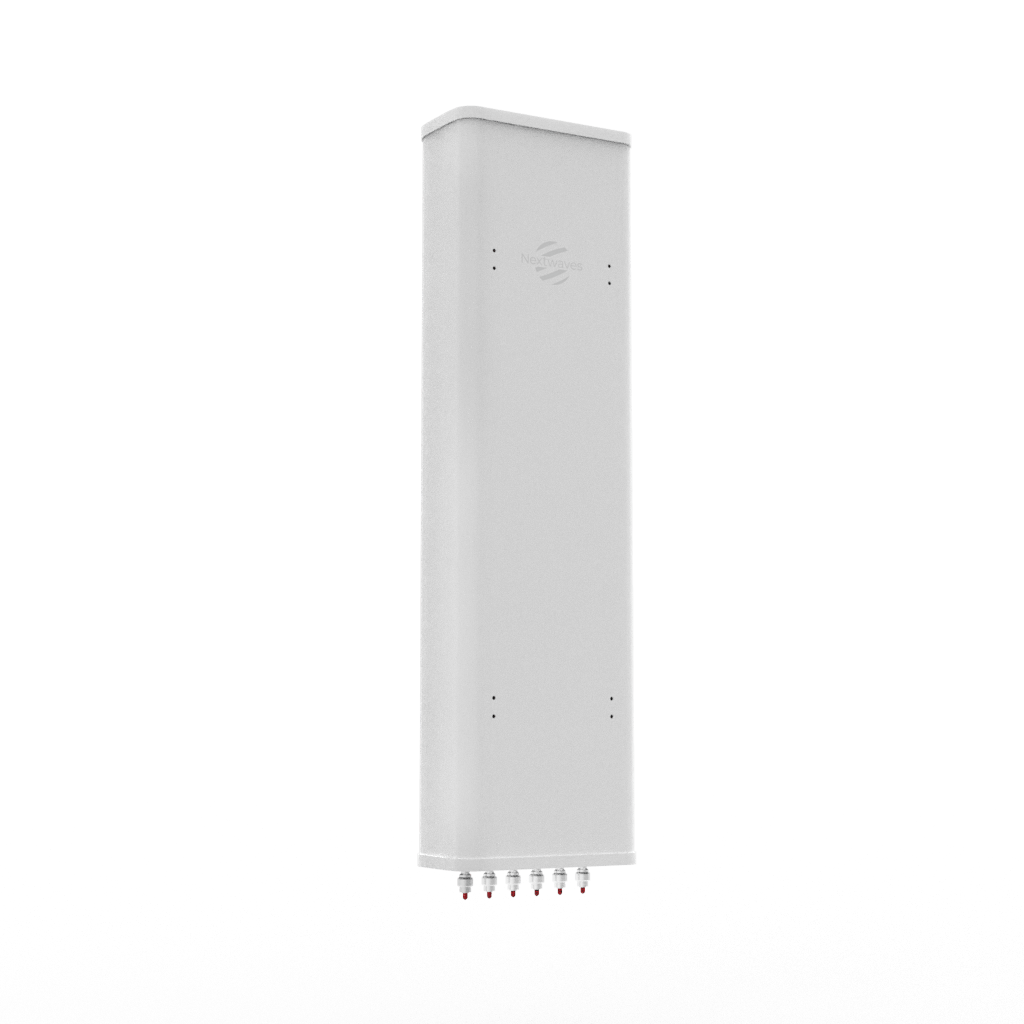
BTS 4G Antenna - Lowband

The BTS 4G Antenna - Lowband is a base station panel antenna covering 698 - 960 MHz with 13.2 - 13.8 dBi gain.

  • Frequency: 698 - 960 MHz
  • Antenna gain: 13.2 - 13.8 dBi
  • Dimensions (WxLxD): 350 x 1380 x 150 mm
Devis / Achat

Description

The BTS 4G Antenna - Lowband is a base station panel antenna covering 698 - 960 MHz with 13.2 - 13.8 dBi gain. Dual ±45° polarization, an adjustable 0° - 10° electrical downtilt via a replaceable internal RET and 0° - 20° mechanical downtilt let operators shape coverage per sector. A 67° horizontal and 15° vertical beamwidth suit 4G/LTE base stations, with six 4.3-10 Female connectors and an ASA+PC UV-resistant radome on a 350 x 1380 x 150 mm body.

Fonctionnalités

  1. 698 - 960 MHz low-band coverage for 4G/LTE base stations
  2. 13.2 - 13.8 dBi antenna gain
  3. Dual ±45° polarization
  4. 0° - 10° adjustable electrical downtilt
  5. 67° ± 4.0° horizontal and 15° ± 2.5° vertical beamwidth

Applications

  • Telecommunications
  • 4G/LTE Base Stations
  • Signal Coverage Extension

Spécifications techniques

Frequency
698 - 960 MHz
Antenna gain
13.2 - 13.8 dBi
Polarization
Dual, ± 45°
Electrical downtilt
0° - 10 °
Horizontal beamwidth
67° ± 4.0 °
Vertical beamwidth
15° ± 2.5°
Dimensions (WxLxD)
350 x 1380 x 150 mm
Net Weight
≤ 17 kg
Lightning Protection
DC ground
Connector
6 x 4.3-10 Connector Female (IP67), bottom positioned
E-TILT Adjusting module
Replaceable internal RET, 1 x bottom positioned
Mechanical downtilt
0° - 20°
Mounting interface
Pole mounting (Ø45 - Ø120 mm)
Wind load (at 150 km/h)
Front/Rear: 640 N, Lateral: 350 N
Survival wind speed
200 km/h
Radome material
ASA+PC, UV resistance
Radome color
Gray (RAL 7047)

RESSOURCES

Outils et documentation RFID

Accédez à notre SDK, aux outils de connectivité des lecteurs et aux guides d'utilisation pour intégrer et déployer efficacement des solutions RFID.

SDK du protocole Nextwaves NRN

Nos SDK open source pour TypeScript, Python et Go offrent une intégration complète avec les lecteurs RFID Nextwaves NRN. Construisez des applications d'inventaire, le suivi des actifs et la surveillance des étiquettes en temps réel avec un minimum de configuration.

Voir sur GitHub

Référence d'encodage GS1 EPC

Référence détaillée pour SGTIN-96, SSCC-96, GRAI-96 et autres schémas d'encodage GS1 EPC. Inclut le calcul du chiffre de contrôle, la recherche du préfixe d'entreprise et la génération d'URI GS1 Digital Link pour une intégration transparente de la chaîne d'approvisionnement.

Essayer l'encodeur EPC