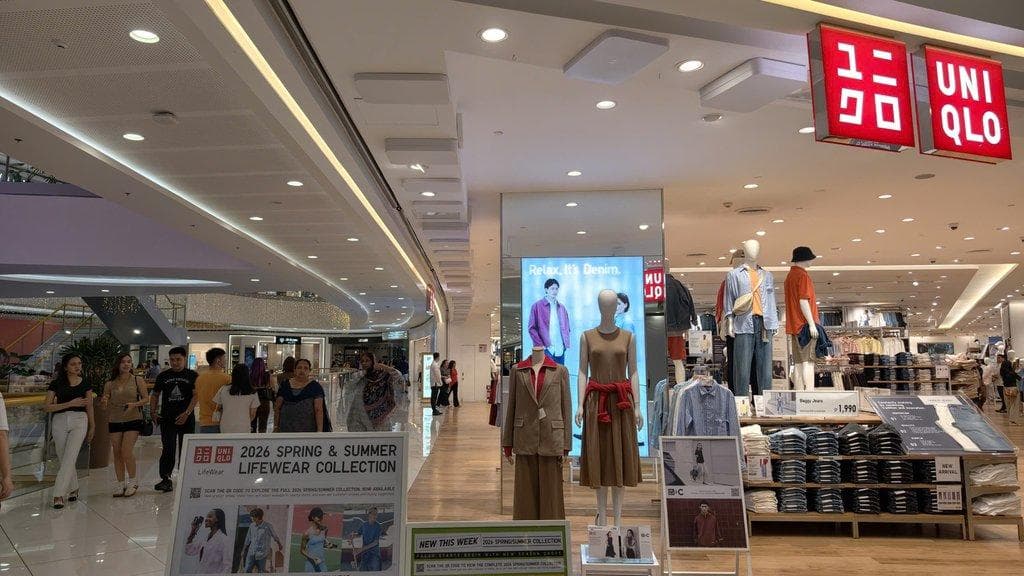
Uniqlo's Invisible Revolution: Decoding Ceiling-Mounted RFID Antenna Technology
When walking into a modern Uniqlo store, customers might not notice anything different right away. The bulky, awkward security gates at the entrance are gone. The space is open, airy, and barrier-free. However, the absence of those gates signals a deep technological revolution happening right above their heads. Uniqlo has pioneered removing traditional pedestal RFID security systems and replacing them with a nearly invisible solution: ceiling-mounted RFID antennas. This change isn't just an aesthetic upgrade; it represents a technical leap from a simple 2D radio energy curtain to an intelligent, directional 3D surveillance network. To understand the importance of this shift, we need to dive into the physics and engineering, comparing two generations of technology and decoding how phased array antennas are reshaping the future of retail.
The Old Generation: Anatomy of a Traditional RFID Security Gate
Security gate systems, or pedestals, have been a familiar part of the retail experience for decades. Basically, they are two pillars placed on either side of an exit, creating a "detection field" between them. Inside each pillar is one or more large loop antennas. Their operating principle is relatively simple: these antennas emit a continuous radio energy field, usually at UHF (Ultra-High Frequency) between 860-960 MHz. When a product with an RFID tag enters this field, the chip on the tag "wakes up" and uses the captured energy to broadcast its unique identification code (EPC - Electronic Product Code). The antenna in the gate picks up this feedback signal, and if the system determines the item hasn't been paid for, it triggers the alarm.
However, this simplicity comes with many inherent technical limits. The biggest limitation lies in the nature of the beam pattern they create. A traditional gate antenna creates a wide, diffused, and non-directional beam. Imagine it like a light bulb without a shade, spreading light in all directions. This RF energy field forms an invisible 2D "curtain" between the two pillars. Any tag passing through this curtain will be read. The problem is, the system has no way of knowing where the tag is within the field or which direction it is moving.
This leads to two major issues:
-
Stray Tag False Alarms: Because the beam is wide and uncontrolled, gate antennas can accidentally read tags on products displayed on shelves or racks near the exit. A customer browsing near the door can trigger a false alarm. This is a built-in problem because the system cannot distinguish between a tag actually leaving the store and one just standing near the door.
-
No Directionality: Gate systems only know that a tag is in their detection field. They cannot determine if the tag is entering or exiting the store. This means a customer who just bought something might trigger the alarm again if they walk back in (for example, if they forgot something). It also makes analyzing customer movement data impossible.
Additionally, these gates take up valuable floor space, usually 60-80cm wide per pillar, narrowing the walkway and creating a psychological barrier-a constant reminder of theft prevention. They are also prone to interference from nearby metal objects, like shopping carts or building structures, which can distort the RF field and create "blind spots."
The New Generation: Inside a Ceiling Antenna - The Power of Phased Arrays
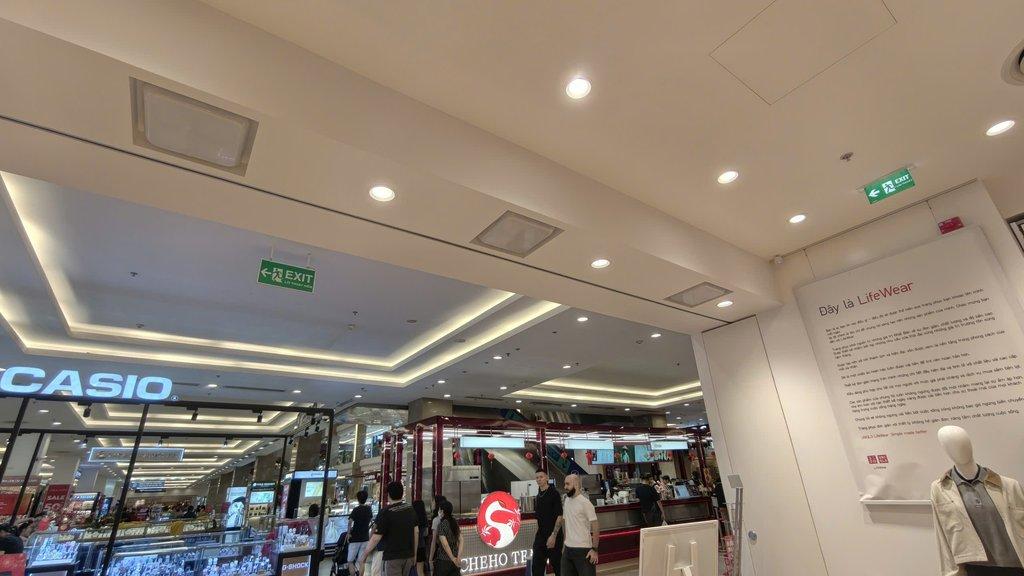
The solution pioneered by Uniqlo and leading tech providers like Nedap (with iD Top), Sensormatic (with RFID Overhead 360), and Impinj (with xArray) is a total shift in antenna architecture. Instead of one large, single antenna, the ceiling system uses a phased array antenna. This concept is borrowed from advanced military and telecom applications, such as radar and 5G networks.
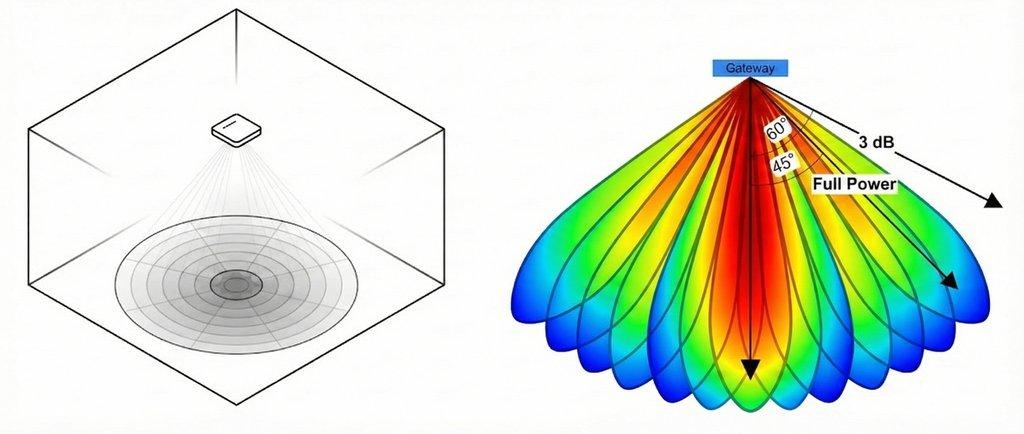
A phased array consists of many small, individual antenna elements (usually square or round patch antennas) arranged in a matrix on a single circuit board. For example, a system might have a 4x4 array of 16 antenna elements. The magic happens not in the elements themselves, but in how they are controlled. Instead of giving all elements the same RF signal, the system uses phase shifters to precisely adjust the time delay (or phase) of the signal sent to each element.
The principle of wave interference tells us that when waves combine, they can strengthen (constructive interference) or cancel (destructive interference) each other. By controlling the phase difference between signals from each antenna element, the system can "steer" the main beam of the entire array in a specific direction. This is called beam steering technology.
Imagine you and 15 friends standing in a line shouting together. If you all shout at the same time, the sound wave travels straight ahead. But if the first person shouts, then the second person shouts a millisecond later, the third a millisecond after that, and so on, the combined sound wave won't go straight-it will tilt to the side. By changing these delay intervals, you can control the direction of the total shout without moving. A phased array antenna works the same way with radio waves.
Creating Smart Beams:
Systems like the Impinj xArray can create up to 52 distinct "beam states," while the Zebra ATR7000 can create hundreds of narrow, flashlight-like beams. Each beam can be directed to a specific 3D space below the antenna. Instead of a 2D "curtain," the system now has a set of 3D RF energy "fingers" it can point anywhere within its coverage area.
This directly solves the problems of gate systems:
-
Eliminating Stray Tags: The system can be programmed to only create beams in a tightly defined 3D detection zone right at the exit. It can create RF energy "dead zones" in areas where products are displayed nearby. If a tag is read, the system knows its EPC code and exactly which beam read it. Since each beam corresponds to a specific spatial location, the system can pinpoint the tag's position with high accuracy and ignore tags outside the pre-defined alarm zone.
-
Accurate Direction Detection: By scanning through different beams rapidly, the system can track a tag's path as it moves. For example, the Nedap iD Top system uses three beams pointing in three different directions. If a tag is read first by Beam 1, then Beam 2, and finally Beam 3, the system can conclude with certainty that the tag is moving in a specific direction (e.g., leaving the store). Conversely, if the order is 3-2-1, it knows the tag is entering. This direction detection is a breakthrough, allowing the system to reliably distinguish between a potential theft and a returning customer.
Differences in Polarization and Gain:
Traditional gate antennas often use circular polarization to ensure they can read tags regardless of their orientation. However, their beams have relatively low and wide gain. Antenna gain measures the ability to focus energy in a specific direction. A wide beam means energy is spread over a large area.
Phased array antennas also use circular or dual-linear polarization for optimal reading. However, by combining energy from multiple elements, they can create much higher gain and significantly narrower beams. A narrow, high-gain beam is like a laser pointer, focusing energy on a small spot, allowing it to read tags at greater distances with higher reliability. The ability to switch quickly between many narrow, high-gain beams allows the ceiling system to cover a large area with precision that a wide-beam, low-gain antenna could never achieve.
In short, the move from security gates to ceiling systems is a shift from a blunt tool to a precision scalpel. It replaces a static, non-directional energy field with an intelligent, adaptive 3D surveillance network that can see, track, and understand the movement of every product in the retail space with unprecedented detail. This is the technical foundation that allows Uniqlo to create a shopping experience that is both secure and completely barrier-free.
Impact and Future: Beyond Security
The technical superiority of phased array antennas doesn't stop at theft prevention. The ability to locate and track the movement of every product in real-time opens up a range of valuable applications, turning a security system into a powerful business intelligence platform.
Customer Flow Analysis: By anonymously tracking the movement of products in customer baskets, retailers can gain invaluable insights into how customers move through the store, which areas attract the most attention, and which products are often considered but not bought. This data can be used to optimize store layouts, display strategies, and marketing campaigns.
Smart Fitting Room Management: The system can automatically detect which items are taken into and out of fitting rooms. This helps staff know which items were left behind, ensuring they are quickly returned to the sales floor instead of piling up. It also provides data on fitting room conversion rates-the percentage of tried-on items that are actually purchased-a key indicator of product fit and appeal.
Full Automation: In the future, the same ceiling antenna system could perform multiple functions. It could continuously inventory the entire store in real-time, eliminating the need for manual counts. It can act as a security system. And it could even enable a truly contactless checkout experience, where customers simply walk out of the store and their accounts are automatically charged for the items they carry, similar to the Amazon Go model.
Uniqlo's shift to ceiling-mounted RFID security isn't just a story about one retailer. It's a glimpse into the future of data-driven retail. It proves that by investing in advanced foundational technology, companies can solve old problems in entirely new ways while opening up previously unimaginable opportunities. The revolution won't be televised; it will happen quietly, right above us, driven by the invisible beams of phased array antennas.
Deep Physics Analysis: The Magic of Wave Interference
To truly understand the power of beamforming technology, we need to look at some basic physics principles of waves. At the core of a phased array is the phenomenon of wave interference. When two or more waves meet in space, their amplitudes add together. If the peak of one wave meets the peak of another, they reinforce each other and create a wave with a larger amplitude (constructive interference). Conversely, if the peak of one wave meets the valley of another, they cancel each other out, creating a wave with a smaller amplitude or zero (destructive interference).
In a phased array antenna, each small antenna element acts as an individual signal source. By controlling the relative phase of the signal fed to each element, the system can precisely control where constructive and destructive interference occurs in space. The phase of a wave is essentially its position in the vibration cycle at a specific time. Shifting the phase of a signal is equivalent to delaying it by a tiny fraction of time.
Creating the Main Beam:
When all antenna elements in the array emit signals in phase (no delay), the waves interfere most strongly in the direct forward direction, perpendicular to the array surface. This creates a powerful main lobe pointing straight down, like a spotlight. In other directions, the waves arrive at slightly different times, leading to varying degrees of destructive interference, which creates much smaller sidelobes.
Beam Steering:
The real magic begins when we introduce a linear phase shift across the array. Suppose we have a row of 8 antenna elements. If we feed the signal to the first element, then the second with a small phase delay (e.g., 22.5 degrees), the third with a 45-degree delay, and so on, the resulting wavefront will no longer be perpendicular to the array. Instead, the direction where all waves arrive in phase (creating maximum constructive interference) will shift by an angle. By increasing or decreasing the phase shift between adjacent elements, the system can steer the main beam to almost any desired angle within its field of view. This entire process is done electronically at extremely high speeds (microseconds) without any moving mechanical parts.
Beam Shaping:
Beyond steering the direction, advanced systems can also shape the beam. By applying more complex phase and amplitude adjustments to the elements, the system can make the beam wider or narrower, or even create "nulls" in the beam to eliminate interference from a specific direction. For example, the system can create a wide fan-shaped beam to cover an entire walkway, or a very narrow pencil beam to locate a tag with high precision. This capability is vital for creating well-defined 3D detection zones and minimizing unwanted tag reads.
Detailed Comparison: Security Gates vs. Ceiling-Mounted Antennas
To clarify the differences, let's look at a detailed comparison of technical specs and performance between the two technologies:
| Technical Feature | Security Gate System (Pedestal) | Ceiling Antenna System (Overhead Phased Array) |
|---|---|---|
| Antenna Architecture | 1-2 large loop antennas, single or circular polarization. | Array of many (8, 16, 32+) small patch elements. |
| Beam Steering | None. Fixed, static beam. | Yes. Electronic beam steering. |
| Number of Beams | 1 or 2 wide, diffused beams. | Dozens to hundreds of narrow, addressable beams (e.g., Impinj xArray has 52 beams). |
| Gain | Low to medium. Energy is spread out. | High. Energy is concentrated into narrow beams. |
| Beam Width | Very wide (usually > 90 degrees). | Very narrow (can be down to a few degrees per beam). |
| Direction Detection | Impossible. Only detects presence. | Yes. Tracks tag trajectory through beams to determine direction. |
| Stray Tag Rejection | Poor. Prone to false alarms from nearby tags. | Excellent. Creates precise 3D detection zones and ignores outside tags. |
| Location Accuracy | Very low. Only knows the tag is "between the gates." | High. Can locate tags in 3D space with high precision (e.g., Zebra ATR7000 within 0.6m). |
| Coverage Area | A 2D "curtain" between two gates. | A 3D hemisphere below the antenna, divided into many small zones. |
| Physical Footprint | Large. Takes up floor space, narrows the walkway. | None. Ceiling-mounted, completely invisible to customers. |
| Aesthetics | Poor. Creates a feeling of surveillance, obstructs store design. | Excellent. Frees up space, creating an open and friendly entrance. |
| Scalability | Difficult. Needs more gates to cover wider entrances. | Easy. Multiple antennas can be used to cover large areas seamlessly. |
By applying more complex phase and amplitude adjustments to the elements, the system can make the beam wider or narrower, or even create "nulls" in the beam to eliminate interference from a specific direction. For example, the system can create a wide fan-shaped beam to cover an entire walkway, or a very narrow pencil beam to locate a tag with high precision. This capability is vital for creating well-defined 3D detection zones and minimizing unwanted tag reads.
Analysis of Typical Market Products
The shift to ceiling-mounted systems is driven by several breakthrough products from leading RFID technology companies. Each product takes a slightly different approach to the challenge of 3D space monitoring.
1. Nedap iD Top:
Nedap, a Dutch company, was one of the earliest pioneers with their iD Top system. Their approach focuses on simplicity and reliability in direction detection. iD Top uses an antenna array designed to create three distinct, well-defined beams. By tracking the order in which a tag is detected by these three beams, the system can reliably determine if a tag is entering, exiting, or just passing by. Nedap's philosophy is to focus on perfecting the core task of EAS-preventing loss at the exit-with the highest possible accuracy. They emphasize "stray tag filtering" and "direction detection" as key advantages, helping to almost completely eliminate false alarms and provide clear data on potential loss events.
2. Impinj xArray Gateway:
Impinj, a leading American RFID chip and reader manufacturer, took a more ambitious approach with the xArray Gateway. Instead of just focusing on exit security, xArray is designed as an "always-on" wide-area monitoring platform. It uses a much more complex antenna array capable of creating 52 individual beams. This allows it to not only detect direction but also determine the location of a tag within its coverage area with relative accuracy. Impinj calls this "Item Intelligence." Their vision is for retailers to deploy multiple xArrays throughout the store-on the sales floor, in the warehouse, in fitting rooms-to create a comprehensive sensor network that tracks every product in real-time. In this scenario, the EAS function is just one of many applications running on the platform. Other applications include continuous automated inventory, customer behavior analysis, and fast product searching.
3. Zebra ATR7000:
Zebra Technologies, a giant in automated data collection, has taken the game to a new level with their ATR7000 reader. Marketed as a Real-Time Location System (RTLS), the ATR7000 can create hundreds of ultra-narrow, flashlight-like beams. This allows it to achieve incredible location accuracy, often within 0.6 meters. Instead of just knowing a product is in a wide "zone," the ATR7000 can tell you which shelf it is on, or even which part of the shelf. This technology is particularly useful in complex environments like large warehouses or manufacturing floors, but it is also being applied in retail to provide the most detailed location data possible. For EAS applications, this precision means the system can create an extremely sharp virtual boundary at the exit, further minimizing the chance of errors.
The diversity in these approaches shows the maturity of the market. Retailers can now choose a solution that best fits their specific needs, whether it's a simple, reliable ceiling-mounted EAS system or a comprehensive RTLS platform providing detailed data on everything happening in their physical space. However, all these solutions share a common fundamental principle: the power of the phased array antenna to turn a 3D space into an intelligent data network.
Conclusion: From Security Gates to Sensor Networks
Uniqlo's transition from RFID security gates to ceiling-mounted systems is not just a hardware change; it is a shift in philosophy. It marks the move from a defensive approach focused on catching thieves to a proactive approach focused on understanding and optimizing the entire retail space. Phased array antenna technology is at the heart of this transformation, providing the "eyes" and "brains" needed to turn a static physical space into a dynamic digital environment.
By removing the physical and psychological barriers of traditional gates, Uniqlo has created a more open and welcoming shopping experience. But more importantly, they have deployed a platform capable of gathering data with unprecedented detail. They don't just know what left the store, but also which path it took, where it was before, and what other products it interacted with. This is the kind of data that can drive smarter business decisions, from store layout to product strategy.
For the retail industry as a whole, Uniqlo's story is a call to action. It shows that the technology to create true "smart stores" is already here. The challenge no longer lies in the technology itself, but in the ability of organizations to apply it strategically, integrate it into existing processes, and use the insights it provides to create real value for both the business and the customer. The future of retail will not be shaped by bigger gates or louder alarms, but by the quiet intelligence of invisible sensor networks, working tirelessly to make our shopping experience more seamless, personalized, and efficient than ever. The antenna revolution has begun, and it is happening right over our heads.
Was this article helpful?
Related Articles
Maximizing Asset Visibility: The Ultimate Guide to Anti-Metal UHF RFID Tags
Mar 2, 2026
Mastering UHF RFID in Odoo: Hardware, Workflows, and Best Practices
Mar 2, 2026
Chainway C72 Comprehensive Review: Specs, Pricing, and Top Alternatives
Mar 2, 2026
The Ultimate UWB Module Comparison: Prices, Specs, and Use Cases
Feb 23, 2026