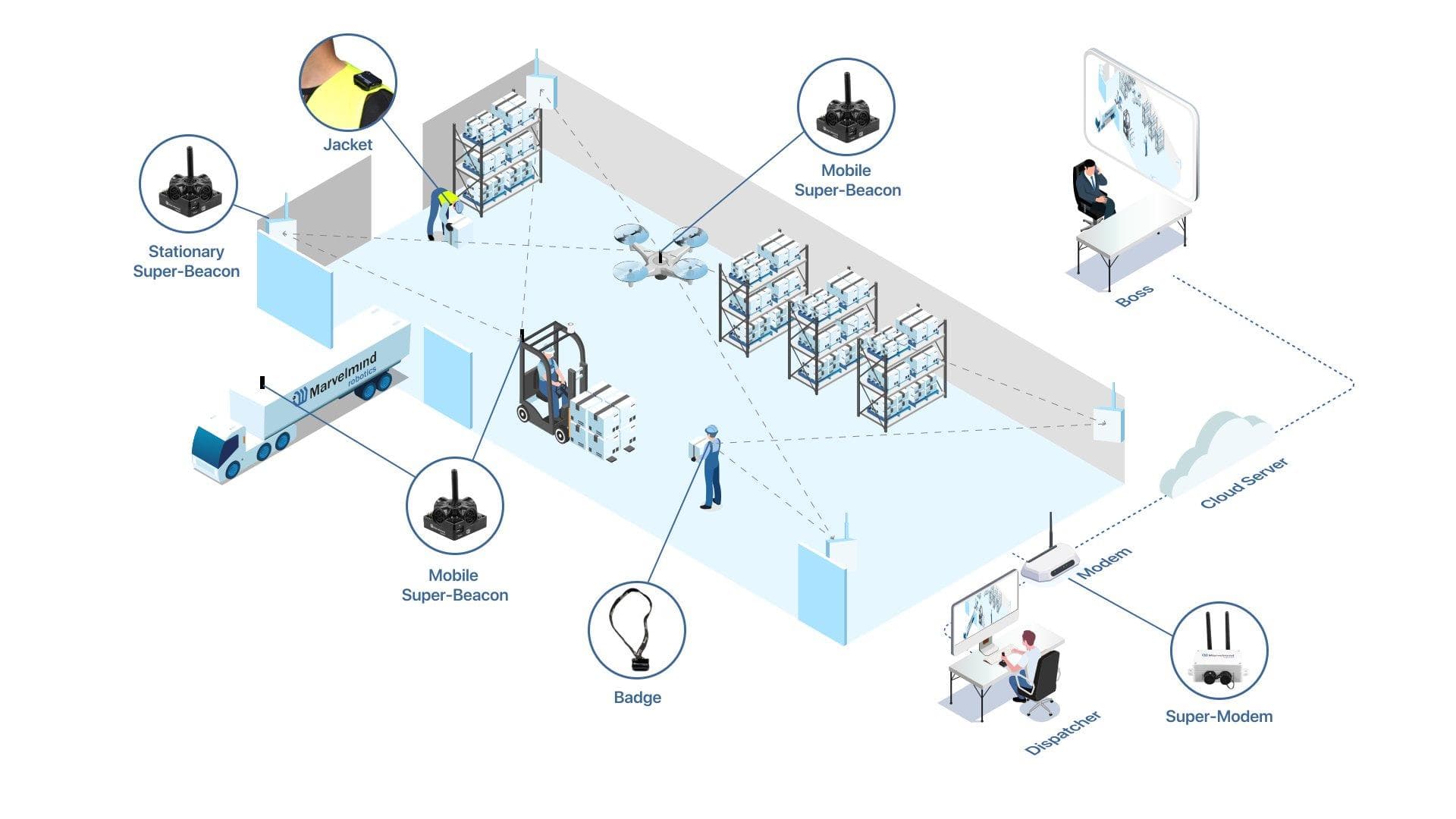
Navigating the complexities of large-scale indoor environments demands a tracking solution that balances pinpoint accuracy with operational efficiency. While Ultra-Wideband (UWB) has long been the gold standard for precision, emerging technologies like Bluetooth AoA are redefining the landscape by offering a cheap, easy-to-deploy alternative. Join us as we compare these contenders to determine if a standard mobile app with Bluetooth is the most effective tool for your facility's needs.
The Challenge of Indoor Navigation in Large Venues
Global Positioning System (GPS) technology fails indoors. This limitation stems from physics. GPS satellites orbit 20,000 kilometers above Earth. They transmit low-power radio signals. These signals require a direct line of sight to your device. Solid structures obstruct this connection.
Building materials absorb and reflect radio waves. Concrete, steel, and low-emissivity glass act as barriers. Engineers call this signal attenuation. A standard roof reduces signal strength by 20 to 30 decibels. This loss renders satellite data useless for indoor navigation. Your device defaults to a broad accuracy radius of 50 meters or fails completely. Nextwaves Industries identifies this signal loss as the primary bottleneck for indoor operational efficiency.
Operational Demands of Large Venues
A "large venue" exceeds simple room-level tracking. These environments cover thousands of square meters. They present complex layouts with high ceilings and metallic interference. We categorize these venues into two distinct operational types. Each mandates specific accuracy levels.
- High-Traffic Public Spaces: Airports, convention centers, and stadiums fall into this category. The priority is pedestrian flow and experience. A 20,000-capacity stadium needs to guide a visually impaired attendee to a specific seat. Zone-level accuracy fails here.
- Industrial Environments: Logistics hubs, cold chain storage, and manufacturing plants prioritize asset visibility. An automated forklift requires centimeter-level precision to engage a pallet. A variance of one meter causes collisions or inventory errors.
The Blue Dot Expectation
Users demand continuity. They expect the "Blue Dot" on their mobile screen to behave indoors exactly as it does outdoors. It must move smoothly. It must update instantly. It must show orientation. This expectation sets a high bar for indoor positioning systems (IPS).
Standard Bluetooth Low Energy (BLE) beacons using Received Signal Strength Indicator (RSSI) often struggle here. RSSI fluctuates due to interference. The Blue Dot jumps erratically. It lags behind the user. In a sprawling convention center, this lag causes visitors to miss turns. In a warehouse, it means a lost high-value asset.
| Environment | The Challenge | Required Precision | Stadiums | Dense crowds block signals; complex tiers. | 10-30 cm (Seat-level) | Airports | Long distances; rapid movement. | 3-5 m (Gate-level) | Warehouses | Metal racking causes multipath interference. | 10-30 cm (Item-level) |
|---|
Achieving this "Blue Dot" stability requires technology stronger than basic signal strength measurement. You need systems capable of Time-of-Flight (ToF) or Angle-of-Arrival (AoA) calculations. Technologies like Ultra-Wideband (UWB) and the new Bluetooth Channel Sounding meet these rigid demands. Nextwaves encourages facility managers to assess their specific accuracy needs before investing in infrastructure.
Ultra-Wideband (UWB): The Gold Standard for Precision
Ultra-Wideband (UWB) establishes the benchmark for indoor positioning. It delivers 10-30 cm precision. This accuracy surpasses Bluetooth Low Energy (BLE) and Wi-Fi. It serves mission-critical applications where approximate location fails. Nextwaves Industries integrates UWB into high-performance inventory systems for this reason.
Mechanism: Time-of-Flight vs. Signal Strength
Most positioning systems estimate distance using Received Signal Strength Indicator (RSSI). RSSI measures how loud a signal sounds. Environmental factors distort this measurement. Metal absorbs signals. Walls reflect them. The resulting location data fluctuates.
UWB uses Time-of-Flight (ToF). It measures the time a radio pulse takes to travel from a transmitter (tag) to a receiver (anchor). It calculates distance based on the speed of light. Light speed remains constant. This method eliminates errors caused by signal attenuation.
| Metric | RSSI (BLE/Wi-Fi) | UWB (Time-of-Flight) | Accuracy | 1-3 Meters | 10-30 Centimeters | Interference | High (Absorbed by obstacles) | Low (Resists multipath effects) | Latency | Variable | Real-time (Sub-10ms) |
|---|
Operational Advantages
UWB operates across a wide frequency bandwidth. This exceeds 500 MHz. Short signal pulses distinguish direct paths from reflections. This capability prevents multipath fading. Signal reflections confuse narrowband systems like Wi-Fi. UWB ignores these false signals.
You require this stability in industrial environments. Warehouses contain metal racking and moving machinery. These objects block standard RF signals. Nextwaves UWB readers maintain a connection despite these obstacles.
Applications in Supply Chain
- Asset Tracking: Locate high-value tools on the production floor.
- Collision Avoidance: Alert forklift drivers to pedestrian proximity.
- AGV Guidance: Direct automated vehicles without magnetic tape or QR codes.
- Process Analysis: Map movement to identify bottlenecks.
Precision drives efficiency. UWB provides the data necessary for optimization. Nextwaves Industries supplies the hardware to execute this strategy. Contact us to deploy high-precision tracking in your facility.
Bluetooth Angle of Arrival (AoA): The Modern Challenger
Bluetooth 5.1 introduced a fundamental shift in positioning technology. The industry moved from estimating distance via signal weakness to calculating direction via signal phase. This method is Angle of Arrival (AoA). It bridges the gap between low-cost beacons and high-cost Ultra-Wideband systems.
The Mechanism: Calculating Direction
Standard Bluetooth positioning relies on Received Signal Strength Indicator (RSSI). RSSI guesses distance based on how loud the signal sounds. Environmental factors like walls or water bodies distort this data. AoA changes the math.
You install specialized receivers known as locators. These locators feature multi-antenna arrays. A standard Bluetooth tag transmits a direction-finding signal. The signal hits the antennas in the array at slightly different times. The system measures the phase difference of the incoming radio waves. Software calculates the precise angle (azimuth and elevation) of the source. Multiple locators triangulate the exact
Bluetooth 5.1 introduced Angle of Arrival (AoA). This technology shifts indoor positioning from signal strength estimation to direction finding. Traditional Bluetooth Low Energy (BLE) systems rely on Received Signal Strength Indicator (RSSI). RSSI provides zone-level data. AoA delivers precise coordinates.
Real-World Accuracy
AoA achieves positioning accuracy between 0.1 and 0.5 meters. Standard RSSI fluctuates between 5 and 10 meters. This precision enables granular tracking in dense environments. You locate specific pallets in crowded staging areas. You eliminate time spent searching for misplaced assets.
Key Applications in Logistics
Nextwaves deploys AoA for specific operational goals:
- Forklift Optimization: Track vehicle routes to reduce idle time.
- Employee Safety: Detect proximity between heavy machinery and staff tags.
- Wayfinding: Guide pickers to exact bin locations via handheld tablets.
Integration with RFID
AoA complements UHF RFID. RFID handles bulk scanning at dock doors. AoA handles real-time movement on the floor. Nextwaves software merges these data streams. You view a single unified dashboard for all inventory states.
Standard Bluetooth Beacons (RSSI): The Cost-Effective Proximity Solution
The Mechanics of Signal Strength
Standard Bluetooth beacons broadcast a continuous identifier. Your mobile device detects this signal and measures its intensity. Engineers call this measurement the Received Signal Strength Indicator (RSSI). The system estimates distance based on signal degradation. A strong signal implies the beacon sits nearby. A weak signal suggests distance.
Accuracy Limitations
RSSI offers zone-level accuracy. Expect a variance of 3 to 5 meters. Environmental factors impact signal stability heavily. Metal shelving reflects radio waves. Human bodies absorb 2.4 GHz signals. A crowded venue changes the signal profile completely. This fluctuation makes consistent sub-meter positioning impossible with RSSI alone.
The Economic Advantage
Low deployment costs drive RSSI adoption. This technology presents the lowest barrier to entry for indoor positioning.
- Hardware Costs: Beacons cost between $10 and $20 per unit.
- Installation: Battery-powered units require no cabling. Peel-and-stick mounting works for most surfaces.
- Maintenance: Coin-cell batteries last 5 years or more.
- Compatibility: Almost every smartphone detects BLE signals natively.
Optimizing Performance
Software compensates for hardware inaccuracy. Modern applications use Sensor Fusion. This process combines RSSI data with the smartphone's accelerometer and gyroscope. Augmented Reality (AR) overlays provide visual cues to the user. These additions mask signal instability but do not fix the underlying lack of precision. Major providers like Mappedin and Pointr use this approach to enable wayfinding in airports without expensive infrastructure.
Verdict: When to Use RSSI
Select standard beacons for proximity detection. They excel at triggering notifications when a user enters a general area. Retailers use them for "near me" marketing. Airports use them for general gate finding. Do not use RSSI for precise asset tracking or complex industrial guidance. For tasks requiring centimeter-level precision, Nextwaves recommends evaluating UWB or Angle-of-Arrival systems.
Comparative Verdict: Matching Tech to Venue Type
Warehouses and Logistics: Precision Safety
High-velocity industrial environments demand absolute precision. UWB delivers 10-30 cm accuracy. This technology prevents forklift collisions and tracks individual pallets in dense storage. Metal racking and moving machinery create signal interference. UWB resists this interference better than any other standard. The investment of approximately $10 per square meter pays for itself through accident prevention and inventory accuracy. Nextwaves recommends UWB for all mission-critical industrial tracking.
Stadiums and Airports: High-Traffic Wayfinding
Large public venues require a balance between accuracy and consumer accessibility. Bluetooth Angle-of-Arrival (AoA) fits this need. It provides sub-meter accuracy (0.5m-1.5m). This precision guides fans to specific seats or travelers to boarding gates. AoA requires ceiling-mounted antenna arrays. This infrastructure supports high user density without the extreme cost of UWB. It enables turn-by-turn navigation apps for complex terminals and arenas.
Museums and Retail: Proximity Engagement
Pinpoint location matters less here than zone detection. Standard Bluetooth Low Energy (BLE) beacons suffice. These units cost between $10 and $20. They trigger mobile notifications for exhibit details or digital coupons when a user enters a 3-5 meter zone. The battery life extends beyond five years. This solution minimizes installation effort. It maximizes return on investment for informational and promotional use cases.
Future Outlook: Hybrid Systems and Sensor Fusion
Single technologies rarely operate in isolation. Modern positioning systems employ sensor fusion. This technique combines signal data with smartphone accelerometers and compass readings. It stabilizes the user's location on screen. Bluetooth Channel Sounding (CS) enters the market in 2026. This standard brings UWB-level accuracy to standard Bluetooth chips. It eliminates the need for complex antenna arrays. Android 16 and devices like the Pixel 10 already support this protocol. Plan your infrastructure to support these hybrid inputs.
Technology Selection Matrix
| Venue Type | Recommended Tech | Primary Benefit | Warehouse | UWB | Collision Avoidance | Stadium / Airport | Bluetooth AoA | Accurate Wayfinding | Retail / Museum | Standard BLE | Cost Efficiency |
|---|
Select the system that aligns with your operational risks and budget. Contact Nextwaves to audit your facility and design a positioning architecture that meets your specific accuracy requirements.
Was this article helpful?
Related Articles
Maximizing Asset Visibility: The Ultimate Guide to Anti-Metal UHF RFID Tags
Mar 2, 2026
Mastering UHF RFID in Odoo: Hardware, Workflows, and Best Practices
Mar 2, 2026
Chainway C72 Comprehensive Review: Specs, Pricing, and Top Alternatives
Mar 2, 2026
The Ultimate UWB Module Comparison: Prices, Specs, and Use Cases
Feb 23, 2026