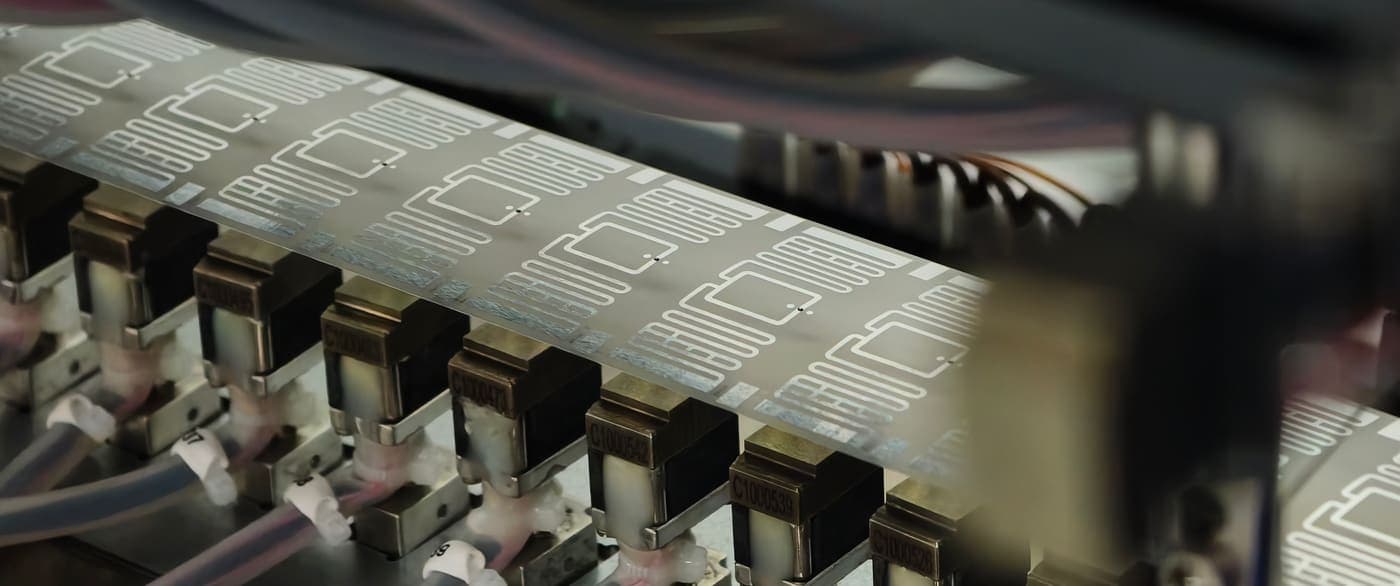
UHF RFID labels were once considered an expensive solution, suitable only for large enterprises. That is no longer true. Nextwaves manufactures UHF RFID labels right in Thu Duc, Ho Chi Minh City, with prices starting from 700 VND per tag. This pricing opens up opportunities to use RFID for both small and medium warehouses, retail chains, asset management units, and many other industries.
Why does Nextwaves sell RFID labels for 700 VND?
Most RFID labels on the Vietnam market are imported goods. Each label passes through a foreign manufacturer, an export unit, an importer, and then a distributor and reseller before reaching end users. Each stage adds costs and profit margins, pushing the final price up.
Nextwaves takes a different approach. We produce RFID inlays and labels at our factory in Ho Chi Minh City, then sell directly to customers without intermediaries. This is the core reason why label prices start from 700 VND, a level that very few domestic providers can achieve.
What is an UHF RFID label, and how does it work?
UHF RFID labels are electronic tags that attach a chip and a small antenna, operating in the ultra-high frequency (UHF) band. They are passive labels, meaning they do not require a battery. When the reader transmits a signal, the label uses that energy to respond with its identification code.
The biggest advantage of UHF RFID is batch reading. A single reader can identify hundreds of tags within one second, at a distance of a few meters, even when the labels are partially obscured or placed inside a shipment box. Tags follow EPC Gen2 and RAIN RFID standards, the two most common standards today, so they are compatible with most RFID reader systems on the market.

How are UHF RFID labels different from barcodes?
Barcodes are still useful for many simple scenarios, but UHF RFID is superior in scale and speed. The table below compares the two technologies based on the most important criteria.
Criteria | Barcode | UHF RFID label |
|---|---|---|
Reading method | Scan each code, requires direct line of sight to the code | Batch reading, no need to see the label |
Read distance | A few centimeters | A few meters, depending on the antenna and the environment |
Inventory counting speed | Slow, manually counting each item | Fast, hundreds of tags per second |
Data | Read-only, fixed when printed | Can be read and rewritten multiple times |
Durability | Fades and tears easily | Better withstands harsher environments |
Cost per label | Nearly 0 VND | From 700 VND |
Suitable for | Basic retail, simple label printing | Warehouses, assets, large-scale retail, anti-theft |
Applications of UHF RFID labels
A 700 VND price tag can generate significant value when applied correctly. Common application areas include:
Warehouse management and inventory counting: count thousands of products in a few minutes instead of a few hours, reducing errors and labor.
-
Retail and payment automation: monitor inventory in real time, speed up checkout at the counter and at self-service kiosks.
-
Asset and equipment tracking: precisely know where tools, equipment, and documents are, and who is holding them.
-
Anti-theft: control items entering and exiting through gates, detect products that have not been paid for or that leave the authorized area.
-
Manufacturing and industry: traceability, track progress along production lines, and manage materials.
Choosing the right inlay type for each need
Not every label can be used for every product. Metal surfaces, liquids, cardboard boxes, or thin materials all affect read performance. Nextwaves advises choosing the correct inlay type based on the surface and operating environment, including specialized inlay lines for metal (on-metal) when needed. Selecting the right label from the start helps ensure stable reader performance and saves costs later.
RFID frequencies in Vietnam
Nextwaves UHF RFID labels operate in the 918 to 923 MHz band, compliant with frequency usage regulations in Vietnam. This frequency range is also compatible with many countries in the ASEAN region, making it convenient for businesses with import-export activities or cross-border supply chains.
Why choose Nextwaves?
Manufactured in Vietnam: good pricing, fast delivery, and on-site technical support within the country.
-
Complete ecosystem: in addition to labels, Nextwaves provides handheld and fixed readers, antennas, Hyperion series kiosks, along with Easy Inventory software and Nextwaves Cloud.
-
All scale coverage: from a few thousand to millions of tags, with better unit pricing as quantities increase.
-
Sample testing and consultation: customers can verify read performance on the actual products before placing orders.
Frequently asked questions
Will a 700 VND UHF RFID label read well?
The price depends on the inlay type and the order quantity. Prices from 700 VND apply to standard UHF label lines when ordering in large quantities, and still achieve stable read performance at a few meters. For special surfaces such as metal or liquids, you need specialized types and the price will differ.
What is the minimum order quantity?
Nextwaves can meet orders from a few thousand to millions of tags. The larger the quantity, the better the unit price.
Can the labels be used with existing readers?
Since the labels follow EPC Gen2 and RAIN RFID standards, they are compatible with most UHF readers on the market, including Nextwaves Hyperion reader lines.
Do you provide samples for testing before ordering?
Yes. Nextwaves provides samples for customers to test read performance on the actual products and in real environments.
Is the tag frequency legal in Vietnam?
Labels operate at UHF 918 to 923 MHz, compliant with regulations in Vietnam and compatible with many ASEAN countries.
Contact for samples and quotations
Contact Nextwaves to receive samples and quotations based on your quantity. Our technical team will recommend the right label type for your specific product and operating environment.