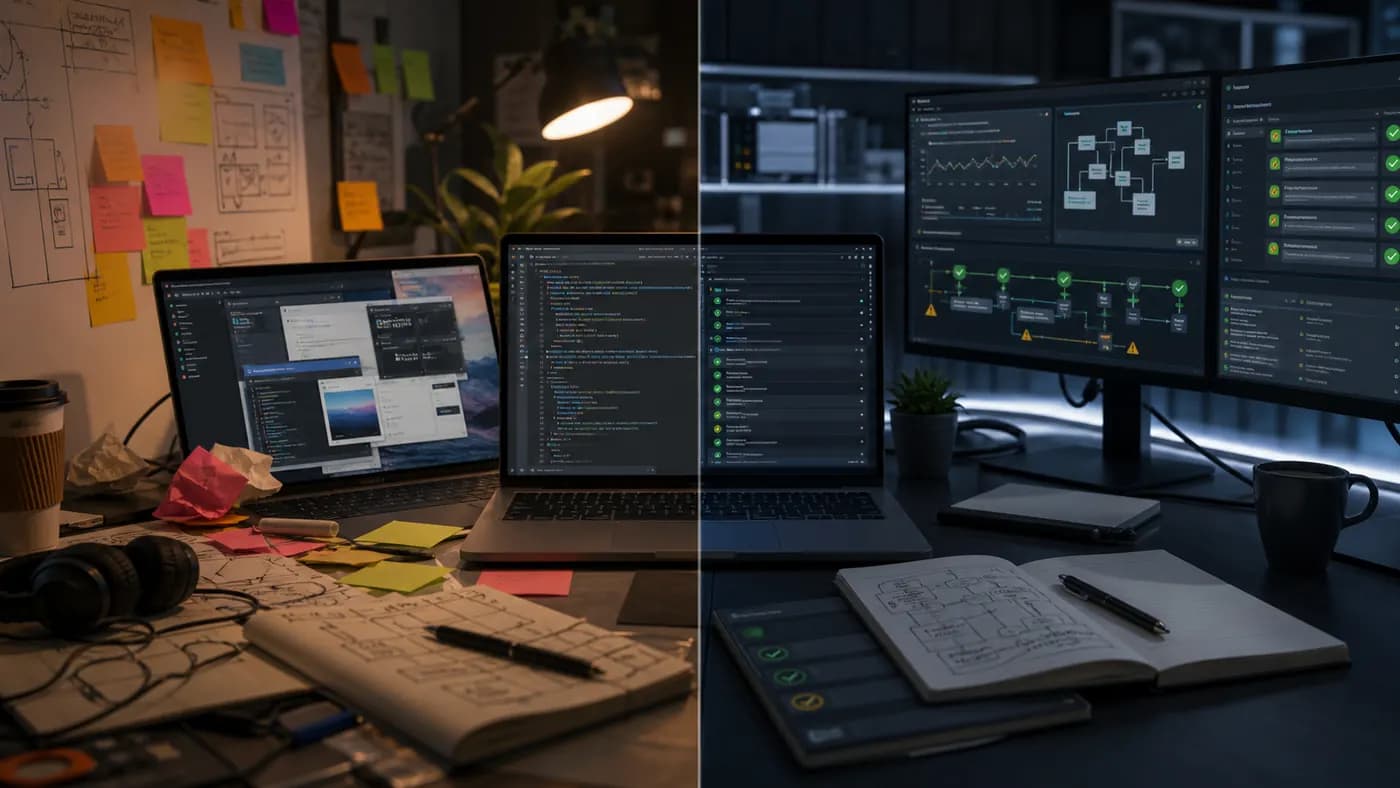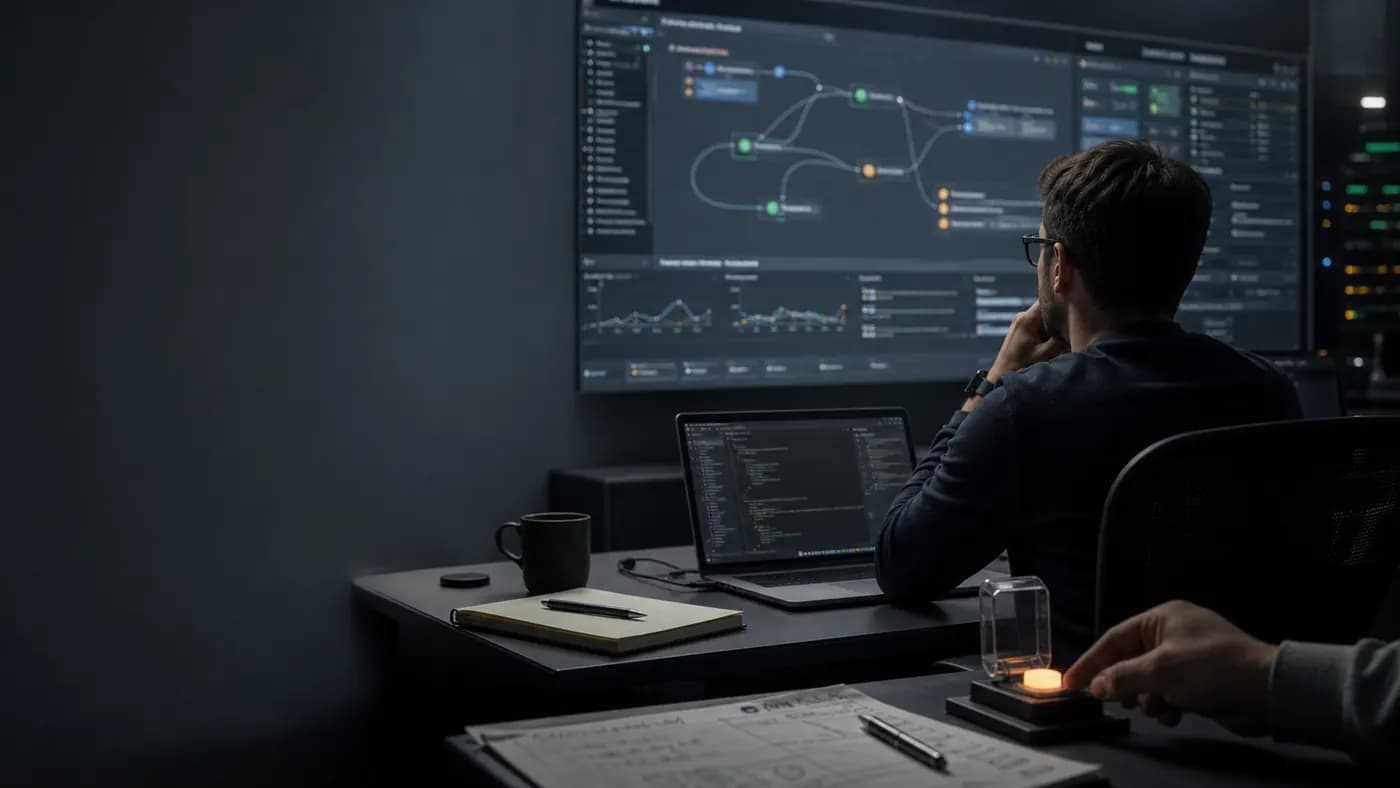
The shift from answering to acting
For the past few years, most of us have related to language models the way we relate to a very well read colleague. You ask a question, you get an answer, and what happens next is up to you. That way of working is quietly being replaced. The interesting problems now are not about getting a model to say the right thing. They are about getting a system to do the right thing, across many steps, with real tools, in messy environments where the first plan rarely survives contact with reality.
This is what agentic engineering is about. It is the discipline of designing, building, and operating systems where a model does not just produce text but takes actions, looks at the results, and decides what to do next until a goal is reached. The model is still at the center of things, but it is now one component inside a larger machine, and most of the real difficulty lives in everything around it.
The shift matters because the skills are different. Prompt writing rewards clever phrasing. Agentic engineering rewards the things that have always made software dependable: clear interfaces, good observability, sensible handling of failure, and a tight loop between what you ship and what you learn. The one genuinely new ingredient is the unpredictable component sitting in the middle of it all.
What an agent actually is
The word agent gets stretched to cover almost anything, so it is worth being precise. An agent is a system that pursues a goal by repeatedly choosing actions based on what it observes, rather than following a fixed script. The defining feature is the loop, not the intelligence. A thermostat follows a rule. An agent decides.
It helps to treat autonomy as a spectrum rather than a yes or no. At one end is a single model call that classifies an email. A little further along, a workflow chains several calls together in a fixed order, which is useful but still scripted. Further still, the model chooses which tool to call and when, and keeps going until it judges the work to be done. At the far end, the system sets its own subgoals, manages its own memory, and runs for hours. Most production systems today sit somewhere in the middle, and that is usually the right place to be, because full autonomy is rarely what a problem actually needs.
Deciding where your system sits on this spectrum is one of the most clarifying things you can do early. It tells you how far you can lean on the model's judgment, how much structure you need to impose, and where the risk is going to concentrate.
The agent loop
Strip away the framework names and the marketing, and almost every agent runs the same loop. It gathers context about its situation, reasons about what to do, takes an action, and observes what happened. Then it goes around again, using what it just learned, until the goal is reached or it gives up.
Each pass through this loop is a decision point, and decision points are where things go right or wrong. A good agent loop is not the one with the cleverest prompt. It is the one where each stage has just enough information to make a sound choice and no more. Give the model the entire history of everything that has happened and it loses the thread. Give it too little and it acts blind. Much of the craft is in deciding what the model gets to see at each turn.
The loop also explains why building agents feels so different from ordinary software. In normal code you can reason about every path. Here the model can choose a path you never imagined, recover from an error in a way you did not plan, or wander off in a direction that looks reasonable for three steps and then falls apart. You are not writing the path. You are shaping the space of possible paths and trying to make the good ones easy to find.
The anatomy of an agent
It helps to picture an agent as a small set of parts that each do one job. There is the model, which supplies reasoning and language. There are tools, which let the system act on the world and read back from it. There is memory and context, which carry the relevant information into each decision. And there is the orchestration around all of it, which runs the loop, enforces limits, and decides when to stop.
What stands out, once you have built a few of these, is how little of the hard work is about the model itself. The model is mostly a fixed choice. You pick one, you prompt it, you move on. The engineering effort goes into the parts around it. Good tools, good context handling, and good orchestration are what separate a demo that works once from a system you can leave running. Teams that fuss over prompt phrasing and neglect these parts tend to build things that look impressive on a Tuesday and are broken by Friday.
Tools and context are the real surface
If the loop is the skeleton, tools and context are where the engineering actually happens.
A tool is the model's hands. It is how the agent reads a database, sends a message, runs a query, or moves a file. The quality of your tools sets a hard ceiling on what the agent can do, and tool design turns out to be a craft in its own right. A good tool does one clear thing, carries a name and description that tell the model exactly when to reach for it, checks its inputs, and returns results that are easy to act on. A vague tool with an ambiguous description is worse than no tool at all, because the model will use it confidently and incorrectly. The care you would put into designing an interface for a capable but new colleague is roughly the care a tool deserves, because that is roughly the situation.
Context is the other half. A model knows only what is placed in front of it, so on every turn you are answering a quiet question: what does the model need to see right now in order to choose well? This is where the phrase context engineering comes from, and it has become one of the central problems of the field. The naive approach is to keep stuffing more into the window, more history, more documents, more instructions. It does not scale. Attention gets diluted, costs climb, and the model starts to miss the very thing that mattered. The better approach treats context as a budget to be spent on purpose. You retrieve what is relevant, summarize what is old, drop what is finished, and keep the working set small and sharp. Getting this right is often the difference between an agent that stays coherent across a long task and one that slowly loses the plot.
Why agents are hard
Here is the uncomfortable fact that every team eventually discovers. A single model call is reasonably reliable. Chain twenty of them together and small error rates compound into systems that fail more often than they succeed.
The arithmetic is unforgiving. If each step in a ten step task is correct ninety five percent of the time, the whole task succeeds only about sixty percent of the time, and that assumes the errors are independent, which they often are not. One bad observation early on can poison every decision that follows. This compounding is the biggest single reason that agents which dazzle in a demo struggle in production. The demo is one happy path. Production is ten thousand paths, and the long tail is full of inputs nobody thought to consider.
The failure modes develop their own personalities once you have seen enough of them. Agents get stuck in loops, calling the same tool again and again and expecting a different answer. They hallucinate a tool or a result that was never there. They announce success when nothing was accomplished. They quietly carry out the wrong task with complete confidence. None of these are bugs you can chase down with a stack trace. They are behaviors you have to design against, detect when they occur, and recover from gracefully. Accepting this early, rather than hoping that a better model will make it all disappear, is what separates teams that ship agents from teams that only demo them.
Evals and observability
If agents fail in subtle, compounding, hard to predict ways, then the most important thing you can build is not the agent. It is the ability to see what it is doing and to measure whether your changes make it better.
Observability comes first. You cannot debug what you cannot see, and an agent's reasoning is invisible by default. Every run should leave a trace: what the agent saw, what it decided, which tools it called, what came back, and where it ended up. The first time a production agent does something baffling, that trace is the difference between a five minute diagnosis and a five hour one. Treat it as foundational rather than as something to bolt on later.
Evals come next, and they are the real engine of progress. An eval is a repeatable test of whether your system does what it should on the cases you care about. Without them you are flying blind, because the trap with agents is that every change feels like an improvement in the moment. You adjust a prompt, the one example you happen to be looking at gets better, and you have no idea what you just broke everywhere else. A good eval suite, built from real failures you have actually seen, turns that guesswork into measurement. The teams that improve fastest are not the ones with the cleverest prompts. They are the ones with the tightest loop between observing real behavior, scoring it, finding the failure modes, fixing them, and checking that the fix held.
This loop is unglamorous and it is everything. Agentic engineering, more than most kinds of software, is an empirical discipline. You do not reason your way to a reliable agent. You measure your way there.
Guardrails, autonomy, and the human in the loop
Because agents act in the world, the cost of a mistake is no longer a wrong sentence. It is a deleted file, a message sent to the wrong person, a card that gets charged. This changes how you think about safety. You are not only trying to make the model accurate. You are trying to make sure that when it is wrong, and it will be wrong, the blast radius stays small.
The main lever is matching autonomy to stakes. Reading data is cheap to get wrong, so let the agent do it freely. Actions that are expensive or hard to undo deserve friction: a confirmation step, a spending limit, a check the action has to pass before it runs. The skill is in being permissive where it is safe and strict where it is not, instead of wrapping everything in the same heavy process. An agent that has to ask permission for every move is just a slow chatbot, and an agent that can do anything at all is a liability.
The human in the loop is the other half, and the aim is to design the loop well rather than to remove the person entirely. The best designs place a human at the few decision points that genuinely matter and keep them out of the rest. A person who approves every single step soon learns to click yes without reading, which is worse than having no human at all. A person brought in at the one moment that carries real risk, with enough context to make a real judgment, is one of the most effective guardrails there is.
Principles for building well
If there is a single thread running through all of this, it is that agentic engineering rewards restraint and feedback more than cleverness. A few principles tend to hold up.
Start with the simplest thing that could work. A fixed workflow you understand beats an autonomous agent you do not. Add autonomy only when a problem genuinely demands it, and you will find that demand is rarer than the excitement around it suggests.
Invest in the boring parts first. Tools, context handling, traces, and evals are where reliability comes from. They are less fun than prompt wizardry and they matter a great deal more.
Design for failure from the beginning, because your agent will fail. The only question is whether it fails loudly and recoverably or silently and expensively, and your job is to engineer the second case out of existence.
Measure everything, and trust the measurements over your intuition. Your sense of whether a change helped is almost always wrong. The eval suite is right.
And keep the human where the human counts. Not everywhere, which teaches people to stop paying attention, and not nowhere, which removes the last line of defense, but at the points that matter, with the context to act on them.
None of these are exotic. They are the ordinary virtues of good engineering, applied to a component that happens to think a little and to surprise you often. That, in the end, is what agentic engineering really is. It is not a new kind of magic. It is the careful work of building dependable systems around a powerful and unpredictable core, and getting good at it is mostly a matter of taking that unpredictability seriously.