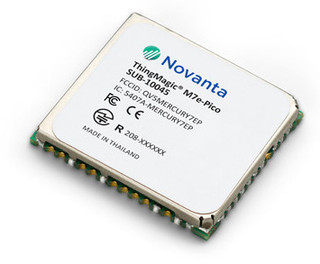
The ThingMagic M7e-Pico is a tiny $100 Impinj E310-based UHF module. Determine its engineering limits and software integration costs.
Technical Specifications
Hardware Overview
The ThingMagic (JADAK) M7e-Pico is an industrial-grade RFID device. It operates within the Global (860-960 MHz) range and supports the EPC Gen2v2, ISO 18000-63 standard, making it widely deployed across enterprise logistics applications.
With an IP rating of Bare PCB (None), it offers protection against specific environmental conditions typical in warehouses or retail backrooms. The reader utilizes 3.3V to 5.25V DC for continuous performance, while its stated maximum read rate peaks at up to ~50 tags/sec.
Connectivity and Network Integration
In modern deployments, network integration is the most significant hurdle. This model offers UART Serial / I2C options for transferring data back to central systems.
However, a major bottleneck with legacy ThingMagic (JADAK) hardware is the heavy reliance on proprietary SDKs (like LLRP) or expensive third-party IoT middleware to process raw tag data into meaningful business intelligence.
The Nextwaves Alternative
If your engineering team is evaluating the ThingMagic (JADAK) M7e-Pico, the Nextwaves NR155 presents a vastly superior cloud-native architecture. Legacy systems inherently drive high capital expenditure through vendor lock-in and proprietary software ecosystems.
Nextwaves completely eliminates this barrier by providing a standard MQTT REST API directly on the device. Your software developers can integrate tag reading directly into your custom ERP or WMS backend in days instead of months, completely bypassing recurring middleware licensing fees.
Frequently Asked Questions
What is the M7e-Pico?
The ThingMagic (JADAK) M7e-Pico is a bare-board surface mount UHF RFID module built around the Impinj E310 reader chip. It parses EPC Gen2v2, ISO 18000-63 formatted tags across Global (860-960 MHz) bandwidths for embedding into medical devices or portable printers.
How much does this setup cost initially?
A raw module starts at around $100 for small batches. This price explicitly excludes necessary engineering costs such as custom PCB carrier boards, soldering, secondary MCU processors, antennas, and housing enclosures required to make it functional.
Why should I choose Nextwaves instead?
Buying raw modules shifts immense software and hardware development burdens onto your engineering teams. Nextwaves offers monolithic, fully integrated turnkey readers that plug directly into standard Ethernet ports out-of-the-box.
Is the hardware durable enough for warehouses?
As a bare SMD component, it weighs a sheer 3 g and measures just 18 x 21 x 3 mm. Lacking any chassis, it holds a Bare PCB (None) rating and will instantly fail if exposed to unmanaged static discharge or moisture.
Does it support multiple network types?
The component interfaces strictly over raw UART Serial or I2C pinouts. It has no native IP networking, meaning all Ethernet, Wi-Fi, or Bluetooth tunneling must be added and secured by the parent device's host processor.
Can my team install this internally?
Hardware engineers must solder the module to a custom motherboard, while software engineers deploy the ThingMagic Mercury API across the host MCU to initialize the radio and cycle its inventory logic.
How does the remote management work?
Geared specifically toward power-constrained OEM embedding, it achieves a maximum read rate of up to ~50 tags/sec. It is suited for single-item identification or wearable tool tracking, not wholesale pallet sweeping.
Do I need proprietary software to run it?
The host processor dictates entirely how parsed data reaches your cloud. You must build firmware bridging logic that converts local UART UART frames into IP packets sent to your enterprise database via Wi-Fi or LTE.
What warranty comes with the reader?
JADAK provides standard component-level warranties against manufacturing faults. However, soldering temperatures or static shocks experienced during OEM integration frequently void these warranties if not strictly logged.
Are the antennas sold separately?
Equipped with a single MMCX or U.FL edge connector to pair with a custom antenna element across the Global (860-960 MHz) block. The maximum transmit power peaks at +24 dBm.