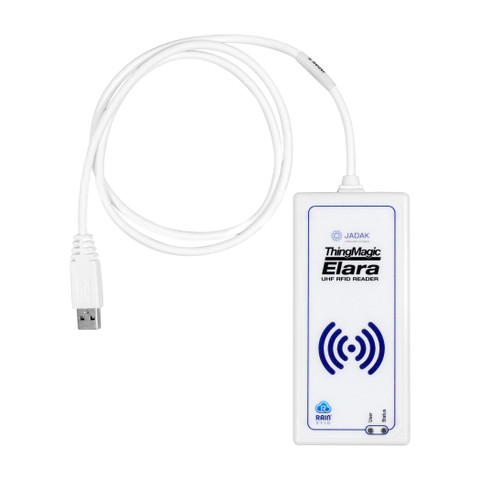
The ThingMagic Elara is a desktop USB EPC reader priced around $400. Review its keyboard emulation functions and compare against Nextwaves Webhook nodes.
Technical Specifications
Hardware Overview
The ThingMagic (JADAK) Elara is an industrial-grade RFID device. It operates within the Global range and supports the EPC Gen2v2, ISO 18000-63 standard, making it widely deployed across enterprise logistics applications.
With an IP rating of indoor rating, it offers protection against specific environmental conditions typical in warehouses or retail backrooms. The reader utilizes USB Bus Power for continuous performance, while its stated maximum read rate peaks at ~50 tags/sec.
Connectivity and Network Integration
In modern deployments, network integration is the most significant hurdle. This model offers USB Type A (keyboard emulation) options for transferring data back to central systems.
However, a major bottleneck with legacy ThingMagic (JADAK) hardware is the heavy reliance on proprietary SDKs (like LLRP) or expensive third-party IoT middleware to process raw tag data into meaningful business intelligence.
The Nextwaves Alternative
If your engineering team is evaluating the ThingMagic (JADAK) Elara, the Nextwaves NR155 presents a vastly superior cloud-native architecture. Legacy systems inherently drive high capital expenditure through vendor lock-in and proprietary software ecosystems.
Nextwaves completely eliminates this barrier by providing a standard MQTT REST API directly on the device. Your software developers can integrate tag reading directly into your custom ERP or WMS backend in days instead of months, completely bypassing recurring middleware licensing fees.
Frequently Asked Questions
What is the Elara?
The ThingMagic (JADAK) Elara is a plug-and-play desktop RFID scanner. It decodes EPC Gen2v2, ISO 18000-63 formats across the Global spectrum, specifically engineered to act as an automated keyboard wedge for simple data entry tasks.
How much does this setup cost initially?
Units are configured starting at $400. Due to its minimalist design, integration budgets are extremely low, drawing USB Bus Power natively and containing no external networking logic or wiring harnesses.
Why should I choose Nextwaves instead?
Nextwaves hardware specializes in untethered operations. Instead of typing data directly into a focused spreadsheet cell like the Elara, our systems seamlessly broadcast massive inventory dumps securely over cloud webhooks.
Is the hardware durable enough for warehouses?
The lightweight plastic shell weighs just 0.19 kg with physical dimensions mapping 97 x 61 x 25 mm. Carrying a generic indoor rating, it is explicitly designed for POS counters, medical carts, or library checkout desks.
Does it support multiple network types?
The device acts as a Human Interface Device (HID) over USB Type A (keyboard emulation). It possesses zero networking logic and inherently relies entirely on the host operating system's firewall.
Can my team install this internally?
Implementation is completely driverless. Setup simply involves plugging the reader into a host PC; any scanned EPC Gen2v2, ISO 18000-63 tags are instantly 'typed' into the active cursor window as raw text stings.
How does the remote management work?
Powered internally by an M6e-Nano embedded core, read counts are severely capped to roughly ~50 tags/sec. It serves strictly as a single-item point-of-friction terminal, incapable of running dense background audits.
Do I need proprietary software to run it?
Because data injection from its USB Type A (keyboard emulation) interface is handled identically to typing on a physical keyboard, complex autonomous background routing to external CRMs requires hacky OS script writing.
What warranty comes with the reader?
The base hardware unit is protected against factory defects for a single year. Standard enterprise support SLAs are rarely purchased for these low-friction utility scanners.
Are the antennas sold separately?
An internal antenna element spans the Global band footprint. The RF power limits are intentionally dialed downwards by the manufacturer to create a contained 12-inch sensing bubble to prevent duplicate reading.