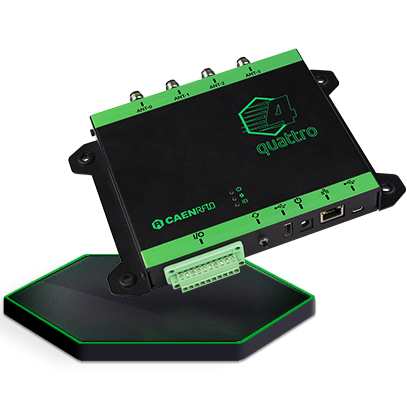
The CAEN RFID Quattro is a 4-port reader for indoor retail or smart cabinets. Compare its $1000 MSRP and specs to Nextwaves REST API controllers.
Technical Specifications
Hardware Overview
The CAEN RFID Quattro (R4321P) is an industrial-grade RFID device. It operates within the 865.6-867.6 MHz (ETSI) / 902-928 MHz (FCC) range and supports the EPC C1 G2, ISO 18000-63 standard, making it widely deployed across enterprise logistics applications.
With an IP rating of IP30, it offers protection against specific environmental conditions typical in warehouses or retail backrooms. The reader utilizes 5V DC or PoE (802.3af) for continuous performance, while its stated maximum read rate peaks at Up to 400 Kb/s.
Connectivity and Network Integration
In modern deployments, network integration is the most significant hurdle. This model offers Ethernet (PoE), USB, GPIO options for transferring data back to central systems.
However, a major bottleneck with legacy CAEN RFID hardware is the heavy reliance on proprietary SDKs (like LLRP) or expensive third-party IoT middleware to process raw tag data into meaningful business intelligence.
The Nextwaves Alternative
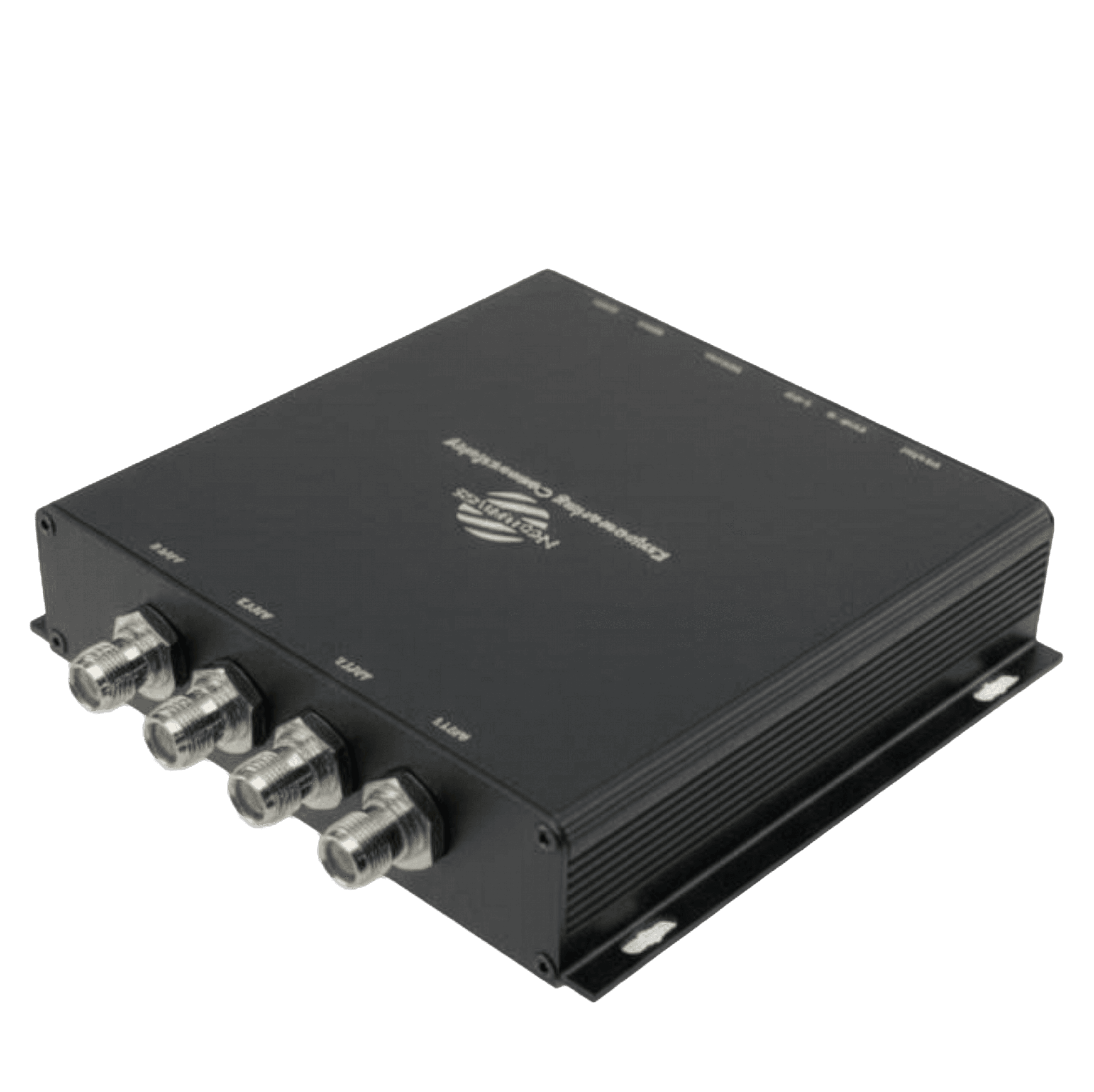
If your engineering team is evaluating the CAEN RFID Quattro (R4321P), the Nextwaves NR155 presents a vastly superior cloud-native architecture. Legacy systems inherently drive high capital expenditure through vendor lock-in and proprietary software ecosystems.
Nextwaves completely eliminates this barrier by providing a standard MQTT REST API directly on the device. Your software developers can integrate tag reading directly into your custom ERP or WMS backend in days instead of months, completely bypassing recurring middleware licensing fees.
Frequently Asked Questions
What is the Quattro (R4321P)?
The CAEN RFID Quattro (R4321P) is a compact, stationary EPC C1 G2, ISO 18000-63 RFID reader. Operating on the 865.6-867.6 MHz (ETSI) / 902-928 MHz (FCC) frequency bands, it is primarily intended for indoor smart cabinet or point-of-sale integration.
How much does this setup cost initially?
The base hardware cost is generally around $1000. A full deployment budget must include up to 4 external antennas, MMCX cables, and 5V DC or PoE (802.3af) networking switching gear.
Why should I choose Nextwaves instead?
Nextwaves maintains an open-architecture approach. Our devices embed MQTT and REST API endpoints natively, allowing developers to query state directly without licensing third-party IoT middleware.
Is the hardware durable enough for warehouses?
The sleek casing weighs 740 g and has dimensions of 210 x 140 x 27 mm. With an indoor-only IP30 rating, it provides minimal durability against environmental ingress and must be kept away from splashing water.
Does it support multiple network types?
Network connectivity is established through its Ethernet (PoE), USB, GPIO ports. While typical IT protocols provide baseline security, segregating RFID hardware on dedicated LAN subnets is heavily recommended.
Can my team install this internally?
Physical mounting utilizes standard flush brackets. To guarantee accuracy, RF transmission settings and dense-interrogator modes must be calibrated to your facility's indoor interference profile.
How does the remote management work?
Under optimal lab conditions, the hardware supports data link rates Up to 400 Kb/s. Firmware and configuration updates are traditionally compiled against the CAEN RFID API.
Do I need proprietary software to run it?
Bridging tag data from the Ethernet (PoE), USB, GPIO interfaces to cloud CRMs or ERPs usually requires intermediate C/C++ polling software, which introduces legacy code overhead.
What warranty comes with the reader?
The manufacturer generally backs the hardware with a standard one-year warranty. Integrators often suggest purchasing extended technical agreements for scaled rollouts.
Are the antennas sold separately?
External near-field or far-field antennas are required to establish the RF portal. Antenna polarization must be carefully selected across the 865.6-867.6 MHz (ETSI) / 902-928 MHz (FCC) band.