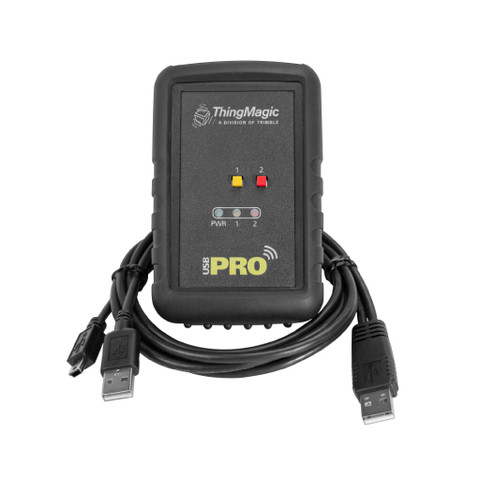
The ThingMagic USB Pro is a $700 specialized desktop reader reliant on USB. Compare its wired requirements against Nextwaves wireless autonomous hardware.
Zehaztapen Teknikoak
Hardwarearen Ikuspegi Orokorra
ThingMagic (JADAK) USB Pro RFID gailu industrial bat da. Global tartean funtzionatzen du eta EPC Gen2v2, ISO 18000-63 estandarra onartzen du, enpresen logistika aplikazioetan oso zabalduta egon dadin.
indoor rating IP balorazioarekin, biltegi edo txikizkako atzeko gelatan ohikoak diren ingurumen baldintza zehatzen aurkako babesa eskaintzen du. Irakurgailuak USB Bus Power erabiltzen du etengabeko errendimendurako, eta bere irakurketa-abiadura maximoa ~50 tags/sec da.
Konektibitatea eta Sarearen Integrazioa
Egungo inplementazioetan, sarearen integrazioa da oztopo nagusia. Eredu honek USB 2.0 Type A aukera eskaintzen ditu datuak sistema zentraletara transferitzeko.
Hala ere, ThingMagic (JADAK) hardware zaharkituaren arazo nagusia SDK jabedunen (LLRP bezalakoak) edo hirugarrenen IoT middleware garestien menpekotasun handia da, etiketen datu gordinak negozio adimen esanguratsu bihurtzeko.
Nextwaves Alternatiba
Zure ingeniaritza taldea ThingMagic (JADAK) USB Pro ebaluatzen ari bada, Nextwaves NR155-ak hodeian oinarritutako arkitektura askoz hobea aurkezten du. Ondare-sistemek kapital-gastu handiak eragiten dituzte saltzaileen blokeoaren eta software-ekosistema jabedunen bidez.
Nextwaves-ek oztopo hori guztiz ezabatzen du MQTT REST API estandar bat gailuan zuzenean eskainiz. Zure software garatzaileek etiketen irakurketa zuzenean integra dezakete zure ERP edo WMS atzeko plano pertsonalizatuan egunetan, hilabetetan baino, bitarteko lizentzia-kuota errepikariak guztiz saihestuz.
Galdera Arruntenak
Zer da USB Pro?
The ThingMagic (JADAK) USB Pro is a stationary, desktop-mounted RFID interrogator. It supports the EPC Gen2v2, ISO 18000-63 protocols over Global frequencies, primarily intended for individual asset encoding, access credential issuance, and point-of-sale checkout.
Zenbat balio du konfigurazio honek hasieran?
Retail pricing typically falls around $700. Deployment budgeting is generally simple since it relies on USB Bus Power directly from the connected PC host without needing external AC wiring or separate antenna brackets.
Zergatik aukeratu beharko nuke Nextwaves besteen ordez?
Nextwaves infrastructure utilizes standalone networking hardware to communicate directly to your SQL databases via webhooks. You completely remove the requirement of keeping a Windows PC constantly powered simply to shuttle EPC data.
Hardwarea nahikoa iraunkorra al da biltegietarako?
The aluminum enclosure checks in at 0.27 kg and measures 97 x 61 x 25 mm. It carries an indoor rating, intended strictly for dry, climate-controlled environments like ticketing booths or developer testing benches.
Sare mota anitz onartzen al ditu?
Data routing is strictly confined to a physical USB 2.0 Type A interface. It establishes no network connections of its own, meaning all security auditing falls entirely on the policies of the connected host computer.
Nire taldeak barnean instala al dezake hau?
Setup is heavily reliant on the ThingMagic Mercury API. Software teams must compile C# / Java bindings to initialize the reader, control the internal transceiver, and manage the stream of incoming hex identifiers.
Nola funtzionatzen du urruneko kudeaketak?
Driven internally by an M6e-Micro module, the desktop read speed peaks at roughly ~50 tags/sec. It is optimized for near-field single tag targeting rather than high-density warehousing sweeps.
Software jabedunik behar al dut hura exekutatzeko?
Because it acts as a peripheral via its USB 2.0 Type A link, developers must write host-side daemon software that polls the USB pipe, packages the data into JSON, and transmits it out to enterprise logistics systems.
Zer berme dakar irakurgailuak?
JADAK supports the USB Pro with a standard desktop hardware warranty. System integrations often utilize it primarily as a programming station rather than a critical high-throughput checkpoint.
Antenak bereiz saltzen al dira?
This model integrates a small ceramic antenna tuned across a wide Global broadband footprint. It deliberately restricts transmit output (up to +30 dBm) to prevent reading unintended tags situated further away in the room.