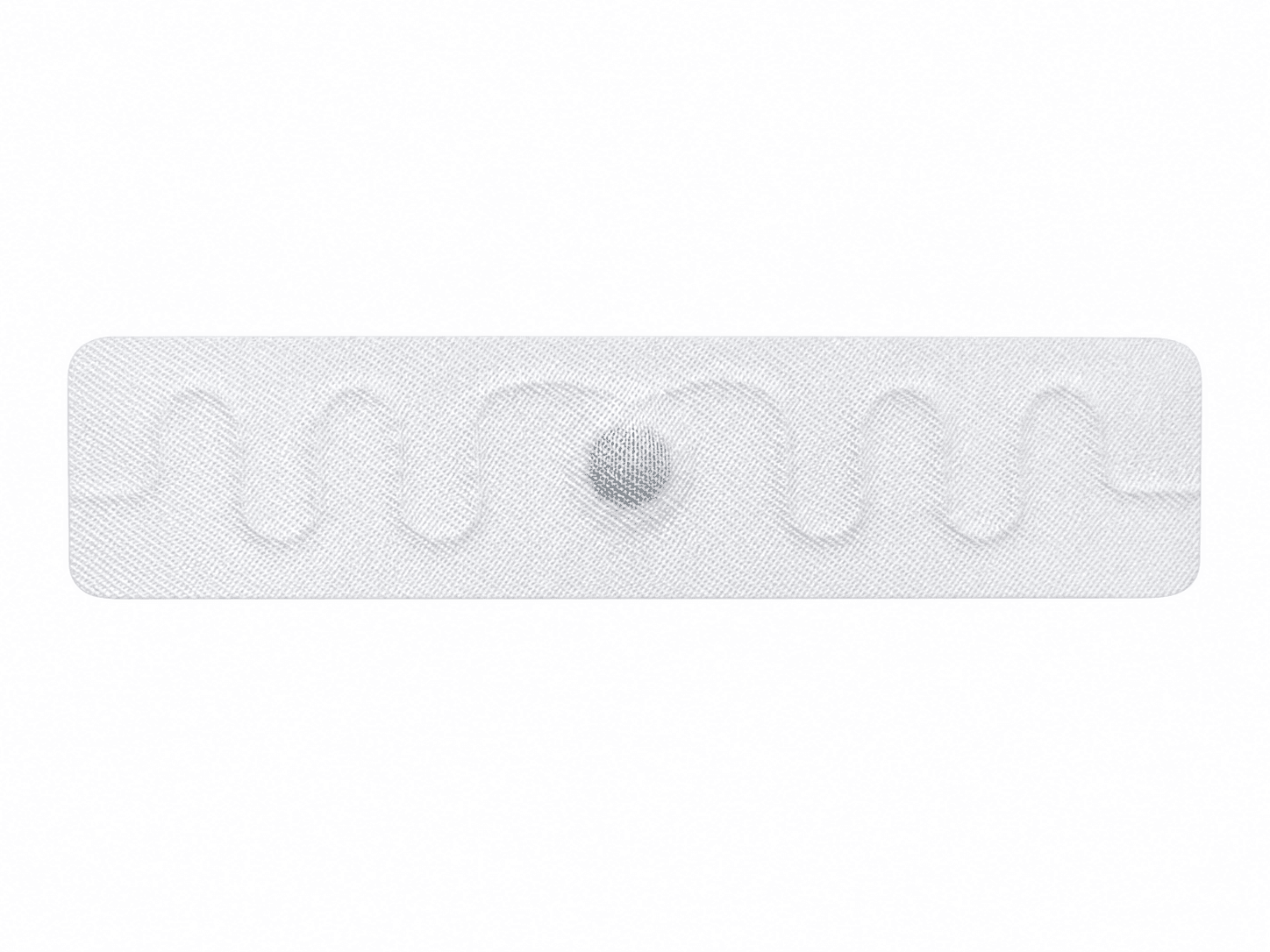
Every hotel, hospital, and industrial laundry runs on linen it cannot fully see. Sheets, towels, gowns, uniforms, and tablecloths move through wash, dry, press, sort, and delivery cycles every single day, often across multiple sites. Yet most operators still track this inventory the same way they did decades ago: by hand, by estimate, or not at all. The result is predictable. Linen disappears, par levels drift, and nobody can say with certainty how many items are sitting clean on a shelf versus lost in a guest room, a ward, or a competitor's facility.
The fix is surprisingly small. It is a tag.
What a UHF RFID laundry tag actually is
A UHF RFID laundry tag is a passive transponder engineered to survive the laundry environment. Unlike a paper barcode or a printed label, it carries no battery and needs no line of sight to be read. A reader emits radio energy in the UHF band, the tag harvests that energy, and it responds with a unique identifier. That identifier is what turns an anonymous towel into a trackable asset with a name, a history, and a lifecycle.
The hard part is not the radio. It is the survival. A laundry tag has to endure industrial washing at high temperature, aggressive detergents and bleach, high-pressure ironing, tumble drying, and hundreds of cycles without failing. This is why a general purpose UHF tag will not do. Laundry tags are sealed in heat-resistant and chemical-resistant materials, sized to sew or heat-seal into a hem, and rated for the mechanical and thermal stress of a real laundry line. A well-built tag is expected to outlive the linen it is attached to.
How it changes the operation
The value of the tag is not the tag. It is what becomes possible once every item can identify itself.
The first change is speed. UHF RFID supports bulk reading, which means a full cart of mixed linen can be counted in seconds as it passes a reader, rather than item by item. A stack of fifty towels that once took minutes to count manually is now read in a single pass, with no human touching each piece.
The second change is automation. Reading points can be placed at the dirty intake, at the clean output, at the loading dock, and at delivery. Each pass records where an item is and when it moved. Counting stops being a separate task that someone has to remember to do, and becomes a by-product of linen simply moving through its normal route.
The third change is accountability. Because every item carries a unique identity, the system knows how many wash cycles a sheet has been through, when it should be retired, and where losses are concentrated. If linen consistently vanishes between a specific ward and the laundry, the data shows it. Shrinkage stops being a vague monthly write-off and becomes a measurable, addressable number.
Where it pays off
Hotels use laundry tags to hold suppliers and outsourced laundries accountable, to protect par levels across multiple properties, and to stop quietly subsidising linen that walks out the door. When clean and dirty counts are reconciled automatically, billing disputes with a contract laundry shrink to almost nothing.
Hospitals and healthcare facilities face an even sharper version of the problem. Surgical gowns, scrubs, and ward linen carry hygiene and compliance obligations, and losses are expensive. Tagging lets a facility prove how many times an item has been processed, retire it on schedule, and maintain the documentation that auditors expect.
Industrial and commercial laundries, the businesses that process linen for everyone else, gain the most leverage of all. For them, accurate counts are the product. A laundry that can guarantee what it received, what it returned, and what it processed can charge for that certainty and defend its margins. Uniform rental operators apply the same logic to garments, tracking each item to a specific customer and route.
Choosing the right tag
Not every laundry tag is the same, and the wrong choice quietly undermines the whole project. A few factors matter more than the rest.
Read range and orientation determine how reliably a tag is captured when linen is stacked, folded, or bunched in a cart. A tag that reads perfectly on a bench can disappear inside a dense pile if it was not designed for that environment.
Durability rating determines the return on investment. A tag that survives two hundred cycles when the linen lasts a hundred and fifty is a tag you only pay for once. A tag that fails early turns into a recurring cost and a gap in your data.
Frequency compatibility matters for any operation that crosses borders or runs equipment from different regions. UHF RFID frequency allocations vary by country, so tags and readers should be matched to the band approved in the market where they will run. In Vietnam, for example, the relevant UHF band sits in the 918 to 923 MHz range, and a deployment planned for regional expansion across ASEAN should account for those differences from the start.
Form factor and attachment method decide how the tag gets into the linen in the first place. Sewn-in hem tags, heat-sealed patches, and button-style tags each suit different garments and processes, and the right one depends on how the items are made and laundered.
Inside the chip
Everything the tag does begins with the integrated circuit, the IC, sealed inside it. This is the brain of the tag, and the choice of chip sets the ceiling on performance.
Almost every serious laundry tag today runs an EPC Class-1 Gen2v2 chip that complies with the ISO/IEC 18000-6C air interface standard. That compliance is what guarantees the tag will talk to any conformant UHF reader, whether fixed, handheld, or portal-mounted, regardless of who made it. It is the difference between an open system you can build on and a proprietary trap you cannot.
The chip carries several distinct blocks of memory. The EPC memory holds the unique electronic product code, the identity that ties the physical towel to its record in software. A factory-locked TID, the tag identifier, provides a permanent serial number that cannot be altered and is useful for anti-counterfeiting and for guaranteeing each item is truly unique. Many chips also offer a block of user memory for storing data on the item itself, such as wash count or commissioning date, which is valuable when readers are not always connected to a central system.
Chip families fall into a clear hierarchy of capability. NXP UCODE 7 is the older workhorse still found in budget tags. UCODE 8 raised sensitivity and read reliability. UCODE 9 and the high-performance UCODE 9xe are the current high end, and the difference is not marginal: a 9xe tag with a 2 W ERP fixed reader can read past 14 metres, and one commercial laundry lifted sorting accuracy from 85 percent to 99.5 percent simply by upgrading to 9xe chips. Impinj Monza R6 and R6-P and the Alien Higgs family are the other widely used options. The practical takeaway is that the chip choice should follow the read environment. Dense, stacked, bunched linen passing a portal at speed demands the most sensitive chip you can justify, because every fraction of a decibel of sensitivity becomes a tag you do not miss.
The physics of survival
A laundry tag is really two engineering problems bonded together: a radio that has to perform, and a package that has to survive. The package is where most of the physics lives.
The antenna is not a copper trace on a label, the way it is in a paper tag. In a laundry tag it is typically woven from conductive threads, often stainless steel or other metal fibres, laced directly into the fabric weave. Threading the antenna into the textile rather than printing it onto a film removes the abrasion points and delamination that destroy ordinary tags after a handful of cycles. The chip itself is mounted as a chip-on-board module and sealed in epoxy or a high-temperature resin, then encapsulated in the outer body.
That outer body is chosen for thermal and chemical endurance. Polyester and cotton blend textiles are the common, cost-effective option. For the harshest service, PPS and PPE thermoplastics are used because they hold their dimensional shape and protect the inlay across repeated near-autoclave washes, outperforming silicone or standard polyester. Silicone bodies remain popular where softness and sewability matter most.
The numbers these materials have to meet are demanding. A quality tag is rated for 200 or more industrial wash cycles, with premium tags certified well beyond, in some independently tested cases past 500 cycles at 95 degrees Celsius and pH 11.5 with no measurable signal loss. The thermal profile spans the full laundry line: washing around 90 degrees Celsius for roughly 15 minutes, tumble pre-drying near 80 degrees, ironing at 180 to 185 degrees for short bursts of 10 to 15 seconds, and sterilisation around 135 degrees for 20 minutes. Mechanically, the tag must survive the water extractor, which can apply pressures up to 60 bar, the single most violent moment in the cycle. Good tags are also validated to be skin-safe and to pass medical screening such as MRI, CT, and needle detection, which matters directly in healthcare textiles.
Physical size is a balancing act. A larger antenna generally reads further, but the tag has to disappear into a hem without being felt by a guest or a patient. The industry has converged on a few compact formats, with 70 by 15 millimetres being the most common, alongside smaller 50 by 12 and 58 by 15 millimetre versions for towels, gowns, and space-constrained items. A finished tag of this kind weighs well under a gram and is thin enough to sew into a seam, with the chip location being the only slightly thicker point.
A reference spec profile
For a typical high-performance UHF RFID laundry tag, the specification looks roughly like this:
Protocol: EPC Class-1 Gen2v2, ISO/IEC 18000-6C
Chip: NXP UCODE 8 / 9 / 9xe, Impinj Monza R6/R6-P, or Alien Higgs
Operating frequency: 860 to 960 MHz, region dependent, with 918 to 923 MHz in Vietnam
Read range: up to 6 m typical, and over 14 m with a 9xe chip and a 2 W ERP fixed reader
Wash cycles: 200 or more as standard, rising to 250 or beyond 500 for premium tags
Washing temperature: around 90 degrees C for 15 minutes
Ironing: 180 to 185 degrees C for 10 to 15 seconds
Sterilisation: around 135 degrees C for 20 minutes
Press resistance: up to 60 bar
Body material: polyester and cotton textile, PPS/PPE thermoplastic, or silicone
Antenna: woven conductive metal fibre, embedded into the seam
Dimensions: 70 by 15 mm is common, with 50 by 12 and 58 by 15 mm variants
Weight: under 1 gram, around 0.4 g
Attachment: sewn into the hem, heat-sealed, or in a sewn pouch
These are reference figures drawn from across the industry, not a single product datasheet, so always confirm the exact ratings of the specific tag against the wash chemistry, temperature, and read environment of your facility before committing to a large deployment.
The bigger picture
A laundry tag on its own is just a number waiting to be read. Its value appears only when readers, antennas, and software turn those numbers into a live picture of inventory. At Nextwaves, the laundry tag sits inside the broader Hyperion ecosystem, where fixed readers, handheld scanners, antennas, and the Nextwaves Cloud platform work together so that a tagged item is not just identified but tracked, costed, and managed across its entire life.
That is the real argument for tagging laundry. The tag is small and inexpensive, but the problem it solves, the slow and invisible drain of unmanaged linen, is neither. For any operation that moves serious volumes of textiles, the question is no longer whether to tag, but how soon the losses stop.